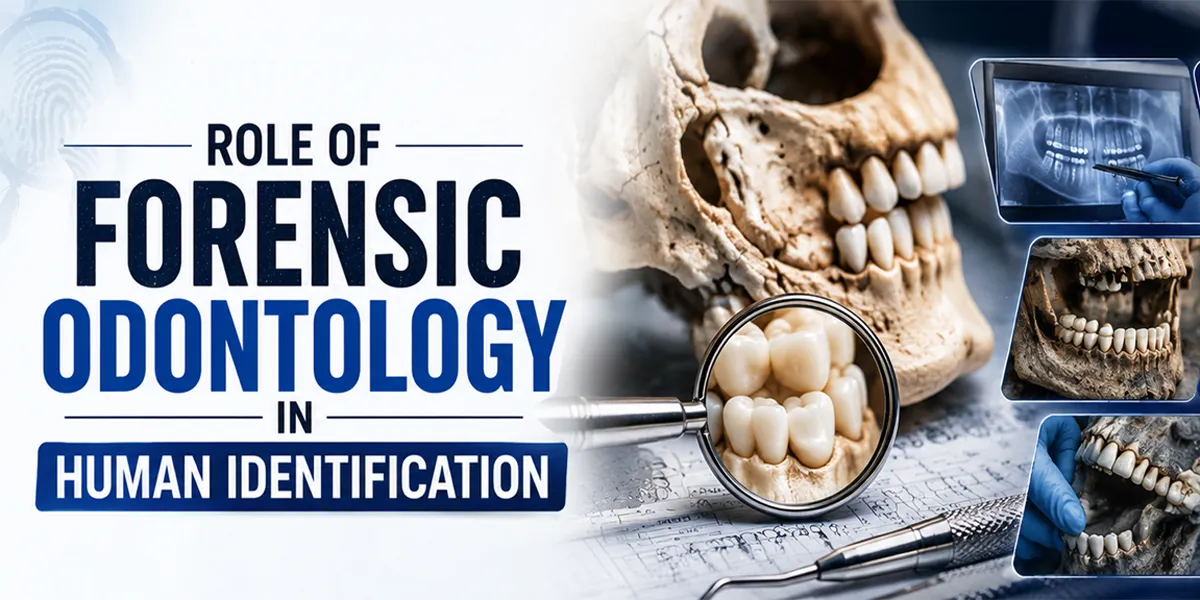
My dear crime show lovers out there, have you realized that a dentist plays an important role in identifying human remains? Yes, dentists are not only for curing your dental problems or doing root canal treatments all the time, as many people might think. But they also deal with crime investigation and that part of forensic science called forensic odontology or forensic dentistry.
In the 1970s, Kieser-Nielsen described forensic odontology as a specialized branch of forensic medicine that deals with the proper handling and examination of dental evidence. In simple words, forensic odontologists are highly specialized, specially trained dentists who help in the identification of human remains. Their role became crucial when all other techniques of forensic science, like fingerprints, face recognition, etc., fail in the process of human identification.
How Does a Forensic Odontologist Help in Human Identification?
Let’s look at some of the forensic odontology techniques that play a vital role in human identification:
1. Age estimation
In popular crime shows, you might have seen investigators ask questions like what the age of the victim is and what’s the victim's gender and more. To a common person, this might sound like basic stuff. But these basic questions help in the identification process. Age of a person can be described in various ways, such as anatomical age, chronological age, dental age, sexual and mental age.
In the case of a child, forensic experts identify age by studying tooth eruption patterns and dental development. In the case of adults, age estimation is based upon various factors such as:
- Root transparency.
- Cementum deposition.
- Tooth wear.
- Secondary dentin formation.
There are various techniques of investigation utilized for age estimation, such as:
- Histological.
- Physical and chemical analysis.
- Radiographic.
- Clinical or visual examination.
2. Bite mark analysis
The bite mark is considered one of the important areas of forensic odontology. They are defined as wounds or indentations on skin or objects caused by teeth, either by themselves or in conjunction with other mouth parts. In most cases, bite marks are linked with the most violent nature of crimes such as theft, assault, rape, child abuse, etc. From an investigative perspective, bite marks also have their drawbacks, like incomplete bites, short duration, and being less reliable due to fewer teeth.
Identification takes place based on appearance such as type of injury, individual characteristics of the tooth, duration of crime/incident, size, color, shape (based on 2D or 3D images), digital impressions, and more. Due to multiple combinations such as distortion, jaw movements, tissue flexibility, unclear photographs, and various factors like these, the job of bite mark analysis is very difficult for a forensic investigation department.
Classification of bite marks is done based on these 7 categories:
- Artefact (related to the bitten part of the body).
- Incision (linked with torn skin or a neat puncture).
- Laceration (related to a near-skin puncture).
- Avulsion (related to the removal of skin).
- Hemorrhage (minor bleeding spot).
- Contusion (described as a bruise or ruptured blood vessels).
- Abrasion (a non-damaging mark on skin).
3. DNA analysis
One of the best sources of genomic DNA is thought to be teeth. What makes them significant? Because they are resilient. The cellular cementum, accessory canal, vascular pulp, and odontoblastic process are the main locations where DNA is readily discovered. The fact that even a root canal gives enough material for PCR analysis, which creates a DNA profile for further comparison with ante-mortem samples or paternal DNA, is something that patients are unaware of.
As per the American Board of Forensic Odontology, dental identification is divided into four major parts:
- Positive identification: Where the data from post-mortem and ante-mortem match clearly and indicate that it belongs to the same individual.
- Possible identification: Where the data from post-mortem and ante-mortem only have a few consistent patterns. Establishment of the identity becomes difficult due to the quality of the records.
- Not enough evidence: Simply defined as not enough data to reach any conclusion, or also described as insufficient evidence.
- Exclusion: Clear inconsistency can be seen in the data of ante-mortem or post-mortem reports.
Some Other Techniques of Forensic Odontology
The above-mentioned methods or techniques are not the only ones but the most important ones. Apart from them, there are a few other techniques of forensic dentistry as follows:
- Chéloscopy.
- Rugoscopy.
- Radiographs.
- Species identification.
- Race determination.
- Gender determination.
Challenges in Forensic Odontology
No matter how beneficial forensic odontology is for crime investigation, just like everything else, forensic odontologists too have their share of challenges to overcome:
- Poorly maintained or unavailable records.
- Lack of awareness among healthcare providers.
- Prohibited access to advanced forensic laboratories.
- Not enough trained forensic odontologists.
- Scientific limitations in bite mark interpretation.
- Absence or differences in dental records.
Most of these issues can be overcome by enhancing record-keeping and expanding forensic dental education.
Conclusion
Due to advancements in technology, the tasks of experts like forensic odontologists and forensic anthropologists become relatively easier since they don’t rely on traditional methods or practices. This helps in the identification of disaster victims, determining the real age, assessing dental evidence, and helping in DNA recovery; these processes continue to offer reliable outcomes when traditional methods are no longer possible.
Challenges like inconsistency or absence of dental records or debate over bite mark evidence continue to persist. But advancements in digital technology and forensic research are becoming stronger with each passing year. Since the future of forensic science continues to evolve, so does the significance of forensic odontology when it comes to delivering justice, establishing identities, and ultimately providing relief and bringing closure to the families that have suffered a lot. When all other methods or techniques of human identification fail, in that moment a person’s teeth become a silent witness waiting to reveal the truth.