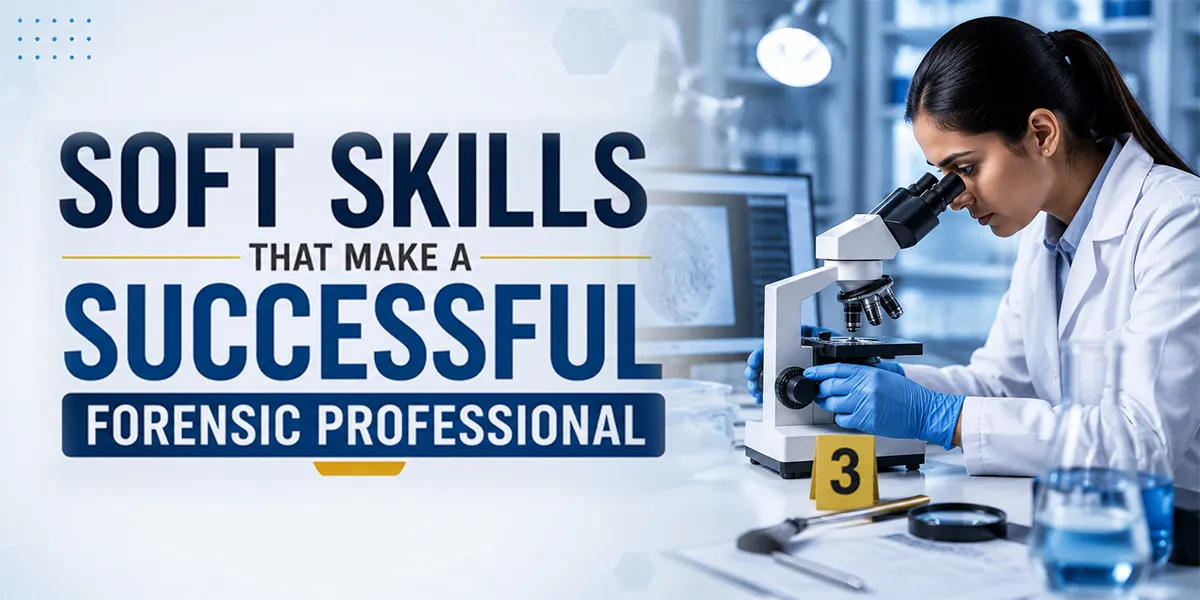
A strong desire to solve puzzles and unflinching objectivity may be the driving forces behind successful forensic specialists. However, the field requires much more than just an interest in research and impartial judgment. To be successful in the field, forensic specialists need a wide range of skills and knowledge, from a facility with laboratory equipment to a deep understanding of the law.
These characteristics will ultimately depend on the career path you choose.
However, all
forensic specialists possess several essential abilities. Let's look at five of the most crucial
forensic professional skills and how they impact the criminal justice system.
1. Technical Skills in Forensic Science
The word "forensic science" itself may evoke thoughts of an expert showing up at a crime scene, blowing off shot shells, following blood trails, and searching for torn clothing—concepts of the profession that have been heavily influenced by television and movies. While some forensic experts do work as crime scene investigators, many forensic science specialists perform incredibly complex tasks in the background, such as:
- DNA extraction from blood specimens
- Using a microscope to examine bullets, hairs, fibers, and other materials
- Finding information and resources on digital devices such as laptops and smartphones
- Determining whether intoxicants are present in human blood
- Creating, assessing, and contrasting latent fingerprints
- Performing analytics on data
Naturally, this part of the job description for a forensic specialist necessitates both a strong background in the sciences and a firm knowledge of the most recent forensic tools, equipment, and technology. But the benefits might be enormous. Advances in DNA analysis in forensic science and genetic genealogy research have solved many criminal cases, including the identification of "The Golden State Killer."
2. Analytical and Critical Thinking Skills
During a criminal investigation, a forensic scientist is required to evaluate the significance of physical evidence and use deductive reasoning to connect it to the complexities of a crime, the suspect, and the victims. Jeffrey Dahmer, the infamous killer who killed 17 men in the 1970s and 1980s, was apprehended and prosecuted using forensic profiling, a branch of forensic science that looks at behavioral patterns to develop a logical, relevant profile of possible criminal offenders. A forensic scientist must be able to evaluate the importance of tangible evidence and apply deductive reasoning to link it to the possible complexity of a crime, the suspect, and the victims during a criminal investigation.
Think about the case of Jeffrey Dahmer. The infamous murderer murdered seventeen individuals in the 1970s and 1980s. He was apprehended and brought to justice using criminal profiling, a subfield of forensic science that looks at behavioral patterns to create a logical, meaningful profile of potential criminal offenders.
3. Attention to Detail
Forensic specialists must also pay great attention to details, whether they are employed as crime scene investigators or digital forensic specialists. But do forensic experts often go to crime scenes? For instance, in order to locate and examine crucial pieces of evidence, crime scene experts must inspect every square inch of a crime scene. But do forensic specialists often go to crime scenes?
For instance, to locate and examine crucial pieces of evidence, crime scene experts must inspect every square inch of a crime scene, including:
- Bullet casings
- Footprints
- Blood and other bodily fluids
- Tire tracks
- Hairs
- Fibers
The amount of attention to detail needed in forensic investigations cannot be overstated; even a seemingly minor error can result in an incorrect conviction. A sharp eye for detail also guarantees that forensic specialists adhere to crucial regulations, policies, and procedures. An apparently minor error can result in a false conviction. A sharp eye for detail also guarantees that forensic specialists adhere to crucial regulations, policies, and procedures.
4. Communication and Interpersonal Skills
Forensic specialists are typically a part of a bigger team. They must therefore be able to communicate with a range of people efficiently, including:
- Investigators and law enforcement personnel
- Individuals involved in the legal and judicial systems
- Medical professionals as witnesses
In addition, forensic specialists are frequently asked to testify in court. This calls for professionalism, integrity, eloquence, and the capacity to remain composed in both criminal and civil procedures.
5. Continuous Learning and Adaptability
Despite its origins in ancient Greek and Roman cultures, forensic science has advanced significantly since then and continues to do so. One may wonder if a career in forensic science is feasible in the present world. In recent years, criminal investigations have been transformed by technology. They are being completed at a speed and accuracy never seen before. This is due to individuals such as:
- Automated fingerprint and facial recognition
- Rapid DNA testing
- Cloud forensics
- Alternative light photography
- Time-tracing fingerprint technology
- Drones
Despite having its origins in the ancient Greek and Roman cultures, forensic science has advanced significantly since then and is still developing today. One may wonder if a career in forensic science is feasible in the present world. In recent years, criminal investigations have been transformed by technology. They are being completed at a speed and accuracy never seen before. This is due to individuals such as:
Develop your Forensic Skills with our Courses
You can establish a solid foundation in evidence analysis, scientific investigation, and contemporary forensic techniques by enrolling in and studying forensic science courses at Lloyd Institute of Forensic Science, such as the B.Sc. + M.Sc. in Forensic Science, M.Sc. in Forensic Science, Professional Diploma in Fingerprint Science, and other industry-oriented courses.
These courses include advanced laboratory experience, hands-on training, professional faculty leadership, and a practical learning style. The program gives prospective forensic experts the tools they need to succeed in cybersecurity, forensic labs, crime investigation, fingerprint analysis, and related fields. In addition to improving technical proficiency and critical thinking, these programs equip students to make confident contributions to the rapidly developing fields of criminal justice and forensic science.