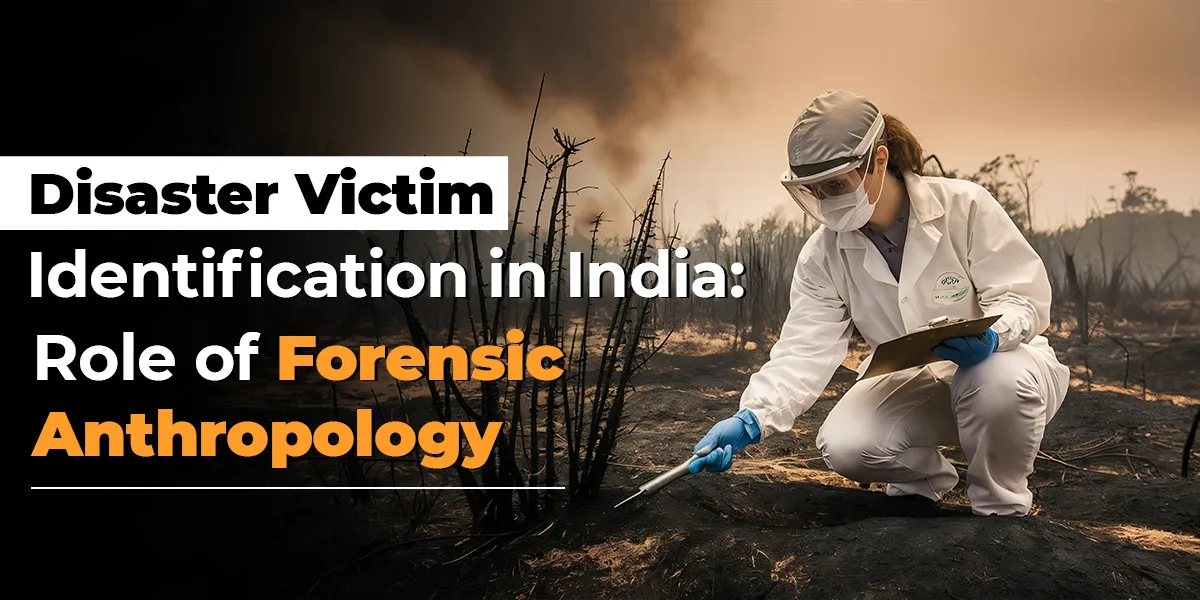
Natural disasters and large-scale accidents tend to leave unfathomable imprints of destruction. In these tragic circumstances, figuring out the victims becomes one of the most crucial and emotional parts of the experience.
Families wait anxiously for the confirmation regarding the identity of their loved ones, and it is an official struggle to cope with these overwhelming casualties. This is the place of study where forensic science, especially forensic anthropology, plays an active role in Disaster Victim Identification (DVI).
In India, where earthquakes, floods, fires, air crashes, and many other disasters happen, the role of forensic science experts comes into play. They are increasingly being used to aid identification when traditional methods fail.
In this blog, you will explore the importance of forensic anthropology in disaster victim identification in India, its processes, challenges, and emerging relevance for contemporary forensic investigation.
Understanding of the Disaster Victim Identification (DVI)
The name "disaster victim identification" (DVI) refers to a process for systematically identifying victims of mass disasters. These disasters may include:
- The natural disasters include earthquakes, tsunamis, floods, and landslides.
- Crashes of planes or train collisions are referred to as transportation accidents or disasters.
- Terrorist attacks or bomb blasts.
- Fires and explosions.
In many of these disasters, the bodies of victims may be heavily damaged or decomposed or partially taken apart, such that visual identification is impossible. Traditional methods such as personal recognition or recording may not work. So it needs scientific methods.
The DVI process typically has four main stages:
- Recovery of human remains.
- Post-mortem examination.
- Collection of ante-mortem data (missing persons' details).
- Reconciliation and identification.
Forensic anthropologists have a role to play in post-mortem analysis when skeletal remains are scarce.
What is forensic anthropology?
Forensic anthropology is a specialized area of forensic science in which the study of bodies (particularly human bones and skeletal remains) is investigated at the forensic level for legal purposes. Skeletal remains provide a resource for forensic anthropologists to identify features such as the following:
- Age at death
- Sex of the individual
- Height or stature
- Time since death
- Trauma or injury evidence
They help narrow down a victim’s identity and match a body with records for those missing. In the case of a disaster, whose body may be burnt, decomposed, or fragmented, skull and bone remains are often the most reliable evidence for an identification process.
Role of Forensic Anthropology in Disaster Victim Identification
Identification by Skeletal Remains
In many disasters, including but not limited to fire, explosion, and plane crash, soft tissues can be destroyed as bones live on. Forensic anthropologists examine the skeletal structure to piece together the bio-profiling of a victim.
For instance, the pelvis and skull are strong indicators of sex determination, while the long bones, like the femur, can help estimate height. Dental bones can also be useful clues.
This information can assist investigators in comparing the skeletal remains with the records of missing people.
Reconstruction of fragmented bodies
The fragmented human remains are common during mass disasters. Victims may be mixed several times, providing a very complex identification.
Forensic anthropologists help in some way by doing the following:
- Sorting out the human bones from the non-human bones.
- Reassembling the fragmented skeleton pieces,
- Deciding whether the bones belong to a single, multiple, or individual collection of bones.
This process is known as "Osteological Sorting," and it is necessary for sorting remains and is vital in the sorting of remains before further discovery.
Detecting Trauma and the Cause of Death
Another crucial role of forensic anthropology is identifying trauma and looking for patterns on bones.
These may include:
- Blunt force fractures.
- Cut marks from sharp weapons.
- Gunshot wounds.
- Thermal damage from fire.
Analyzing these injuries can assist investigators as they attempt to determine the cause and manner of the death, which could be crucial in cases involving explosions, terrorist attacks, or suspicious disasters.
Assisting DNA Analysis
But getting DNA samples is not always easy, and while DNA profiling is highly reliable, it may still require identification by someone else.
Forensic anthropologists can pick the best bones or teeth for DNA extraction from decomposed or skeletonized remains, such as the following:
- Femur
- Teeth
- Skull bones
These sections preserve DNA better when compared to other skeletal components.
So, forensic anthropology works very closely with forensic DNA experts to help to facilitate an identification process.
Disaster Victim Identification: Real-Life Context in India
India has had some such disasters on a scale that forensic identification becomes imperative. Here are some prominent examples:
The year 2004 Indian Ocean Tsunami
Massive casualties were reported in coastal areas of India during the tsunami, especially in Tamil Nadu and the Andaman and Nicobar Islands. Decomposition meant that many of the casualties were not visually recognizable. Anthropologists and odontologists, along with forensic experts, were employed to identify remains based on skeletal analysis and dental records.
Air and Train Accidents
There have been several tragic air and rail accidents in India during the past few decades. In these incidents, bodies are usually burned or shattered into pieces in such cases. Forensic anthropologists help analyze remains, sort through the remains, develop biological profiles, and assist authorities in the identification of victims by comparing victims with missing passenger records.
Building Collapses and Industrial Disasters
Urban catastrophes, like building collapses or factory explosions, also need a forensic identification. And in these situations, skeletal examination is crucial, when entrapped bodies become trapped amid debris for extended periods.
Challenges Faced in Disaster Victim Identification in India
Although forensic anthropology continues to take on increasing importance in India, and the role of forensic anthropology is increasing, several problems remain of great concern:
Lack of Ante-Mortem Data:
For the identification authorities to be successful, they must have detailed information about the missing person, and the information includes
- DNA samples
- Medical records
- Dental records
In many cases, these records are not available or are incomplete, which makes identification more complicated.
Delayed recovery of remains:
The environmental factors, such as humidity and environmental features like heat, humidity and water exposure, can speed up decomposition in India’s climate. Delay in retrieving remains could make identifying them even more complicated.
Specialized Training Needed
Identifying disaster victims requires an elite of professionals with the ability to operate in difficult environments. More training programs in forensic anthropology and disaster response are needed in India.
Increasing Importance of Forensic Anthropology in India
There is a gradual increase in the importance of forensic anthropology in India for the following reasons:
- The increasing relevance of forensic science in the field of criminal investigations.
- Increasing the number of forensic science education programs.
- Efforts by the government to fortify disaster response systems.
- Increasing calls for trained forensic practitioners.
- Specialty courses have recently become available in forensic science at several forensic services and universities and include areas of forensic anthropology as well as disaster victim identification.
B.Sc. or M.Sc. students are being trained to be skilled in the study of the body and how to perform a forensic job in skeletal analysis, the excavation processes, and forensic identification procedures.
Career Opportunities for Disaster Victim Identification
Research in forensic anthropology is a thrilling career for forensic scientists and humanitarian students.
Professionals in this area might collaborate with:
- Forensic science labs.
- Authorities for disaster management.
- Police departments.
- Teams for international disaster response.
- Research institutions and universities alike.
Considering the significance of disaster preparedness and forensic investigation, both the demand and need for skilled forensic anthropologists are predicted to increase in the future.
In the Final Analysis
Disaster victim identification is not simply a scientific process, but it is also a humanitarian responsibility. Accurate identification enables families to be led toward closure and victims to have their dignity and respect.
Forensic anthropology is especially vital for identifying victims in India, where traditional methods fail. And now that the forensic anthropologist can solve crimes with skeletal analysis, trauma discovery, and cooperation with the use of DNA, it provides much relief even in cases of such terrible hardship.
Forensic anthropology's role, as India's forensic and disaster prevention and response systems further enhance, will become even more important. Forensic scientists and family members will be better prepared to respond to disasters and provide answers to grieving families with better training, improved infrastructure, and awareness. For forensic students and technicians, this field is both a potential career advancement and a contribution to society during disaster events.