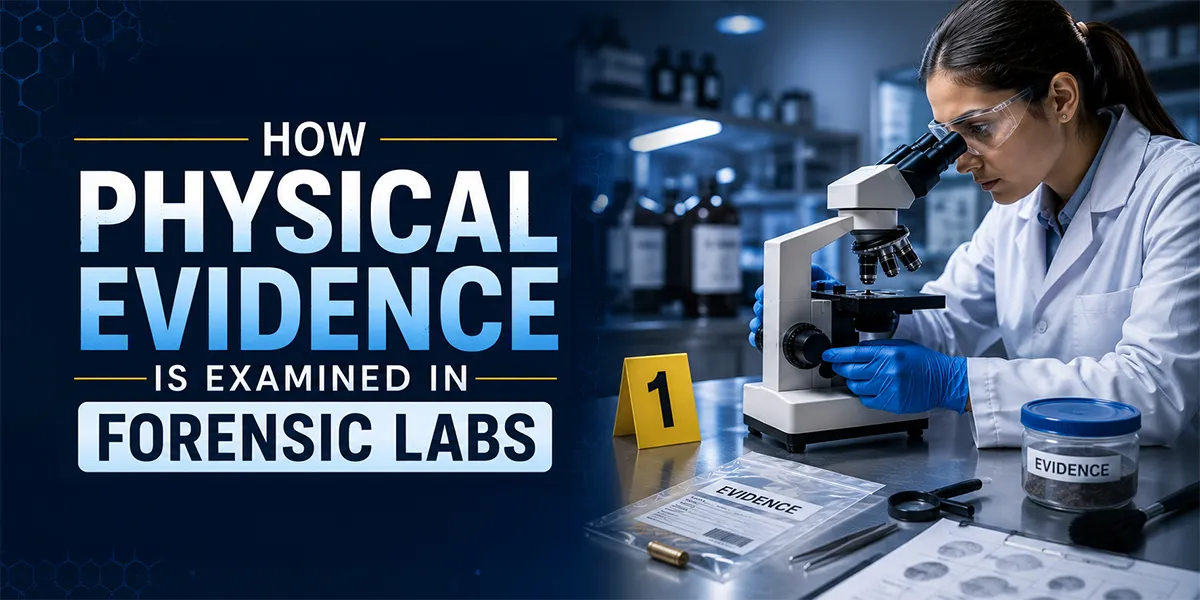
The significance of finding physical evidence to solve a crime and achieve justice cannot be overstated. Forensic experts utilize many aspects of physical evidence to reconstruct the facts and identify suspects, from blood samples to fingerprints, from weaponry to threads. All items collected at a crime scene are employed as a source of physical evidence.
The examination of physical evidence in forensic laboratories involves sophisticated scientific procedures that utilize specialized techniques, advanced equipment, and the utmost precision,
followed by strict protocols. Therefore, today’s forensic sciences rely entirely upon the forensic laboratory for evidence processing.
All forensic experts must examine and analyze evidence collected from a crime scene to find pieces of evidence or hidden facts that cannot be recognized by the naked eye. This article will provide a comprehensive description of how physical evidence is examined in forensic laboratories and the steps associated with such examinations, as well as the significance of the forensic analysis of physical evidence in the criminal investigation process.
What is physical evidence?
Physical evidence includes all objects, materials, or traces of matter that can establish a relationship between an individual, object, location, or event. Physical evidence may consist of biological sources or be non-biological.
Common Types of Physical Evidence:
- Fingerprints
- Blood/Bodily Fluids
- Hair/Fibers
- Weapons/Bullets
- Documents
- Soil/Glass Fragments
- Shoe Impressions
- Digital Devices
- Drugs/Toxins
Each type of physical evidence will be examined using specialized forensic techniques.
How is physical evidence essential within criminal investigations?
Compared with eyewitness accounts, physical evidence is much more credible because it relies on scientific methods of examination. Physical evidence provides investigators with many advantages, including the following:
- Identifying a suspect
- Providing the link between a suspect or suspects and a crime scene
- Aiding in the confirmation or disproof of statements made by suspects or witnesses
- Allowing investigators to recreate the crime scene
- Providing a timeline for when a crime occurred
- Providing evidence in court
Forensic evidence is usually the determining factor in courtrooms for crimes.
The Processes Involved with the Examination of Physical Evidence
The examination of physical evidence follows a predetermined process that incorporates the procedures and protocols established to ensure that the evidence obtained at a crime scene is accurate and reliable.
Step 1: Collection of Evidence: On Scene
The process to collect evidence at a crime scene starts when the investigators are on the scene searching for evidence. Crime scene investigation officers will ensure that they are wearing gloves, masks, and protective clothing to avoid contaminating any evidence prior to it being collected.
Methods of Collection that may be used:
- Tweezers – for hair and fibers
- Swabs – for biological products
- Evidence Bags – for weapons or objects
- Casting material – for footprint and tire tread impressions
- Fingerprint powders and tapes for the lifting of fingerprints
When collecting each item, it is important to ensure that the collection information is documented, which should include the date, time, address, and full name of the person who was the collector.
Step 2: Preservation & Packaging of Evidence
The preservation of evidence is a component of the examination process. Without proper preservation of evidence, damage and/or contamination to the evidence could occur.
Examples of the methods for the preservation and packaging of evidence include:
- Blood Samples shall be preserved under refrigeration
- Wet evidence shall be dried before packaging
- Sharp objects shall be packaged in a rigid container
- Drugs shall be packaged in a tamper-proof package
Examination of Physical Evidence in a Forensic Lab
Forensic labs examine physical evidence from criminals using a variety of methods. For example:
Fingerprint analysis:
- The fingerprint department will take an unknown print and develop a latent fingerprint by dusting or using powders or chemicals to reveal patterns of ridges.
- Once the print is visible, it is photographed and compared to known prints in the database for comparison of the unique ridge patterns that are present in both.
- Many forensic examiners use automated systems that do the fingerprint comparison much faster and more accurately.
DNA Analysis:
DNA is used to establish identity and can provide an incredibly accurate means of identifying a person in any type of criminal case.
Steps include:
- To test DNA samples, labs must extract the DNA from the sample (blood, saliva, and/or hair).
- Identify the amount of DNA present.
- Amplify the DNA using the PCR technique
- Create a DNA profile, and compare that profile with known profiles in the database.
Ballistics Examination
The ballistics department looks at any type of firearm, bullet, or cartridge case that is collected from a crime scene.
- These types of items are first examined for bullet markings.
- Gunshot residue
- Firing distance
- Functionality of the firearm
Ballistics experts will examine the bullets that were recovered from a crime scene and compare them to test-firing bullet samples by using microscopes.
Toxicology Testing
Toxicology laboratories are utilized to analyze poisons, chemicals, alcohol, and drugs present in an organism.
Common Tests
- Blood Alcohol Test
- Drug Abuse / Screening
- Poison Analysis
- Chemical Analysis
This type of testing is essential when investigating issues concerning overdoses, suspected homicides, or intoxication.
Document Examination
A questioned document expert can identify and verify people's handwriting or signatures and analyze printed documents.
Common Techniques
- Analysis of Ink Used
- Comparison of Signature(s)
- Detection of Alterations or Forgery
- Examination Using Ultraviolet (UV) Light or Infrared (IR) Light
Document examination can assist in cases related to fraud, forgery, or cybercrime.
Fiber and Hair Examination
Fibers and hair that are present in a crime scene can provide a link between the perpetrator, the victim, and/or the location where the crime occurred.
Examination Techniques
- Microscopy
- Chemical
- DNA from Hair Roots
- Colour and Texture of Fibres
Even a small amount of fiber can furnish substantial evidence.
Drug and Chemical Testing
Forensic chemists test unknown solid or liquid materials as well as drugs.
Common Tools Used Include:
- Gas Chromatography
- Mass Spectrometry
- Spectroscopy
- Chemical Reagent Tests
Drug and chemical analysis assists forensic scientists in determining the presence of illegal drugs and other hazardous substances.
Modern Technologies Used In Forensics Laboratories
Modern-day forensic laboratories utilize sophisticated instruments with precision for producing accurate results.
Commonly Used Technology:
Microscopes are used for the analysis of trace evidence, such as hair, fiber, and bullet markings.
Chromatography:
Separates chemical compounds into individual compounds for identification.
Spectroscopy:
Identifies the chemical composition of a sample using light to measure the light reflected off and/or absorbed by the sample.
DNA sequencers:
Allow for the genetic profiling and identification of a sample.
Digital imaging systems:
Allow for the enhancement of fingerprints and other forms of evidence.
Difficulties with Physical Evidence
Even with new technology, forensics experts have various difficulties. These include:
Common Problems
- Cross-contamination of Evidence
- Limited Sample Size
- Delayed Collection
- Human Error
- Environmental Degradation
- Case Backlog at Labs
These six issues will be resolved with properly trained staff and up-to-date equipment.
Forensic Expert’s Function
Forensic experts are qualified individuals trained specifically in the extraction of evidence.
Duties of Forensic Experts Include the following:
- Performing Scientific Testing
- Writing Detailed Reports
- Preserving the Integrity of Evidence
- Providing Expert Testimony in Court
- Assisting Investigating Officers
Forensic experts' analysis should remain unbiased and scientifically measured.
Importance of Accuracy in Forensic Examination
A single mistake during a forensic examination can invalidate the entire criminal case. Because of this, the forensic labs follow stringent guidelines when it comes to maintaining the quality of services.
Forms of Quality Assurance
- Calibration of tools
- Standard operating procedures
- Review of reports by other forensic experts
- Laboratory Accreditation
- Continual Education for Forensic Experts
Accurate evaluation of evidence will help give both the victims and the accused a fair trial.
The Future of Forensic Evidence Analysis
Forensic science is rapidly evolving toward using more technology.
Emerging Technologies
- Use of Artificial Intelligence in Evidence Analysis
- Rapid DNA Testing
- 3-dimensional Crime Scene Reconstruction
- Advances in Digital Forensics
- Automated Fingerprint Identification Systems
Continued use of these cutting-edge technologies will allow forensics officers to conduct investigations more quickly and with more precision.
Conclusion
The process of examining physical evidence within a forensic lab is a way of discovering the facts surrounding a crime through science and orderliness. In particular, each step from collecting evidence from the crime scene all the way to analyzing the evidence using advanced technology (i.e., lasers) requires someone with the capability, knowledge, and experience to do each step according to the standards set forth by a forensic scientist. The physical evidence collected at a crime scene is just like a silent witness in that it is able to connect individuals (i.e., suspects and victims) with objective accuracy to crime scene locations.
Forensic laboratories have continued to evolve with technology that is being developed today, which provides evidence for analyzing and investigating a crime (i.e., DNA testing) that can be used to prove innocence or guilt in a criminal investigation. As science continues to improve the methods used for analyzing the physical evidence, the prosecution of a crime and justice for those involved will continue to be more prevalent.