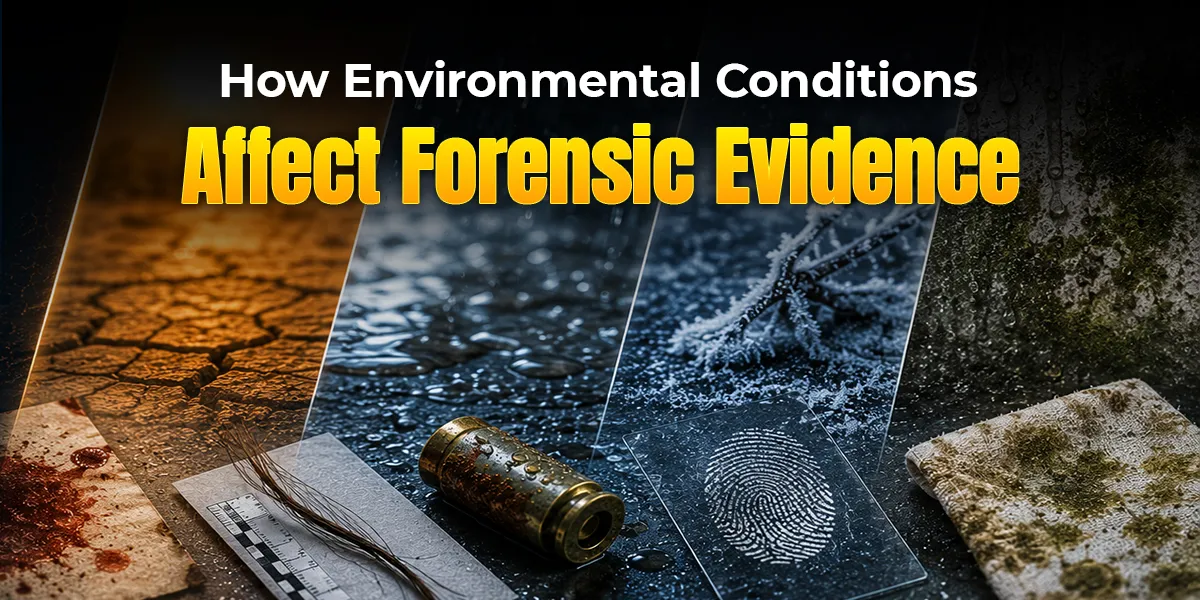
Forensic evidence is very crucial in helping an investigator put together what happened to the victims in a case and provide proof of guilt or innocence in court; the forensic evidence can be easily altered, damaged, or destroyed by environmental elements such as humidity, sunlight, rain, wind, fire, and microorganisms before investigators can collect this important evidence and conduct an analysis of it. This is why it is so important for crime scene investigators, forensic scientists, and law enforcement agencies to understand what types of environmental factors have an effect on forensic evidence.
This blog discusses how environmental factors can affect forensic evidence and the importance of properly preserving forensic evidence.
What Is Forensic Evidence?
Forensic evidence is any material that has been collected from a crime scene and can be used to help establish facts about the investigation. There are many different types of forensic evidence. The following list gives examples of different types of forensic evidence:
- Blood and other biological samples
- Fingerprints
- Hairs and fibres
- DNA evidence
- Footprints and tire tracks
- Weapons and tool markings
- Digital devices
- Paperwork and Trace Evidence
Forensic evidence reacts to environmental exposure in many different ways; therefore, forensic evidence must be protected from being tampered with due to the effect the environment has on some types of forensic evidence. For some types of forensic evidence, such as DNA samples, if they are not sealed and protected properly, they can degrade within hours.
Importance of Environmental Factors in Forensic Evidence
Environmental conditions impact evidence in two ways:
- Physical change: alteration of the physical appearance or structure of forensic evidence.
- Chemistry or Biological degradation: causing loss of evidence through decomposition and contamination.
When an item of forensic evidence has been compromised to such an extent that it has lost reliability, it cannot be used in court as reliable evidence. Therefore, forensic teams must conduct evidence collection quickly and store the collected evidence in a controlled environment.
Effects of temperature on forensic evidence
Temperature is one of the most significant factors in the environment that affects the preservation of forensic evidence.
High temperature
Higher than optimal temperatures accelerate the rate at which decomposition occurs and also cause increased rates for chemical reactions to occur. Therefore, biological forensic evidence such as blood, saliva, and tissue samples begins to deteriorate rapidly in hot environmental conditions.
The following examples illustrate how hot temperatures can affect evidence:
- The breakdown of DNA occurs at a higher rate than at optimal temperatures.
- Bloodstains dry much faster than at optimal temperatures and may crack as they dry.
- The decomposition of bodies occurs at an accelerated rate.
- The internal components of electronic devices may suffer damage due to exposure to heat and humidity.
For example:
During the summer months, bodies exposed to high temperatures at an outdoor crime scene can decompose fast, making it difficult to estimate an accurate timeframe of death.
- Low temperature
- Cold environmental conditions can provide some preservation benefits for certain types of forensic evidence.
- Some of the benefits of using cold environmental conditions include:
- Slower rates for bacterial reproduction
- Longer preservation rates of DNA
- Delayed rates of decomposition
- Maintained the integrity of the blood and tissue samples.
However, freezing temperatures can also damage forensic evidence. Frozen liquids expand, causing a physical change in the original evidence item.
The Effects of Humidity
Humidity means the amount of moisture in the air and can cause considerable damage to many types of forensic evidence.
Biological Evidence
The best conditions for biological evidence to degrade, such as blood, saliva, etc., are wet. This is due to the growth of bacteria and fungi on biological samples.
Some examples of how evidence can be destroyed due to moisture:
- Blood can become diluted or washed away
- Saliva samples can decompose
- Mold can grow on evidentiary materials
- DNA quality can be reduced significantly
Document and Paper Evidence
- The presence of moisture on documents can
- Cause smearing of ink
- Destroy the written identification
- Cause degradation of paper
- Make it impossible to read the documentation
Firearm and Metal Evidence
High humidity can cause weapons to become rusty, metal surfaces to corrode, and bullet markings to be damaged. This may result in interference with ballistic examination.
Impact of Rain on Crime Scene Evidence
Rain poses one of the most significant threats to outdoor crime scene evidence.
Examples of Evidence Affected by Rain:
- Footprints and Tire Tracks
Rainwater can erase impressions made in dirt, mud, and sand.
- Blood Stains
Blood evidence can be completely washed away, have patterns changed due to the flow of water, or become diluted.
- Trace Evidence
Evidence of hair, fibers, soil particles, and gunshot residue can all be displaced due to moisture.
Because of the potential for damage to fragile evidence, investigators will ordinarily make the collection of important fragile evidence their highest priority during wet conditions.
Effect of sunlight and UV rays
Direct sunlight exposure and UV rays can damage evidence over time.
DNA Degradation
Ultraviolet rays cause DNA to break down so that it is harder to use for identification purposes.
Fading of blood and fibres
With exposure to the sun, blood can change from its original color or characteristics, and the original color or characteristics of cloth fibers can fade.
Fingerprint damage
Latent fingerprints on surfaces that are exposed to intense sunlight and heat may disappear.
Outdoor evidence that is left in the sunlight over a length of time will have lost a large amount of its forensic value.
Wind and air movement
Wind can move around lightweight evidence, thus affecting an investigation at an outdoor crime scene.
The following types of lightweight evidence at outdoor crime scenes can be affected by wind:
- Hair
- Fibers
- Soil particles
- Ash and gunpowder residue
- Small pieces of paper
Strong winds can scatter this type of lightweight evidence across a large distance and make it very difficult for investigators to reconstruct the crime scene.
In outdoor crime scenes investigated by law enforcement, protective barriers or tents are often used to secure evidence from wind contamination/manipulation.
The Impact of Submerged Water
Collecting forensic evidence underwater presents unique challenges.
The Effect of Water on Human Remains
Water accelerates decomposition, resulting in skin becoming soft and damaged, and can also remove any external injuries or trace evidence.
Fingerprints Found in Water. Fingerprints can be:
- Washed away
- Distorted
- Hard to recover
- Firearms/Weapons
Weapons submerged in water can corrode rapidly, resulting in loss or damage to fingerprints and ballistics marks.
Digital Evidence
Digital devices such as phones, laptops, external drives, etc., which are submerged in water, may fail; in some instances, forensics can recover data from such devices using specialized techniques.
Fire and Heat Damage to Evidence
Fire scenes are known as one of the most difficult types of crime scenes for forensic investigators to collect evidence from.
- Difficulties Associated With Fire
- Destruction of biological evidence
- Melting or eliminating plastic and electronic items
- Contamination by smoke
- Loss of structural integrity
It's important to note that extreme heat can reduce fingerprints and/or DNA to ash; however, experts can recover the following:
- Bone fragments
- Accelerants
- Fire patterns
- Metal objects
Using the above items can provide assistance in determining if an event was caused by an accidental fire or an intentional fire.
Microbial Activity and Its Impacts on Human Remains
Microorganisms, such as bacteria and fungi, are responsible for the natural decomposition process of organic matter.
Impacts of Microbial Activity on Human Remains
- Accelerate the decomposition of the remains
- Change in the structure of tissue
- Alteration in the results of toxicology tests
Effects of Microbial Activity on Biological Samples
Microbial contamination can occur in the following:
- Blood samples
- Semen
- Saliva
As a result, if biological evidence isn't properly stored, then it cannot be used for further testing in a lab.
Seasonal Challenges in Forensic Evidence
Different seasons present different challenges for forensic investigators.
Summer:
- Decomposition is faster
- Insect activity is increased
- DNA is more rapidly degraded
Winter:
- Evidence may be covered with snow
- Freezing may preserve a body
- Footprints may disappear after a snowfall
Monsoon and Rainy Season:
- Evidence may wash away
- Mud can contaminate evidence
- Greater moisture causes damage
To account for the above conditions, crime scene investigators must adapt their methods depending on the season.
Insects and Environmental Forensics
Insects play a crucial role in forensic investigations, particularly with respect to deaths detected outside.
Forensic Entomology
This is the use of insect evidence in criminal investigations. The field of forensic entomology is very important because:
- It helps establish the time of death
- It can help determine if there has been body movement
- It can provide information about the environmental exposure of the deceased before death
However, insects are influenced by the environmental conditions in which they exist, and the temperatures and humidity levels at which they live will have an effect on how quickly the insect colonizes a human/dead body.
How to Preserve Evidence
For forensic investigators, following strict procedures for evidence is key to preventing further environmental impacts.
Common Evidence Preservation Methods
Proper Packaging:
- Use of paper bags for biological evidence
- Use of airtight containers for chemical evidence
- Use of waterproof packaging as appropriate
Refrigeration of Biological Evidence:
- Low-temperature storage of biological samples prevents their decomposition.
Air-Drying Wet Evidence Before Storage:
- Wet clothing and blood-stained materials must be air-dried before being placed in storage.
Analysis of Fragile Evidence Immediately Following Outdoor Crime Scenes:
- At outdoor crime scenes, fragile evidence should be collected immediately following the discovery of the crime.
Using Protective Covers:
- Covering up evidence with a tarp or a tent helps ensure that the evidence will not be contaminated by rain, wind, or sunlight.
- Proper handling is critical to ensure that the evidence is admissible in a court of law.
Chain of Custody: Importance of Proper Evidence Management
Evidence is not only at risk of being contaminated through environmental exposure; environmental exposure is not the only risk to the forensic reliability of an individual piece of evidence due to how the piece of evidence was handled improperly.
"Chain of custody" describes the paper trail that documents the process of how evidence is collected, stored, transferred, and examined. By maintaining an accurate paper trail throughout the investigative process, the authenticity and tamper-free status of the evidence will be maintained.
Conclusion
Forensic evidence is strongly influenced by environmental factors, which can also affect the likelihood of critical pieces of evidence being recovered or destroyed. Temperature, humidity, rainfall, sunshine, wind, fire, and bacteria are types of environmental conditions that can change or destroy evidence before it is examined by forensic experts. Therefore, in any investigation, it is necessary to collect, correctly store, and scientifically preserve the evidence quickly.
Even though current modern forensic techniques to recover damaged or lost evidence continue to develop, prevention will always be the first choice. By understanding how various environmental factors impact forensic evidence, investigators will be able to limit the amount of harm that occurs to forensic evidence in order to support the use of reliable scientific evidence in the prosecution of criminals.