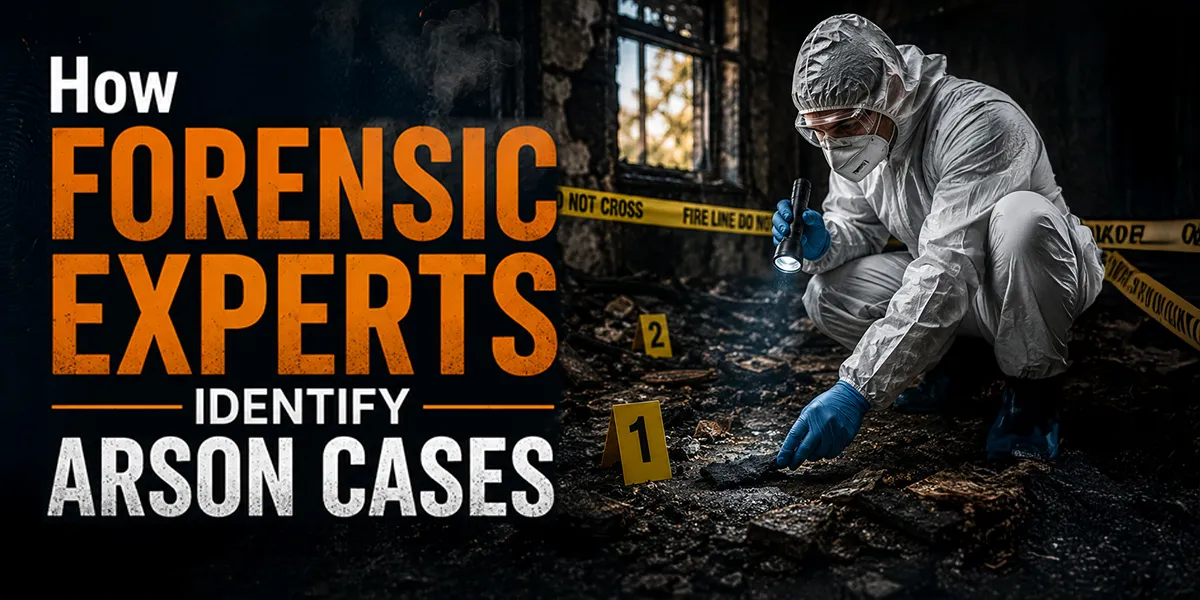
Forensic experts investigate arson (illegal fire setting) by using their combined training in science, observation, technology, and investigative techniques to determine what actually happened in a fire incident. Due to the destructive nature of fire, forensic experts must conduct their investigation of a fire scene very carefully to determine whether the fire was accidental or intentional.
Forensic experts play an important role in a major part of an ongoing arson investigation by determining the cause and origin of the fire, collecting fire evidence, and evaluating burn patterns to assist in the successful prosecution of an offender. A good understanding of how forensic experts identify arson will help support the importance of forensic science to criminal investigations.
What are Arson cases?
Arson cases are basically the illegal act of setting fire to a building, cars, woods, or other structures for an unlawful reason. It is a very serious crime due to its potential to cause death, harm to the environment, and property damage.
Examples of Arson Include the Following:
- House fire for insurance money
- Burning a store in revenge
- Deliberately starting a forest fire
- Burning a car to destroy evidence of a previous crime.
Some common motives for arson include:
- Financial gain
- Insurance fraud
- Revenge or personal disputes
- Concealing another crime
- Vandalism
- Political or terrorist motivation
Just because an individual set fire to a property does not mean it is an arson fire. For example:
Many fires are accidental; electrical faults, gas leaks, negligence, and/or acts of god can cause these types of fires. Therefore, an initial responsibility of forensic investigators is to determine if the fire was accidental or intentional.
Role of Forensic Expert in Arson Investigation
Forensic specialists are independently qualified personnel who conduct scientific examinations of fire incidents.
Their primary objectives include:
- Finding where the fire began
- Finding out how fire started
- Collecting and securing items of evidence identifying flammable liquids or accelerants
- Reconstructing the sequence of events
- Providing supporting scientific evidence in litigation
These experts often collaborate with fire service personnel, law enforcement officers, chemists, and forensic laboratories during an investigation.
Securing the site of a Fire Incidence
An investigation can begin once the fire has been controlled. Fire investigators treat the fire incident as they would any other crime scene; the first step is to secure the fire incident to prevent further damage to evidence and to limit access to the fire incident.
At a fire incident, fire investigators:
- Prevent anyone other than investigators from entering the fire scene.
- Photograph and document the entire fire scene
- Document the appearance of smoke, fire, damage, and debris
- Make sketches and diagrams of the fire scene
At a fire incident, investigators take careful notes documenting their findings because fire scenes change rapidly after the smoke, and structural collapse may destroy evidence.
Identifying Where a Fire Starts
Another major component of forensic arson investigations, finding where a fire originated, is called determining the point of origin.
Forensic professionals will evaluate physical evidence of how the fire behaved, including:
- The burn characteristics of the flooring and wall surfaces
- The depth of charring
- How smoke and flame moved in relation to the point of origin
- How much heat was produced in different areas of the affected structure
- How items melted
It is typical for a fire to spread upwards and outwards from the point of origin, so investigators will study those burn characteristics and theoretically reverse the fire's path back to the fire's starting point.
Common Burn Characteristics
There are common burn characteristics that indicate whether an arson fire occurred:
- V-pattern: will leave a characteristic "v" on the wall surface in the area of origin.
- Pour pattern: can be found on the flooring surface. The presence of irregular burn marks suggests an accelerant was poured onto the affected area.
- Alligatoring: This describes the characteristic cracks on a wood surface caused by high-intensity heat.
- Multiple points of origin: if a fire has multiple points of origin, it is likely arson.
The burn patterns described above are also valuable in determining how the fire spread and can provide an indication of whether an accelerant was utilized or not.
Identifying Accelerants
An accelerant is any substance that is used to speed up the ignition, increase the intensity, or cause a fire. Some common examples of accelerants:
- Gasoline
- Diesel
- Kerosene
- Alcohol
- Paint thinner
The presence of any of the above materials represents the possibility of arson.
Methods of Detection
Forensic specialists have numerous methods they use to identify accelerants.
Canine Units
Specially trained dogs can detect flammable liquids in small amounts even after a fire has been put out. They assist investigators in determining the area from which samples should be taken.
Sample Collection
Investigators take samples from the site of the fire. The samples can come from a variety of things, including debris, ash, soil, carpets, wood, and clothing. The samples are collected and placed in airtight containers so that the chemical residues will be preserved for analysis.
Laboratory Analysis
The samples that are collected will be sent to a forensic laboratory, where scientists use the following processes to identify the chemical makeup of accelerants found at the scene:
- Gas Chromatography (GC)
- Mass Spectrometry (MS)
- Gas Chromatography-Mass Spectrometry (GC-MS)
The above processes help to establish the chemical makeup of each accelerant found at the scene.
Electrical and Mechanical Examination
Not all fires are intentionally started. Some result from electrical malfunctions or mechanical failures. Therefore, forensic experts must examine the following:
- Wiring Systems
- Circuit Breakers
- Electrical Appliances
- Gas Cylinders
- Heating Systems
If investigators can show that there was a short circuit, overheating, or an inadvertent spark, the fire can be classified as accidental rather than non-accidental.
Electrical engineers and fire specialists frequently contribute their expertise to the conduct of these examinations.
Studying Fire Behaviour
Fire behavior study is one of the most critical parts of an arson investigation (as important as examining the evidence). Fire behaves differently with each material and in each environment.
The following are factors that affect fire behavior:
- Oxygen
- Temperature
- Fuel source
- Ventilation
- Structure of the building
Once the fire has been reviewed, the investigators will attempt to determine if there were any unnatural causes to the fire, such as accelerants. If the fire spreads at a very fast rate, this will lend credibility to an accelerant being used.
Witness Statements and CCTV Analysis
Arson case investigations do include physical evidence, but also include all aspects of the case, including
- Witness statements
- CCTV (closed-circuit television)
- Telephone records
- Security alarm data
Any vehicular movement in an area before the start of the fire
Witnesses who are likely to provide information regarding suspicious activity prior to the fire occurring. They are:
- Suspicious odors, such as the smell of gasoline
- Person(s) they do not know are present at or near the structure
- Hearing explosions
- Multiple fires started at the same time in multiple locations
CCTV footage can assist investigators with identifying the individuals who entered or exited the immediate vicinity just prior to the fire starting.
Use of modern technology in Arson Investigation
Modern forensic technology utilizes advanced technology to assist investigators in their investigations of arson cases.
Thermal Imaging
Thermal cameras allow fire investigators to identify heat patterns and hidden hotspots within buildings.
3D Fire Scene Reconstruction
Computer-generated models in a 3D environment are used to provide a way for experts to recreate a fire scene digitally by allowing them to visualise how a fire would have progressed.
Drones
Drones can provide a unique perspective of a site, especially at sites experiencing large fires like a forest fire or an industrial accident.
Digital forensic
Digital forensics can include investigating emails, web searches, and other types of electronic communications found to be linked to making threats, filing insurance claims, or suspicious planning.
These technological innovations improve the accuracy of investigations and decrease the possibility of making mistakes.
Obstacles Forensic Experts Encounter
Investigators face numerous challenges when conducting arson investigations due to the destruction fires cause by damaging physical evidence. Examples of these challenges include:
- The loss of physical forensic evidence.
- Water damage from attempting to put out a fire.
- Structural collapse of the structure where the fire occurred.
- The contamination of the fire scene.
- Burn patterns that give the investigative team false information; and
- The limited number of eyewitness accounts about what started the fire.
At times, what may seem like an accidental fire may actually be an intentional fire and vice versa, so investigators must rely upon scientific evidence rather than their own judgment.
Why the Chain of Custody is Important
All evidence taken from the scene of a fire must be collected properly, and Forensic experts have a chain of custody to provide proof of who collected the evidence and what happened to it from the time of collection to when it is tested and/or stored.
Properly maintaining the chain of custody assures the following:
- The evidence taken from the fire scene has not been tampered with.
- The results from laboratory testing of the evidence taken from the fire scene will be accurate.
- The evidence taken from the fire scene can and will be admitted into a court of law.
Any mistakes made in handling evidence taken from the fire scene have the potential to damage the integrity of the legal case.
Role of forensic experts in court
The forensic professional’s role is to prepare a summary report detailing the results of their investigation. Summarized findings include:
- The cause of the fire
- The origin of the fire
- Any indication of accelerants present
- Any scientific analyses completed
- Any information gathered that provides support for arson
They may be called upon to provide testimony in a civil or criminal trial to assist the judge and/or jury in understanding the technical evidence presented and determining if there is enough evidence to convict the accused.
Conclusion
Arson investigation is a specialized field of forensic science that draws on the knowledge of chemistry, physics, engineering, and criminal investigative techniques to identify arson cases through the examination of the fire patterns and the point of origin of the fire, the presence of an accelerant, the study of fire dynamics, and the evaluation of the laboratory findings.
Scientific methods provide a means of differentiating between unintentional fires and those caused intentionally (what can be referred to as arson). The availability of new tools, including thermal imaging cameras, forensic labs, drones, and digital reconstruction, has increased precision and dependability in contemporary arson investigation processes and methodologies.
In addition to assisting law enforcement with solving criminal investigations through the gathering of evidence against suspect(s) or perpetrators, the job responsibilities of a forensic expert include helping achieve justice, deterring subsequent incidents, and safeguarding the well-being of the public through the use of modern technology. Arson investigations will improve significantly as forensic science advances and enables arson investigators to better identify who may have committed an arson and determine the facts that led to a fire being classified as an arson.