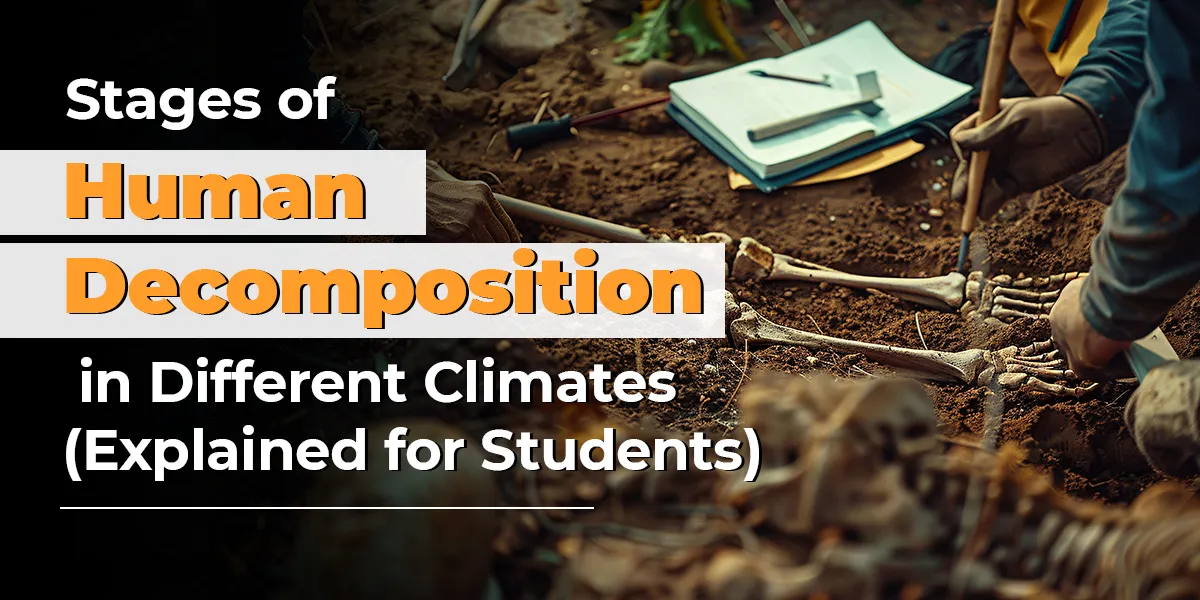
Human decomposition is the natural degradation of the body after death. Knowledge of decomposition and its relationship with an expert’s ability to interpret postmortem time in forensic science is important. The process generally proceeds relatively predictably, but climate and environmental factors like temperature, humidity, and soil play a crucial role in how quickly the stages of decomposition occur.
This blog explains the stages of human decomposition and the effects of different climates.
The Five Stages of Human Decomposition
Below are the five most important stages of human decomposition that are explained briefly:
1. Fresh Stage (0-3 days after death)
The fresh stage starts at the time of death when the heart stops pumping to provide oxygen to the cells. Without oxygen, the cells start to die, and this process is also known as autolysis.
Key changes:
- The body temperature starts to decrease (Algor Mortis).
- The body gets deposited in the lower portions of the body (livor mortis).
- Muscles start to stiffen (rigor mortis).
- Internal enzymes begin to digest cells.
- Bacteria already harbored in the body, especially in the intestines, begin to digest tissues.
2. Bloat Stage (2–7 Days)
In this phase, bacteria generate gases as they lyse tissues. These gases build up in the body cavities.
Key Changes
- Gas buildup leads to swelling in the body.
- Skin may look a little greenish or marbled.
- Strong odor develops.
- Blisters form on the skin.
- Insects like flies start to lay eggs.
- The abdomen often feels especially swollen, and the body may look bigger than usual.
Effect of Climate
- Warm and humid climates: Gas production and swelling happen rapidly.
- Cold climates: Bloating could be delayed for days or even weeks.
- Water environments: Bloating can lead to the body floating.
3. Active Decay Stage (5–11 Days)
This is when tissue breaks down quickly. The body starts to collapse when gases pass out, and soft tissues break down.
Key Changes
- The body deflates as gases are released.
- The body lets out a huge amount of fluids.
- Strong decomposition odor.
- Maggots and insects feed on tissues actively.
- Skin and organs can break down quickly.
This is the phase that typically is where the body typically loses the most mass.
Effect of Climate
- Hot climates: Active decay happens very quickly due to increased insect activity and bacterial growth.
- Cold climates: Insect activity may be limited, slowing the process.
- Arid climates: The body may dry before complete decay occurs.
4. Advanced Decay Stage (10–25 Days)
At this point, most soft tissues are decomposed. The rate of decomposition starts to slow down.
Key Changes
- The strong odor starts to decrease.
- Remaining tissues dry out.
- Fewer insects remain.
- Body mass has been significantly reduced.
Most of the soft tissues have already been eaten by insects or decomposed by this point.
Effect of Climate
- Humid environments: Certain tissues might remain moist and keep decomposing.
- Dry climates: Leftover tissues may be leathery and mummified.
- Cold climates: Decomposition is slow but does continue gradually.
5. Dry/Skeletonization Stage (Weeks to Years)
By the last stage, only bones, cartilage, and trace amounts of dry tissue are left.
Key Changes
- Skeleton becomes visible.
- Remaining hair and dried skin might persist.
- Bones might start to weather or break down over time.
The time required for skeletonization varies totally according to environmental conditions.
Effect of Climate
- Hot and humid climates: Skeletonization can happen within weeks or months.
- Cold climates: It may take several months to years.
- Desert climates: Some bodies might stay partially mummified and not fully decomposed.
Effects of Climate on Decomposition
The decomposition rate is determined by climate, which is one of the most significant influencing factors.
1. Temperature
Increasing temperature increases bacterial growth and insect activity, which speeds up the decomposition.
2. Humidity
Moist environments support microbial growth, while dry environments promote mummification.
3. Insect activity
Like blowflies, which are the biggest contributors to decomposition, their presence is tied to climate and season.
4. Environment
Bodies buried underground, submerged in water, or on the surface decompose at different rates.
Importance in Forensic Science
Understanding decomposition stages helps forensic experts:
- Estimate time since death.
- Determine if a body has been moved.
- Identify environmental conditions at the death scene.
- Assist in criminal investigations and disaster victim identification.
Forensic anthropologists and pathologists study decomposition patterns to gather valuable information about a case.
Conclusion
Human decomposition happens in five major stages, which are fresh, bloat, active decay, advanced decay, and skeletonization. These stages take place on an approximate continuum but are also subject to changes that vary greatly based on climate conditions such as temperature, humidity, and insect activity. These variations are key for forensic science students to understand post-mortem changes for successful investigation.