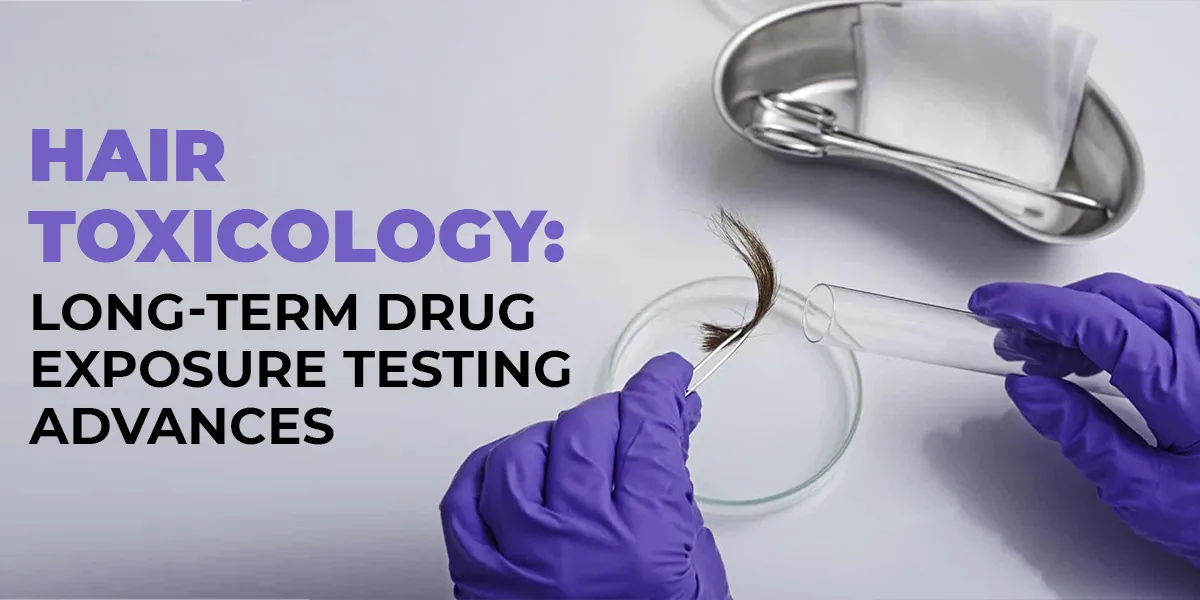
In the ever-evolving field of Toxicology, hair analysis has become a very powerful tool for detecting long-term drug exposure. In contrast to conventional methods such as urine or blood tests, which measure recent drug consumption, hair toxicology gives a timeline of substance which is used over weeks or even months. It has revolutionized new territories in forensic investigations, medical treatment surveillance, work testing, and public health research.
In this blog, we will take a closer look at hair toxicology, what it is, how hair toxicology works, and why it is beneficial.
What Is Hair Toxicology?
Hair Toxicology, also known as hair analysis or hair drug testing, examines a small hair sample to detect the presence of drugs or their metabolites. As hair grows, substances that enter the bloodstream can be incorporated into the hair follicle because hair grows at a constant rate of about 1 centimeter per month. The segments of hair can indicate the practical exposure to drugs, medications, or toxins.
This is especially helpful for looking at long-term use instead of short-term use. For instance, finding out if someone has used opioids or stimulants regularly over the last 90 days gives information that a urine test cannot provide.
The Incorporation of Science
Hair is made primarily of a protein called Keratin. While hair is produced inside the follicle, it interacts with constituents in the blood and body fluids. Drugs and their metabolites (breakdown products) are lodged in the hair shaft and stay that way over time. These substances can enter hair through several pathways:
- Bloodstream diffusion into the follicle
- Sweat and sebum cover the hair
- External contamination
After entering the hair structure, these compounds protect the hair from environmental degradation, leading the hair to be a stable matrix for analysis.
How Hair Drug Testing Works:
In this section, we will discuss the step-by-step process for how hair drug testing works including Sample collection, Segmentation, Preparation, Analysis, and Interpretation. Let's have a detailed look –
Step-by-step process:
Sample collection:
A small lock of hair, about 100 to 120, is cut out straight from the back of the head close to the scalp. The hair is then examined for hair-altering substances before treatment. Head hair may also be used; if it is unavailable, body hair can be provided instead.
Segmentation:
It breaks down hairs into spans over timlines (1 cm for a month's history).
Preparation:
Hair samples are washed to remove external contaminants and chemically treated to extract embedded compounds from those hair samples.
Analysis:
Sophisticated analytical methods like gas chromatography-mass spectrometry (GC-MS) and liquid chromatography-tandem mass spectrometry (LC-MS/MS) are also used to detect and quantify drugs and metabolites with extreme sensitivity.
Interpretation:
The data are interpreted based on concentration levels, and the growth rate is known based on the use pattern to deduce its utilization.
Benefits of Hair Toxicology
Hair Toxicology has several advantages as compared with other testing matrices:
1. Long Detection Window
Hair tests can show drug use over weeks to months, making it an excellent choice for chronic exposure assessment. This contrasts with:
- Urine tests: To look for drugs for about 1–3 days (some days longer).
- Blood tests: Offer a narrow window (hours to a few days).
- Saliva tests: To identify very recent use.
2. Historical Insights from Segmentation
Analyzing various segments of hair allows professionals to develop a chronological record of drug exposure, revealing patterns of drug use rather than being a present-absent result.
3. Non-Invasive Collection
Hair collection is painless and simple, and does not need special facilities. And it mitigates biohazard risk as compared to blood draws.
4. Difficult to Adulterate
Manipulating hair samples to tamper with evidence is very difficult. Unlike urine, hair does not easily have a chance of replacement or dilution.
5. Limitations and Challenges
Though hair toxicology is powerful, it is not without difficulties as well. These are:-
6. Variable Growth Rates
Hair grows at varying rates depending on genetics, age, health, and even body location. The fluctuation means that, at best, the exact timing in this latter case is rough.
7. Cosmetic Treatments
Bleaching, dyeing, and chemical straightening can also change drug concentrations in hair. Labs have to account for this by using protocols for washing and interpretive cautions.
8. Ethnicity and Hair Type Effects
Other reports have shown that hair texture, color, and composition of the hair may affect the incorporation of some substances, according to some research. Scientists are working to alter analytical models and remove bias.
9. External Contamination
Hair can also get traces from environmental drugs, e.g., secondhand smoke.
Modern protocols encompass thorough cleaning and testing to separate external contamination from systemic usage.
Applications of Hair Toxicology
It is a long-term monitoring tool that is nowadays used in forensic science, clinical, and employment settings to detect the incorporation of drugs.
- Forensic and Legal Cases
Hair evidence is often used in legal contexts, including criminal investigations and child custody cases. It can demonstrate patterns of drug use over time, information that may influence court decisions.
- Workplace Testing Programs
Some employers use hair tests to assess employees' drug use histories, especially in high-risk sectors like transportation and heavy industries.
- Clinical Monitoring and Treatment
Clinicians may use hair testing to track compliance with prescribed medication (e.g., opioid replacement therapy) or to assess relapse patterns in various recovery programs.
- Public Health Research
Hair analysis helps researchers study drug trends in populations and provides data on substance use prevalence.
It could even be used in public policy planning.
Recent Advances in Hair Toxicology
Hair toxicology has made remarkable strides thanks to technological innovations. Also, there are some recent developments:
- Ultra-sensitive detection technologies
Mass spectrometry has dramatically increased the sensitivity to drugs. Sophisticated instruments can pick up small amounts of substances, facilitating panoramic studies of traditional drugs, synthetic painkillers, benzodiazepines, and new designer drugs.
- Expanded panels and biomarkers
Testing panels contain numerous compounds and metabolites, and researchers are even investigating new biomarkers that point out patterns of use, metabolic changes, or even stress or health status.
- Segmental Timeline Mapping
Better computational models further strengthen the precision of temporal interpretations. By integrating segmental data with personalized growth models, the analysts can craft more specific drug exposure histories.
- Integration with Genetic and Metabolomic Profiles
Current research is investigating the effects of genetic factors on drug metabolism and incorporation into hair. Combining toxicology with metabolomics has the potential to unlock insights into how people metabolize substances.
- Enhanced Decontamination Protocols
Nowadays advance washing and analytical techniques are used to confidently distinguish between external contamination and true ingestion. This minimizes the number of false positives and adds to the trustworthiness.
- Ethical and Legal Considerations
In a world where hair toxicology is gaining more and more power,the tension between the need for accurate substance assessment and respect for privacy and individual rights must both be considered. The new legal tools and regulations have been evolving so that they apply fairly in employment, courts, legal, and healthcare.
Transparent reporting and culturally sensitive interpretation are essential for the use of evidence.
Looking Ahead:
The area is evolving, not static (hair toxicology). Some possible prospects might be as follows:
- Portable testing platforms for field use
- Machine learning tools to assist in the interpretative process to improve understanding
- Global databases for population-wide records on the move
- Personalized toxicology reports based on genetics and lifestyle
In other words, better health outcomes, safer workplaces, and more enlightened policy.
Conclusion
Hair toxicology connects science, medicine, and justice. Its insight into long-term exposure to drugs has fundamentally changed the way we think about substance and behavior patterns. Hair analysis is a cornerstone of health care and future technologies, and with continuous technological advancements and an enlightened ethical application, hair analysis will continue to play crucial roles in health care, legal systems, workplace safety, employment practices, and public health research.
For investigators, public health professionals, therapists, safety professionals, and anyone involved in drug testing, hair toxicology can provide a glimpse of what has come before so that we can make decisions for the future.