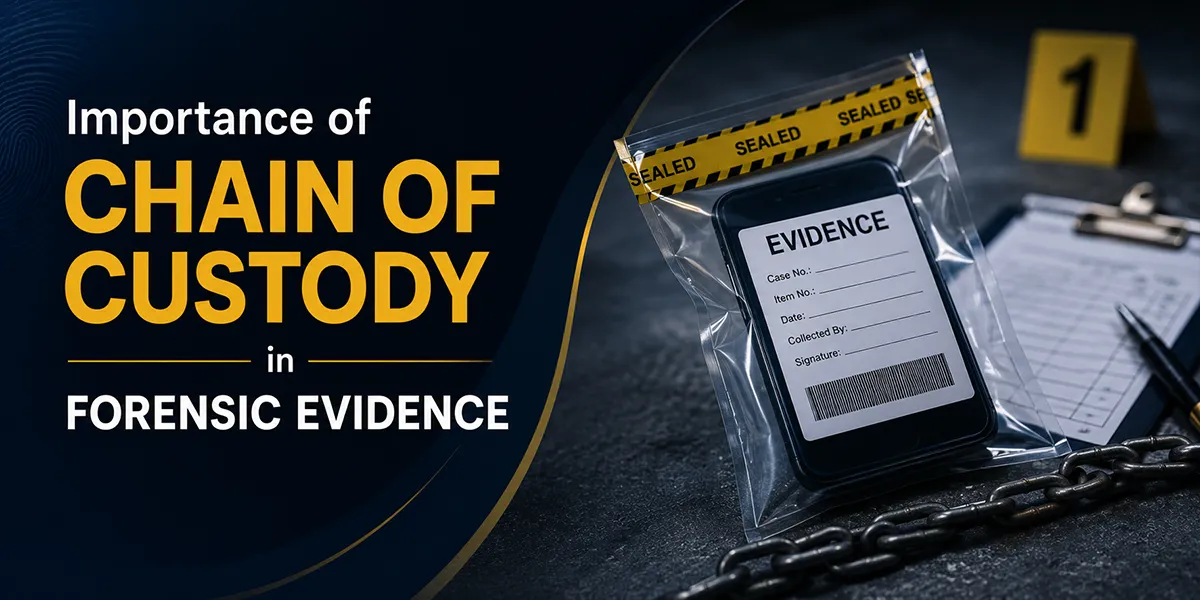
Criminal justice relies heavily upon forensic evidence to assist detectives in apprehending criminals and obtaining just outcomes for victims; however, evidence is nothing without first ensuring that there exists a reliable means of documenting what has happened to an object once it leaves its source until it arrives at its present location. This is referred to as establishing a chain of custody.
Establishing a chain of custody involves keeping track of everything done to the evidence from the time it is collected from the crime scene until it is taken to trial before the judge and jury. Chain of custody ensures the value of the forensic evidence collected is preserved during the course of the criminal investigation.
A chain of custody must be accurately maintained for every type of forensic evidence (fingerprint, DNA, weapon, digital device, toxicology report, etc.) obtained in a criminal investigation; otherwise, the integrity of the forensic evidence could be compromised and will lose credibility in court.
Let’s Understand the term ‘Chain of Custody’
Chain of custody refers to the sequential documentation of all persons involved in the handling of a piece of evidence. It includes:
- A description of the evidence
- The date and time the evidence was collected
- The name and signature of the officer collecting said evidence
- The location of the evidence when it was discovered
- All of the transfers/movements of the evidence
- Storage conditions and security measures for the evidence
This documentation creates a complete and consistent path, or trail, to show that the evidence presented in court is the same evidence that was collected from the crime scene.
For instance, a blood sample collected from a murder scene will be recorded in the chain of custody showing who collected it, who transported it to the forensic laboratory, who tested the sample, where it was stored, and who eventually presented it in court.
Significance of Chain of Custody for Forensic Material
1. Evidence Preservation
Chain of custody represents a procedure for preserving the value of forensic material. Improper handling of forensic material may yield forensic evidence that is contaminated, altered, damaged, or lost. Documenting the handling of items will create a record of how they were handled.
Footprints left on an object might be damaged by an inappropriate touch, or a sample of DNA could be contaminated as a result of recklessness. When a chain of custody is properly maintained, it minimizes the chance of these unwanted events occurring and keeps forensic evidence that is reliable.
2. Acceptance in a Court of Law
The court requires evidence collected by law enforcement to demonstrate that it has been handled properly from the point of collection to the time it is introduced at trial. If there is an unaccounted piece or inconsistency in the chain of custody, the defense attorney could challenge the evidence by claiming it has been altered or swapped.
If this occurs, the court may have no other alternative than to exclude the evidence altogether. Therefore, the chain of custody is an important element in making forensic evidence legally admissible.
3. Protects Evidence from being Altered or Changed
A chain of custody protects against tampering with or fraudulently changing evidence. Since every time evidence is transferred or handled, there is a record of it, it becomes increasingly difficult for even the most advanced criminal to change the evidence without creating a trail of evidence that will undoubtedly lead back to them.
This level of accountability adds to trust in the investigation process and adds to the fairness of the criminal justice system.
4. Demonstrates Accountability by Everyone Involved in Handling the Evidence
Everyone who has handled the evidence has taken responsibility for the safe and proper preservation of the evidence by verifying his or her identification through signature and/or a specific time stamp. If an issue arises during an investigation and there is a break in the chain of custody, the location where the evidence was lost or tampered with can be easily identified and rectified. Additionally, the documentation holds forensic professionals and law enforcement personnel accountable for their actions.
5. Provides Evidence to Forensic Experts That Allows for Accurate Analysis
Forensic experts depend on the integrity of the evidence presented for scientific analysis to help determine the truth. Any alteration or contamination of the evidence will result in false conclusions being drawn. A contaminated DNA sample can lead to a false positive result and provide an inaccurate DNA match, and digital evidence that has been altered may affect the results of a cybercrime investigation. Establishing a chain of custody guarantees that forensic experts are using reliable materials for scientific analysis.
6- Promoting Public Assurance in the Justice System
Public trust is vital for the criminal justice system. How evidence is managed will indicate the level of professionalism, transparency, and fairness in any particular case.
A documented chain of custody for properly managed evidence will create public and judicial confidence in the investigation and the judicial process.
Steps in the Chain of Custody
1- Evidence Should Be Collected
Evidence is collected from the scene of a crime by investigating officers through the use of correct forensic procedures. Each piece of evidence should have tags that include the case number, date, time, and location where collected. Photos and notes should also be taken to confirm the condition of the evidence when it was collected.
2- Packaging and Sealing
The type of evidence will determine the type(s) of container used to package the evidence. For example, if a biological sample is collected, it will need to be packaged in a sterile container; if it is a digital device, it may need to be packaged in an anti-static container. After packaging the evidence, it should be sealed in a way that prevents contamination or tampering.
3- Evidence Tracking/Documentation
A custody form or log will be created for each piece of evidence and will contain the details of all relevant information about each piece of evidence as well as the individuals who handled the evidence. The correct documentation forms the basis of the chain of custody process.
4- Evidence Transportation
Evidence will be transported in a secure manner to forensic labs or storage facilities, where it must be maintained in the appropriate environmental conditions in order to preserve the evidence. Examples of environmental conditions that should be monitored are biological specimens that need to be kept non-decomposing by way of refrigeration.
5- Evidence Storage
Evidence will be stored in secure evidence rooms or lockers that have controlled access to authorized personnel only. Each removal or return of evidence will have an entry in the custody log.
6- Forensic Evidence Examination
Forensic professionals will examine and perform tests on the evidence as well as document the results of each test before resealing the evidence and returning it to storage. The detailed record keeps a complete trail of the evidence for transparency and accountability.
7- Evidence Presentation In Court
The final step of the chain of custody process is the presentation of the evidence in court, including the associated chain of custody documentation. Prosecutors will rely on the chain of custody documentation to demonstrate that the evidence remained safe and unchanged from the moment it was collected until the time of its presentation in court.
Challenges in maintaining the Chain of Custody
Although it is essential, there are numerous challenges in maintaining the chain of custody. These challenges may include:
- Human error in documentation.
- Improper labeling of evidence.
- Loss or misplacement of evidence.
- Evidence contamination while handling evidence.
- Unauthorized access to evidence storage facilities.
- Transport delays and waiting period for examination.
In complex investigations that involve multiple agencies, maintaining an unbroken chain of custody can be even more difficult.
The Benefits of Technology in the Chain of Custody
The use of modern technology has resulted in better chain of custody procedures than ever before. Therefore, many forensic departments utilize digital evidence management systems, barcode tracking, and electronic signatures.
These types of systems help minimize paperwork and increase accuracy while allowing for tracking of evidence in real-time. Additionally, cybercrime investigations utilize specialized software applications to maintain digital evidence integrity.
Lastly, blockchain technology is currently being researched as a tamper-proof mechanism for maintaining a chain of custody records.
Chain of Custody in Digital Forensics
Evidence that has been collected during a digital investigation must be handled differently from other types of evidence due to the nature of digital evidence, because digital evidence can easily be deleted, changed, or corrupted if it is not protected properly.
In digital forensics, investigators perform a forensic copy of the data from the actual device instead of examining the original data. Hash values and encryption can be used to ensure that the data has not changed from the original copy.
Maintaining a robust chain of custody is extremely important in digital investigations because electronic data is easily manipulated.
Conclusion
A chain of custody is one of the core principles in forensic science and the criminal justice system, as it enables the integrity and reliability of evidence to be preserved from the moment it is collected at the crime scene until it is presented in a court of law. A "proper chain of custody" serves to protect evidence from being contaminated, tampered with, or lost and establishes a responsibility for all investigators involved and the forensic experts who will rely on the evidence.
Without a proper chain of custody, any forensic evidence with strong supporting data could be deemed unreliable and not usable in court. Therefore, all law enforcement agencies, forensic laboratories, and legal practitioners must strictly follow established chain of custody procedures to ensure that justice is properly and fairly served.
As forensic science continues to advance with new technology and digital investigations evolve, the importance of maintaining a strong and transparent chain of custody will continue to become increasingly important.