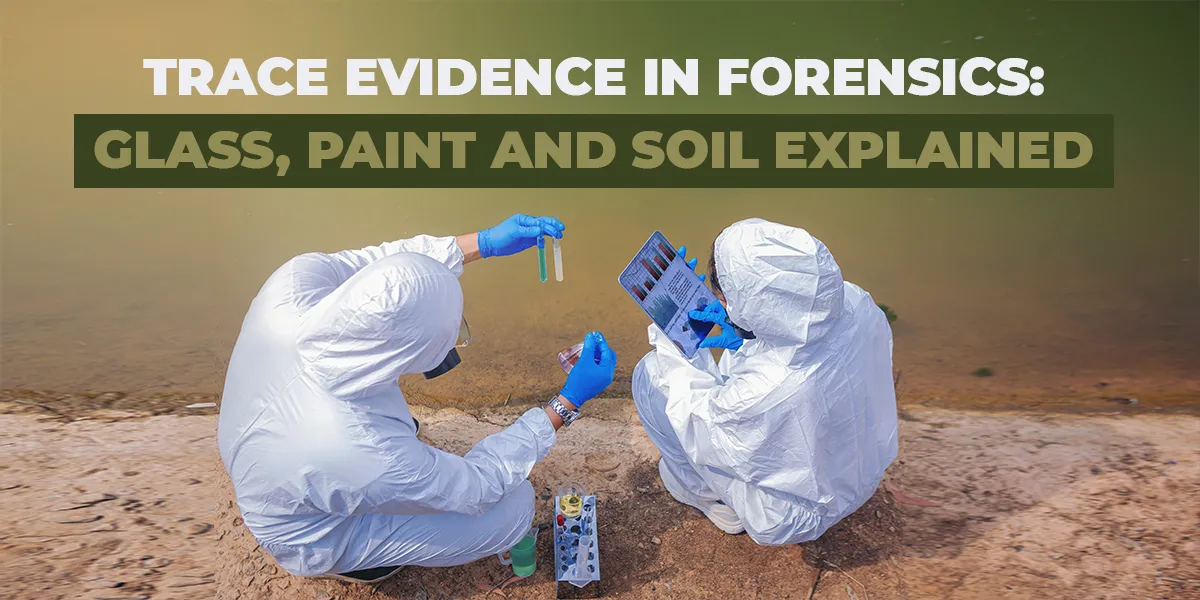
In forensic science, even the smallest piece of evidence can provide major insights. The smallest piece of evidence that you cannot see with the naked eye can connect to either the suspect, the victim, or the crime scene. The small materials used in most forensic investigations are called trace evidence. Trace evidence is any small material that has been transferred as a result of contact (or transfer) between two or more persons, things (objects), or environments. According to the FBI, trace evidence may include the following materials: fibers, hairs, glass fragments, soil, paint, and other microscopic materials that may be used to reconstruct the crime scene.
The concept of trace evidence is based on the scientific principle of Locard's Exchange Principle, which states that every time you make contact with something, you leave a trace behind. When you make contact with a crime scene either by entering or exiting, you have left various forms of evidence (i.e., glass fragments, paint chips, and soil particles) behind and taken things (e.g., glass fragments, paint chips, and soil particles) with you. By analyzing these trace evidence materials, forensic scientists can help determine links between people, vehicles, and places.
In this blog, you will learn about 3 types of trace evidence commonly found in forensic investigations, such as Glass, Paint, and Soil.
How can evidence play a role in Forensic Investigation?
Trace evidence isn't always visible and may be missed during an investigation, but it can be a valuable clue in many investigations, including burglaries, hit-and-run accidents, assaults, and homicides. Forensic professionals and experts collect trace evidence, including small materials from various sources such as clothing, tools, cars, and crime scenes, using laboratory techniques to analyze them.
Organizations such as the American Academy of Forensic Sciences have noted that trace evidence can assist investigators in:
- Establishes a link between a suspect and a crime scene
- Identifying the presence of contact between a person and an object
- Helping reconstruct an event in question
- Corroborating or refuting a witness statement
In some cases, a small piece of evidence may serve as critical evidence in a court of law.
Glass Evidence in Forensic Investigations
One of the most common types of trace evidence found in forensic investigations is glass evidence. This type of trace evidence is often found in cases involving burglary, automobile accidents, or vandalism. When glass breaks, it produces a multitude of small glass fragments that can adhere to clothing, shoes, or hair.
How to Collect Glass Evidence
When collecting glass evidence, investigators will carefully collect glass fragments using tools such as forceps, tape lifts, or vacuum devices. After the glass evidence has been collected, separate packaging is used to prevent contamination. Once a glass fragment has been found on a suspect's clothing, it can be used to help determine the suspect's physical presence at the site of the broken window or windshield.
Laboratory Analysis of Glass
Analyses conducted by forensic scientists on glass include:
- Determining density (size).
- Light refraction index testing to identify how light travels through glass.
- Performing Microscopic Examination to compare physical characteristics.
Many advanced laboratories use Scanning Electron Microscopes (SEMs) to view glass samples under extreme magnification.
Glass evidence can be used to link a suspect to a crime scene in several ways, including:
- Identifying whether or not a suspect was near a broken window
- Determining from what direction the glass came from (i.e., whether the glass broke outwards)
- Establishing whether the glass found on a suspect matches the glass at a crime scene
For example, if a glass fragment found on a suspect's clothing matches the same refractive index and composition of glass taken from the broken window at the crime scene, this can provide significant corroborating evidence.
Paint Evidence in Forensic Science
Paint evidence is another category commonly referred to as forensic science because of the wide variety of offenses as a result of paint evidence, including, but not limited to, hit-and-run accidents, vandalism to property, and disfigurement of property.
Most vehicles, buildings, tools, etc., generally have multiple layers of paint, each of which is produced from different paint formulas.
As a result, when two painted surfaces make contact with each other, such as in an accident involving a vehicle, small paint chips could be transferred from one surface to the other. Consequently, small paint chips may later be recovered from either painted surface and analyzed to determine their origin.
Some examples of paint sources include:
Automotive (car) paint: Paint used to protect the body of a car and commonly used to provide an aesthetic appearance to the car.
Building paint: Paint used to provide an exterior surface coating on a building.
Tool Coatings: Coating applied to a tool to protect it from wear.
Industrial Equipment Paint: Coatings used to protect industrial machinery (i.e., pumps, compressors, etc.) from corrosive and/or hazardous chemicals that they might come into contact with.
Presentation of the Materials and Findings of a Laboratory
Forensic scientists use numerous ways to analyze paint evidence:
- Layer comparison using a microscope
- Analysis of the chemical composition of the paint sample
- Spectroscopy
One instrument used for paint analysis is the Fourier Transform Infrared Spectrometer, which can be used to identify the chemical compounds contained in the paint samples.
Role in Hit and Run
The use of these laboratory analyses of paint can greatly assist investigators in the investigation of hit-and-run incidents.
Scientists can use paint evidence to assist investigators with the following:
- Identifying the make/model/year of the vehicle involved in the accident
- Linking paint fragments found on the victim's clothing to the suspect's vehicle
- Confirmation that either vehicle made contact with another vehicle
As automotive manufacturers have different paint formulas, the information gathered from paint analysis is invaluable to investigating and determining potential suspects.
Soil Evidence in Forensic Investigation
Soil is so often overlooked as evidence of a crime, but soil can provide an abundance of information, as soils from different areas have different compositions. There may be soil particles found on shoes, clothing, vehicles, and tools that tie a suspect to a specific location.
Characteristics of Soil Evidence
Soil is made up of many components, which include:
- Mineral particles
- Organic materials
- Microorganisms
- Plant fragments
- Chemical compounds
Because the soil is dependent on these variations, soil from different areas often has unique characteristics.
Methods of Soil
- Microscopic examination
- Mineral analysis
- Chemical analysis
- Biological analysis
For example, forensic analysts may compare soil samples to identify organic compounds in the sample using Gas Chromatography instrumentation.
Importance of Soil Evidence in Criminal Investigations
Soil evidence can assist investigators by establishing the following:
- Connections between an offender and a burial site or the outdoor scene of a crime.
- If a vehicle has crossed through a specific area.
- Movement patterns during the commission of a crime.
A suspect's shoe lacks soil that matches the crime scene soil, thus supporting the theory that they were present at that location.
Challenges in Analyzing Trace Evidence
Although trace evidence can be quite useful, analytical difficulties often arise due to the following:
- Contamination risks and improper evidence handling can alter evidence.
- Sample size trace evidence is typically comprised of extremely small quantities.
- Environmental effects. Environmental conditions or time can significantly affect the quality of a sample.
Due to the complexity of interpretation, analysts must use great care to avoid false opinions and misinterpretations when analyzing evidence. To mitigate these issues, forensic laboratories utilize strict protocols and standards of quality developed by organizations such as the International Association for Identification.
The Significance of Trace Evidence
Trace evidence is significant in contemporary criminal justice systems. Although it does not always conclusively establish guilt, it is often a great deal of support for the findings of investigators.
When used in conjunction with other types of evidence, such as fingerprints, DNA, or eyewitness accounts, trace evidence provides a more thorough understanding of what happened at the scene of the crime.
There have been many successful prosecutions that were aided by the use of microscopic evidence linking suspects to crime scenes. Not only does this type of evidence have a real scientific basis, but forensic scientists will utilize their skills in gathering and analyzing these types of items to assist investigators in ensuring that they use scientific evidence to guide their investigation instead of conjecture.
Final Thoughts
Trace evidence does not have a large individual impact; however, it does have an extremely large impact on forensic science. Trace evidence includes materials such as glass shards, paint chips, and soil particles. They can provide investigators with insight into unknown connections between victims, suspects, and crime scenes. Forensic investigators apply the scientific process to these types of items according to Locard's Exchange Principle for the purpose of reconstructing the events surrounding a person's crime.
Glass evidence can link a suspect to a broken window or a crash, but paint evidence can assist in identifying vehicles involved in a hit and run, and soil evidence can place a suspect at a specific location. All of these types of trace evidence can assist in the investigation of a particular crime and will ultimately assist in achieving justice for the victim. The smallest pieces of evidence can often convey the most important pieces of evidence in forensic science.