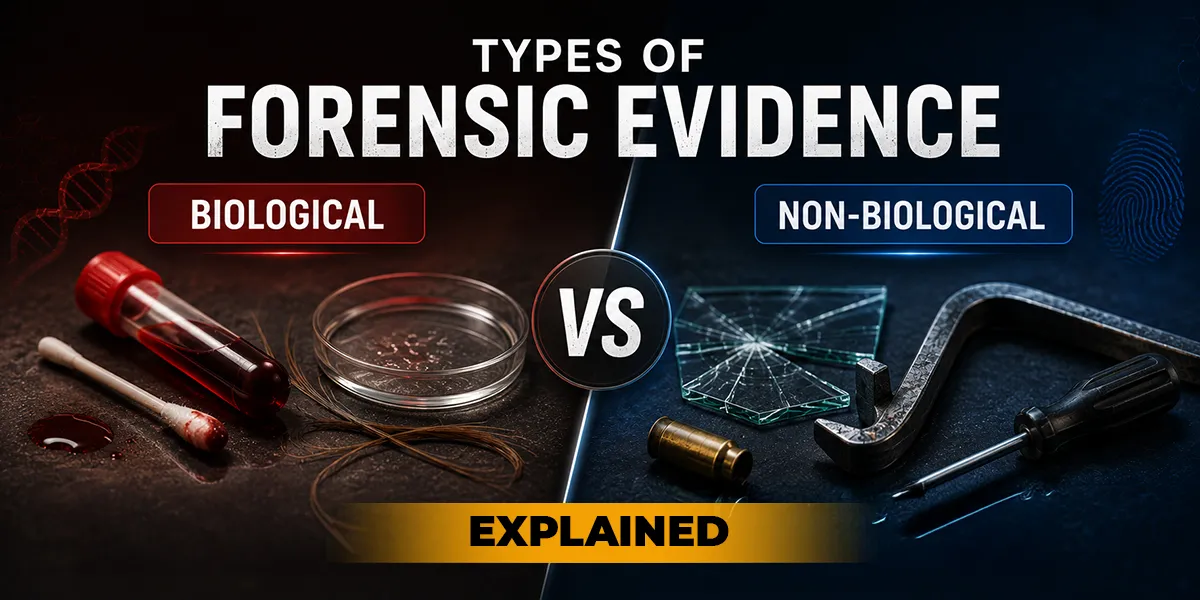
Modern crime investigations depend heavily on forensic evidence to piece together facts about a crime, identify perpetrators, provide timelines for events that took place before the crime, and provide evidence for the prosecution in court.
Forensic evidence can be generally classified into two main categories: biological or organic forensic evidence and non-biological or inorganic forensic evidence. Both categories of forensic evidence play an important role in solving crimes with the use of different types of evidence together.
By understanding how forensic evidence is used in an investigation, students, investigators, attorneys, and even the average person can have a greater understanding of how science and forensic evidence create justice.
This blog will focus on both forms of forensic evidence, their classifications/types, examples of both categories, methods of collection, and how they play a role in the investigation process.
What is Forensic Evidence?
Forensic evidence refers to anything that is collected at a crime scene and can be used to establish the facts of the case. It can link a suspect to a victim, a weapon to a crime scene, or determine when and how the crime occurred.
The primary goal of forensic evidence is to provide scientific evidence that can withstand challenges in court. Therefore, all evidence must be carefully collected, preserved, analyzed, and documented to maintain its integrity.
Forensic evidence is typically classified into two main categories:
- Biological Forensic Evidence
- Non-Biological Forensic Evidence
Biological Forensic Evidence
Biological evidence is evidence that comes from a living thing. In most cases, biological evidence will include DNA and can therefore assist greatly in determining a person’s identity.
Biological evidence is often found in violent criminal activities such as murder, assault, sexual abuse, and kidnapping.
The following are examples of types of biological evidence you might find:
Blood
Blood is one of the most common types of biological evidence. Investigators will use blood to establish:
- DNA profile
- Blood type
- Bloodstain pattern
- The direction of impact on a bloodstain
- Weapon type used
By analyzing the pattern of bloodstains, investigators can reconstruct the events surrounding a crime scene.
Saliva
Saliva can be found on the following:
- Cigarette ends
- Drink containers
- Leftover food
- Bite marks
- Envelopes
Saliva contains epithelial cells that can also assist in identifying suspects because they provide DNA profiles.
Semen
Semen is most often used in sexual assault investigations to prove that sexual contact took place and can be used to identify the perpetrator via DNA testing.
Biological evidence must be collected and preserved properly, as the biological material will deteriorate quickly.
Hair
Evidence of hair may be obtained from:
- Scalp Hair
- Beard Hair
- Body Hair
Analysis of hair can assist in establishing:
- Species of the hair
- Using hair as evidence in the investigation of drugs
- The presence of DNA (DNA will only be found if the hair has a root).
Microscopic examination of hair may aid in linking a suspect or victim to a crime scene.
Tissues and Skin Cells
During an altercation/scrap, several small tissue or skin cells may be found under the fingernails of one or both parties. These smaller biological samples can have DNA material and can assist in identifying the offender/suspect.
Bones and Teeth
Decomposed or burned bodies may provide a source of valuable forensic evidence through bones and teeth. Forensic experts typically analyze to ascertain the following:
- Age
- Sex
- Ancestry
- Cause of injury
Normally, teeth are one of the most durable pieces of evidence that can survive very extreme circumstances.
Urine and Other Biological Fluids
Urine, sweat, and vomit may also be used to provide toxicological evidence to help determine the consumption of drugs and/or alcohol.
Significance of Biological Evidence
The value of biological evidence is based on the use of DNA analysis. The implementation of DNA profiling has provided law enforcement agencies with a variety of new methods and technologies that can assist with identifying individuals with a high level of accuracy.
The advantages provided by DNA profiling are:
- Individual Identification
- Elimination of Incorrectly Accused Individuals
- Identification of a Victim's Suspect's Links
- Solve Cold Cases
- Confirming Family Relationship
At the present time, many law enforcement agencies throughout the world utilize DNA databases to match biological evidence with an individual's criminal history.
Collection and Preservation of Biological Evidence
To prevent contamination, biological evidence must be handled with care.
Safety Guidelines:
- Gloves and PPE (personal protective equipment) must be used while handling evidence.
- Wet samples must be thoroughly dry before packaging (packaged in envelopes or a box).
- Evidence must not be stored in plastic bags (store in paper bags).
- Evidence must be marked or labeled.
- The chain of evidence must be recorded.
Improperly handled biological evidence may destroy DNA evidence or render the evidence inadmissible in court.
Non-biological forensic evidence (physical evidence)
Non-biological forensic evidence (non-biological evidence) includes physical or chemical materials that originate from a non-living source. Non-biological evidence may still provide valuable leads to an investigation, even if the evidence does not contain DNA.
Non-biological forensic evidence is often referred to as physical evidence in different circumstances.
Common Types of Non-Biological Evidence
Fingerprints
Fingerprints are considered to be the oldest and most reliable forensic evidence.
Each person has their own unique fingerprint patterns, which can be classified as:
- Loops
- Whorls
- Arches
Fingerprints can be visible, latent, and plastic. Prints can be compared by qualified experts using technical methods and fingerprint databases.
Firearms and Ballistics Evidence
Examples of ballistic evidence include:
- Bullets
- Cartridge casing or spent round
- Gunshot residue
- Firearms
Examination of the marks left on a bullet by a firearm will help a ballistics examiner determine whether or not the bullet was fired from the suspect's firearm. Gunshot residue analysis can also assist an examiner in determining if the alleged suspect has discharged a weapon shortly before.
Glass Evidence
Broken glass fragments may link a suspect to a victim, vehicle, and/or crime scene. Investigators will examine:
- Thickness of the glass
- Color of the glass
- Fracture patterns of the glass
- Refractive index of the glass
Through an examination of the glass, the forensic scientist may establish the angle and force at which the glass was impacted.
Soil Evidence
Soil found on shoes, vehicles, or tools may link a suspect to a specific location. The forensic scientist examining soil examines the following:
- Mineral content
- Organic material present
- Color
- Grain size
Even small quantities of soil can yield significant evidence of possible association.
Fibers and Textiles
Fibers from clothing, carpeting, and furniture may be transferred to each other during incidental contact. Forensic scientists examining fiber evidence will analyze:
- Type of fiber
- Color of fiber
- Chemical composition of fiber
- Pattern of fabric weave
Fiber evidence may provide the connectivity between a suspect and a victim.
Documents and Handwriting
The analysis of questioned documents will involve the examination of the following evidence:
- Signature
- Handwriting
- Ink
- Printed documents
- Alteration
This evidence will be beneficial in cases of fraud, forgery, and financial crime.
Tools mark impression
Tool Marks and Impressions:
When tools are utilized during an act of forced entry or assault, the corresponding tools will leave identifiable markings on surfaces. Examples of tool marks include crowbar impressions, shoe prints, and tire patterns. Investigators will evaluate these tool marks against potential tool types and footwear.
Drugs and Chemicals
Forensic chemists use a combination of laboratory techniques to analyze illegal drugs, poisons, explosives, and toxic chemicals. Forensic chemistry is a vital component of criminal narcotics investigations and investigates all poisons that can be proven to have been used as a means of injury or death.
Digital Evidence
More and more modern-day criminal investigations utilize digital evidence such as mobile devices, computers, email, video surveillance (CCTV), and social media records. Digital forensics contemplates the recovery and analysis of deleted files from computer systems/electronic devices and tracking of criminal activities conducted via the internet.
Importance of Non-Biological Evidence
The importance of non-biological evidence in a criminal investigation is to assist investigators in the following:
- Reconstructing the elements of a crime scene.
- Developing a timeline of events leading up to and including a criminal act.
- Establishing methods of operation in criminal activity.
- Linking suspects to the crime scene and corroborating witness statements.
While biological evidence may remain absent from a crime scene, physical evidence alone can resolve a case.
Difference between Biological and Non-Biological Evidence
| Biological Evidence | Non-Biological Evidence |
|---|---|
| Originates from living organisms | Does not originate from living organisms |
| Often contains DNA | Usually lacks DNA |
| Includes blood, saliva, hair, semen | Includes fingerprints, glass, fibers, bullets |
| Common in violent crimes | Common to all types of crimes |
| Requires protection from decomposition | Requires protection from contamination or damage |
| Useful for identification through DNA profiling | Useful for linking objects, scenes, and suspects |
Challenges in Forensic Evidence Analysis
Forensic professionals encounter many obstacles, such as:
- Contamination: Improper handling can compromise evidence reliability.
- Environmental damage: Heat, moisture, sunlight, and bacteria may also affect results.
- Human error: Mistakes that are made during collection or laboratory analysis may affect the results.
- Interpretation issues: Some of the evidence requires expert interpretation, which may rely on the analysts.
Role of Chain of Custody
A good chain of custody is an important factor. It provides evidence about who has had physical access to the piece of evidence throughout its lifetime, both prior to when it was presented in court and until it was finally presented. A good chain of custody demonstrates authenticity, safeguards it against tampering, allows for legal admissibility into a court setting, and increases your chance of having a case successfully tried if there is a break in the chain of custody.
Conclusion
The use of both biological and non-biological evidence is essential to forensic investigation. Biological evidence, especially samples that contain DNA, is one of the best forms of personal identification. While both biological and non-
Biological evidence assists with reconstructions of crime scenes, identifying tools or weapons, and establishing connections between suspects and crimes. The two forms of evidence are increasingly being analyzed together to reach the truth in forensic science.
As technology has progressed, forensic scientists are successfully applying scientific techniques to work on complex criminal cases with higher levels of accuracy and reliability than previously thought possible.
It is important for all parties involved in investigations, including students, legal practitioners, investigators, and all persons interested in the scientific process of criminal investigation, to understand the different types of forensic evidence.