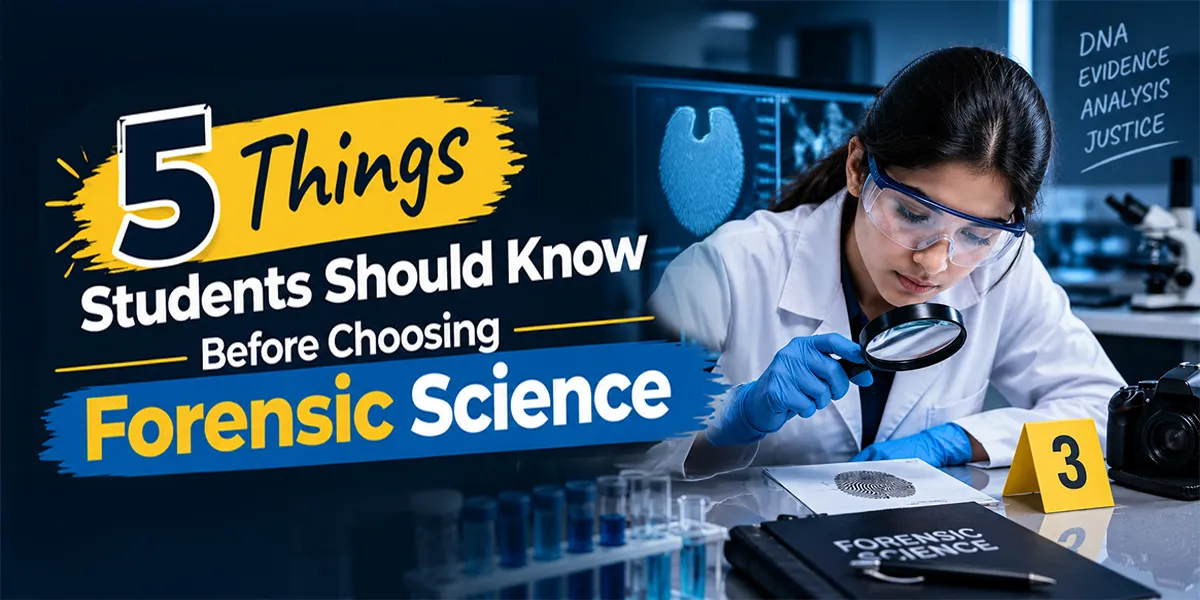
During an investigation, a fingerprint, a DNA sample, or data retrieved from a mobile phone can reveal important details. Forensic science is a field that utilizes scientific techniques to analyze such evidence and help in establishing facts relevant to criminal cases and other legal matters.
For students who are interested in science, analytical thinking, and the practical application of learned skills, this career gives them the ability to apply knowledge from the classroom to actual practical applications.
However, those thinking of going into forensic science need to understand what scientific backgrounds are needed, what skills are needed for correct analysis and interpretation of evidence, and the importance of practical lab experience.
Let's go through five essential things that students need to be aware of before choosing forensic science as a career.
1. Forensic science is about scientific evidence, not just crime investigation
A preconceived notion regarding forensic science is that professionals spend most of their time visiting crime scenes and solving criminal cases.
Students need to know that forensic science is not just for crimes. Scientific analysis also helps with investigations that involve accidents, online crimes, questions about documents, and other situations where evidence needs to be looked at. Forensic science is useful in different areas. It is not only for criminal cases. The same methods can be used for other types of problems that require proof. Students should learn that forensic science is not limited to criminal cases.
Forensic science can be used in different ways. It helps in understanding what happened in various situations. Students need to understand that forensic science is not limited to criminal cases. The same tools and techniques can be used in different areas. Forensic science plays a role in different types of investigations. Students need to know that forensic science is not only for crimes. The work of scientists can help in many different kinds of cases.
2. A strong interest in science is essential
Students should think about their interest in scientific subjects before picking a course. These subjects include biology, chemistry, physics, and, more recently, computer science.
For example, to understand DNA evidence, a student must know about genetics and molecular biology. A toxicologist needs to be skilled in analysis. A firearms examiner must understand physics and how projectiles behave.
The key to making the right choice is to look at your background and what you're truly interested in long-term. Think about what subjects you enjoy and what kind of work you might want to do. This helps guide your decision in choosing a path in forensic science.
3. Attention to detail
In crime shows, forensic investigations have been portrayed as fast-paced activities in which getting a single piece of evidence or clue is enough to solve an entire case. But in reality, that is not true; scientific examination is a highly organized process that involves repetitive procedures, detailed documentation, careful comparisons, and considerable patience.
Before reaching any conclusion, the forensic scientist must examine several samples. Even a small error in labelling, recording, handling, or interpreting evidence can affect the reliability of an investigation.
4. Communication and interpersonal skills
Scientific findings or reports need to be explained in a written format or presented during legal proceedings. This makes it essential for students to work on their writing, documentation, and communication skills.
Most of these qualities can be developed through academic study, laboratory practice, research projects, and internships where available.
5. Consistent learning and adaptability
Forensic science is a field that is in continuous evolution, and new technologies and scientific techniques transform the way evidence is collected, examined, and interpreted. Modern investigations heavily depend upon tools like rapid DNA testing, cloud forensics, automated fingerprint analysis, facial recognition, specialized photography, and drones.
All these aspects contribute to the fact that forensic professionals can thoroughly investigate evidence and find new approaches to study criminal cases.
For students who are willing to proceed to this field, obtaining a degree is not the end of the journey but rather the beginning. They should continually enrich their knowledge, be aware of the latest advancements in the field, and acquire new expertise to improve their professional skills. This can be done by attending training courses, earning a postgraduate degree, or studying specializations.
Moreover, a forensic professional should be flexible and creative enough to choose the most appropriate procedures in particular cases, while upholding high scientific standards and moral principles. Through constant education, one can be successful in the sphere of forensic science and benefit the area of justice.
Conclusion
Therefore, considering the presented factors, students who want to enter forensic science should realize that the scope of their skills, which they can acquire through education, practical experience, specialization, and scientific curiosity, will match their expectations of this career.