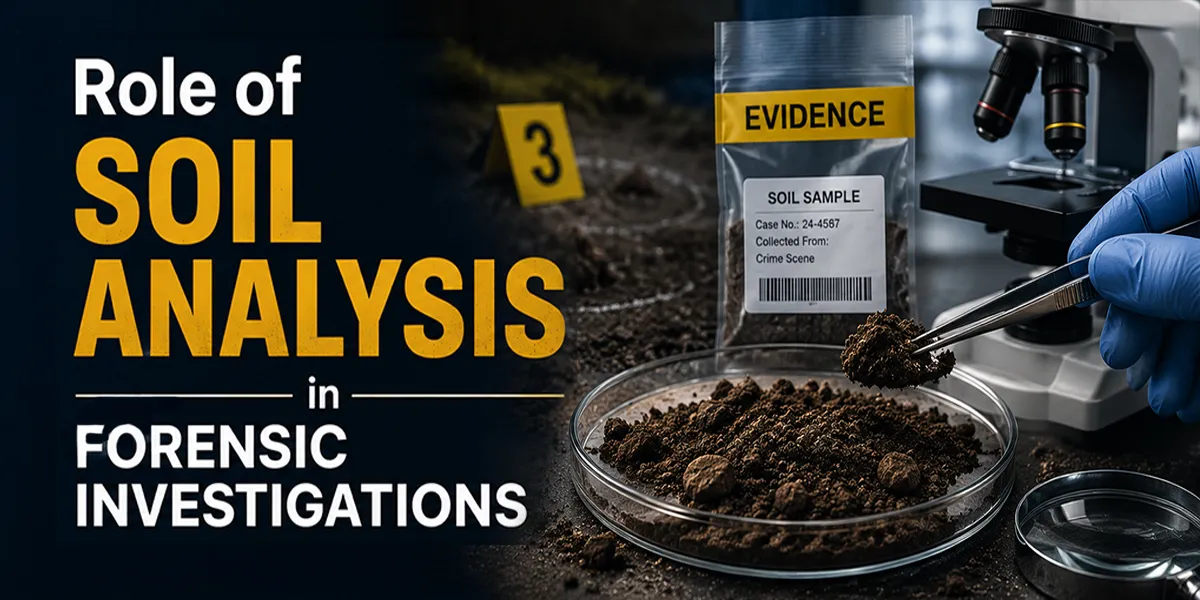
Forensic science uses scientific techniques to reveal hidden evidence that can help lead investigators to a solution for crimes, and soil is a significant form of forensic evidence that is often overlooked. For example, soil found on a pair of shoes, a piece of clothing, a type of car, or tools can connect a suspect with a crime scene and provide vital information within an investigation. Forensic soil analysis is the scientific examination and study of soil during criminal investigations.
The reasons soil is considered to be highly valuable forensic evidence are that each area has its own unique characteristics of soil: every single color of soil, the structure of the soil, the mineral composition of the soil, the amount and type of organic material, as well as the chemical content, will differ from one place to another. These differences allow forensic specialists to compare soil samples with one another and determine if they came from the same area.
This blog describes the role of forensic soil analysis in criminal investigations, the methods used to complete a forensic soil examination, the types of forensic soil evidence used in criminal cases, the application of forensic soil science within criminal cases, and finally, the importance of forensic soil science within modern-day investigations.
What is Soil Analysis in Forensic Science?
In forensic science, soil analysis is the study of soil samples obtained from crime scene sites, victims, suspect parties, vehicles, and other objects, allowing researchers to draw links between people, places, and criminal acts.
When someone traverses an area, soil particles may become attached to their clothing, footwear, or items. Vehicles and tools can also carry soil from one area to another and provide forensic scientists with their respective soil evidence to analyze.
The scientific basis for the soil forensic process relies on the fact that no two soils have the same combination of minerals (chemical compounds), organic materials, microorganisms, and environmental factors.
The significance of soil analysis in crime scene investigations cannot be underestimated. Soil collected from a suspect or a vehicle can provide valuable information to investigators.
1- Linking suspects to the site of a crime
One of the primary ways soil can assist investigators is by linking suspects to specific locations. If the soil that is collected from the soles of a person’s shoes or from their vehicle matches the soil collected from the area surrounding the crime, it can link the suspect to the crime.
For example:
If samples of mud collected from the soles of a suspect’s shoes are determined to have the same minerals and/or plant particles as the soil collected from a burial site, the evidence may place that suspect at the burial site.
2- Locating burial sites
In a homicide investigation, forensics can use soil analysis to locate graves or burial sites that may be concealed. Disturbed soil that has been subject to alteration due to burial will have a different texture, color, or chemical makeup than the surrounding soil.
For example:
If there are variations in the composition of the disturbed soil, it can indicate the potential presence of decomposing material just below the surface, which can assist investigators in determining if there is a body beneath the surface.
3- Reconstructing events associated with the crime
Soil analysis can be used to help reconstruct the events that occurred during the commission of the crime. The presence of different types of soil particles or layers can indicate the movement and pathways of the suspect.
For example:
A sample of soil found inside the suspect's vehicle can indicate whether that vehicle traveled through a wooded area, construction site, or agricultural area.
4- Contradictory/Supportive Statements.
Soil samples collected from the crime scene will only confirm or not confirm what a suspect or witness said about being in or visiting the location of the crime scene.
For example:
If a suspect said they never went to a location from which you took a soil sample and that soil was found on their clothing, then their statement could be challenged.
Characteristics of Soil Evidence in Forensic Science
Forensic scientists examine many different physical and chemical properties found in soils in order to compare soils that may have come from different locations.
1- Color
Soil color may be a result of various minerals contained within the soil, the amount of water in the soil, and the organic components present in the soil.
Soils can generally be categorized into four different colors: red soils, black soils, sandy soils, and clay-rich soils. Different colors help investigators to narrow down particular areas of interest.
2- Texture
Soil texture describes the size of soil particles (in terms of diameter); there are three categories of soil particle sizes:
- Sand
- Silt
- Clay
Various combinations of these three categories create different soil textures.
3- Mineral Composition
Some examples of minerals found in soils are the following:
- Quartz
- Feldspar
- Iron compounds
- Calcium carbonate
Mineral composition will vary from region to region.
4- Organic Matter
- Soils may contain
- Plant fragments
- Pollen
- Seeds
- Microorganisms
These types of organic materials can provide valuable evidence regarding the conditions under which the soils formed and can assist in identifying the specific locations.
5- Chemical Properties
Forensic scientists also examine:
- pH level
- Chemical elements
- Moisture content
- Fertilizer residue
This provides them with further evidence to compare soils.
Collection of Soil Evidence
Proper sampling of soil is critical because it has the potential to contaminate evidence. Investigators must have an industry-based collection process that is used with every case:
- Soil samples must be collected from various locations, which can be designated as the crime scene.
- Each sample is stored in a clean container or paper bag.
- Each sample is labelled precisely.
- Tools used for sample collection are cleaned between uses to avoid contamination.
- Control samples from surrounding areas are collected for comparison purposes.
Methods Used in Forensic Analysis of Soil
Contemporary forensic laboratories utilize several scientific methodologies to examine soil samples.
1- Microscopic Analysis
Microscopes allow scientists to view the following:
- Size of particles
- Grain types of soil
- Living matter found in soil
- Structure of soil.
The comparison of soil specimens through microscopic examination may display similarities between soil samples.
2- Density Testing
Every type of material has its own density and weight. The weight difference between different materials found in the same area allows us to separate various soil components to determine what minerals are present.
3- Chemical Analyses
Chemical testing is performed to:
- Evaluate soil pH.
- determine if metals are present.
- Identify chemical compounds found in soil.
- Determine if organic matter is contained in soil.
Chemical profiling is performed by analyzing the results of the chemical tests conducted on the soil.
4- Spectroscopy
Spectroscopy is the study of the interaction of soil with different wavelengths of light to determine what minerals and/or chemical components are present in the soil.
5- X-Ray Diffraction
X-ray diffraction is used to identify crystalline minerals in soil and can assist forensic scientists in identifying the original location of the sample.
6- Biological Analysis
Biological analysis identifies:
- Pollen
- Fungi
- Bacteria
- Plant debris.
Biological markers provide geographical markers for the specimen being analyzed.
Application of Soil Analysis in Forensic Cases
Soil analysis can be very beneficial for various criminal investigations.
1- Homicidal cases
Soil/ground evidence helps to link someone suspected of committing a homicide with either the crime scene, burial site, or the place where the victim's body was moved to after being killed.
Example
If a suspect's car trunk had earth in it and they had been apprehended after committing a murder and dumping the victim's body about 15 miles away, you could compare the earth found in the suspect's trunk with the earth at the dump site.
2- Hit and Run Accidents
Having mud or earth on a vehicle can help establish the route the vehicle traveled prior to or after the accident.
3- Abduction Cases
Soil accumulation on the victim or the suspect can be used to prove the location where the victim was detained.
4- Robbery and Burglary Cases
Soil or ground that remains on shoes or tools can place suspects at a crime scene.
5- Environmental Investigation
Forensic soil analysis may also be useful for investigating illegal dumping, mining, and pollution.
The role of Locard's theory of exchange
Soil evidence has long been associated with the principle of Edmond Locard's exchange principle, which states that every time two objects come into contact with each other, there will be a transfer of material from one to the other.
When a person enters a location, soil particles are displaced from the surface of the ground onto their shoes, clothing, and/or belongings. The result is that evidence is created that can later be examined by investigators.
Advantages of Soil Analysis in Forensic Science
The benefits of soil analysis in forensic science are numerous. They include:
- Soil is easily transferred and readily found at most locations.
- Soil can withstand the test of time.
- The composition of soil will vary based on where it is found within the area.
- Soil links an individual to a location.
- Soil provides additional support for other kinds of forensic evidence.
Limitations of Soil Analysis
While soil testing is beneficial, it has limits on how well or correctly it can be utilized.
1- Like Location
Some places have very similar soils that can’t be positively identified.
2- Changes to the Environment
Soil can change over time depending on everything from rainfall to wind to the actions of man.
3- Risk of Contamination
If soil samples aren’t collected or stored correctly, they may become contaminated.
4- No Individual Identification
Unlike DNA, soil evidence does not, by itself, prove the identity of an individual and should typically be used in conjunction with other types of forensic evidence.
Technological Advancement and Forensic Soil Studies
The improvements in the accuracy of forensic soil analysis have occurred because of improvements in technology. Technology has permitted the following:
- Detailed identification of soil minerals
- DNA analysis of soil microorganisms
- Geographic mapping
- Computerized comparative systems.
These improvements have increased the validity of forensic soil evidence in investigations and trials.
Conclusion
Soil analysis is an important tool in forensic science because it can help investigators link the suspect, victim, object, or location to a crime scene. While soil is often thought of as a common, unassuming medium, it actually contains extremely unique physical, chemical, and biological properties that can assist investigators in not only establishing connections to a crime scene but also providing investigative leads.
The analysis of soil can assist investigators with various forms of crime and criminal activities by verifying the statements of concerned parties, thereby enabling them to develop connections among evidence, relationships, and ultimately assist in the prosecution of those guilty of a crime.
As forensic science continues to develop and change, soil analysis will remain an effective tool in forensic investigations and contribute to the efficacy of police investigations in the pursuit of justice.