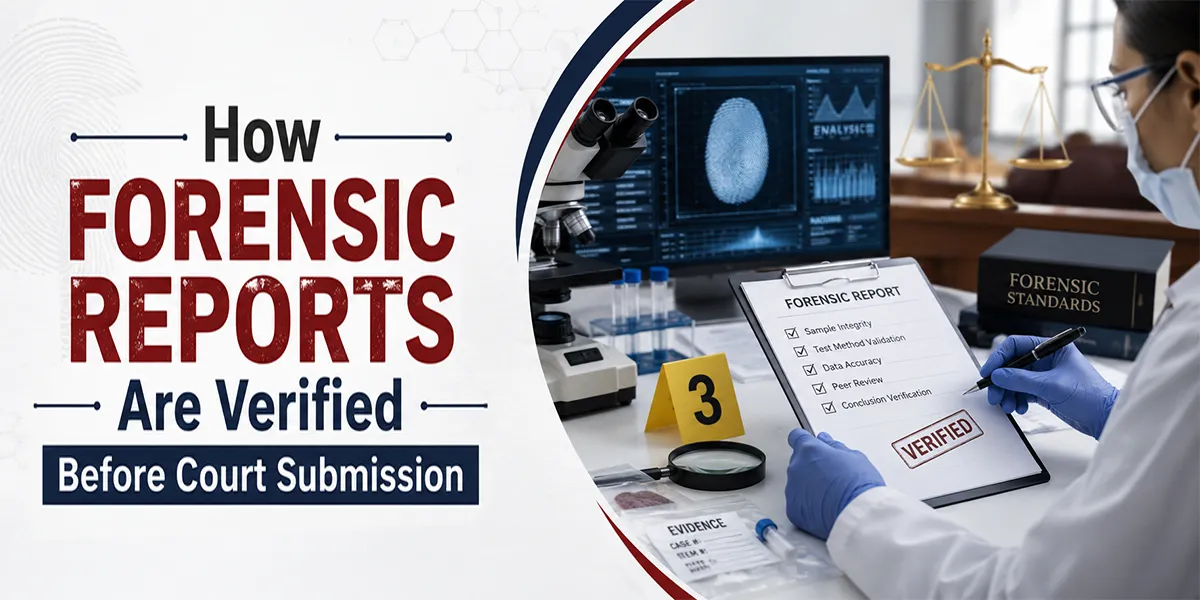
Let’s take a scenario: In a murder case, a criminal’s DNA is found at the crime scene, or a case of cybercrime is established by deleted files retrieved from a stolen laptop. No matter how irrefutable these science-backed findings may seem to us at first glance, we cannot make the cut and present them in front of the judge right away.
Every single report of this sort needs to be analyzed, verified, checked, and ensured for its error-free compilation. Just a simple error from scratch, in terms of a wrongly labeled sample, wrong equation calculation, or any unsupportable conclusion, can easily impact a judgment and a person’s entire life.
Hence, forensic laboratories follow strict quality assurance procedures before submitting a report to the court. This is not like the corporate world, where report submission is sometimes nothing more than a formality. Here, from a judicial perspective, the stakes are high, and it’s an essential safeguard that protects the integrity of the criminal justice system.
Importance of verification for the Indian judicial system
Eyewitnesses have their role, but the problem is that, in most cases, they didn’t witness the entire sequence of events. For connecting the dots of a crime, the role of forensic evidence becomes important due to its objective nature; courts often give weightage to forensic findings. Science is only reliable when the methods used are accurate, validated, and properly documented.
India has witnessed various cases where forensic evidence played a decisive role. At the same time, experts have also raised concerns like delays in forensic examinations, laboratory backlogs, shortage of trained personnel, and inconsistent quality standards across the nation.
The verification process makes sure that every forensic report answers some basic but crucial questions such as:
- Was the evidence properly collected and preserved?
- Were global standard scientific methods followed?
- Are the findings supported by laboratory data?
- Will another qualified expert independently be able to reach the same conclusions?
When these questions are addressed satisfactorily, only then can the report be considered ready for submission to the investigative agency and eventually to the court.
Step 1: Verifying the chain of custody
The verification process starts the moment evidence is gathered from the crime scene. Each step of evidence should be collected through a chain of custody. It means documenting who collected the evidence, when it was transferred, who the receiver is, where it was stored, and when it was examined.
Understand this with an example: blood samples collected during the murder investigation get accidentally mixed with samples from another case during transportation. In this scenario, even if the DNA analysis is technically correct, the result might end up losing its evidentiary value because the identity of a sample is no longer certain.
Both investigators and forensic laboratories meticulously verify these records before beginning scientific analysis.
Step 2: Examining the state of the evidence
Before starting the testing, forensic scientists verify or check whether the evidence has remained intact. Different types of evidence need different sorts of preservation methods, such as:
- Biological samples need to be protected from contamination and excessive heat.
- Firearms need to be secured for preservation of fingerprints and trace evidence.
- Devices like mobiles, laptops, and hard drives should be protected from unauthorized access or data alteration.
- Narcotic substances need to remain properly sealed.
Let’s say damaged packaging, broken seals, or signs of tampering are noticed; then observations should be recorded or documented immediately because they may affect the interpretation of results.
Step 3: Adhering to standard scientific procedures
For different types of examinations, government forensic laboratories in India follow written standard operating procedures (SOPs). Whether the forensic scientists are analyzing fingerprints, DNA, toxicology samples, ballistic evidence, questioned documents, or digital devices, all these need to be validated based on scientific methods instead of personal judgments.
The verification process includes:
- Whether or not approved laboratory procedures were followed
- Instrument property calibrated
- Chemicals and reagents were suitable for use
- Control samples produced expected results
- Observations were recorded accurately
Ensuring consistency while following standard procedures will reduce the possibility of human error.
Step 4: Technical review by another forensic expert
To be doubly sure and avoid the chances of any error or mistake, it is best to take another independent opinion. After the scientist completes their examination, another forensic expert reviews the entire case independently.
The reviewer examines:
- Photographs
- Laboratory worksheets
- Calculations
- Instrument-generated data
- Observations
- Conclusions
If any sort of inconsistency or unsupported opinion is found, then the report is returned for clarification or correction before it's finalized. This independent review eventually enhances the reliability of forensic reports submitted to the court.
Step 5: Making sure conclusions match the evidence
A high-quality forensic report is one that clearly states scientific observations, facts, and expert opinions. For instance, if DNA from a crime scene matches the suspect, then the report should explain:
- Which scientific method was utilized?
- What samples were examined?
- What reasonable conclusion can be drawn?
- What the laboratory results showed?
Let’s say that if evidence is insufficient to identify a suspect conclusively, then a report should clearly state that the findings are inconclusive instead of exaggerating the certainty of the result. Indian courts expect forensic scientists to provide objective scientific opinions instead of assumptions.
Step 6: Quality assurance and Laboratory Accreditation
Most Indian forensic labs get their accreditations from the National Accreditation Board for Testing and Calibration Laboratories (NABL). The standard used by NABL to issue accreditation is ISO/IEC 17025. Accredited labs use strict quality management systems, including:
- Methods validation
- Assessment of staff competence
- Regular equipment calibration
- Internal quality checks
- Participation in proficiency testing
- Documentation control
During this proficiency test, forensic professionals present the unknown samples to show their ability to produce consistent results.
Many forensic labs in India are not accredited by the NABL. But these labs provide accreditation as a mark of quality and credibility.
Step 7: Legal verification before court submission
Scientific rigor is fine, but this alone won’t be enough for a forensic lab.
The report needs to stand legal grounds as well: A Forensic report intended for use in court will typically contain:
- A detailed description of evidence received
- Methodology employed
- Results of testing and analysis
- Expert opinions
- Scientific observations
- Identification details of the case
- Formal certification from the laboratory
- Signatures of the expert personnel involved
- Date of examination.
Under the Bharatiya Sakshya Adhiniyam, 2023, the emphasis on the admissibility of scientific evidence and electronic records has grown tremendously.
Bharatiya Nagarik Suraksha Sanhita, 2023 encourages greater utilization of forensic investigation in serious offences, particularly those punishable with seven years or more of imprisonment.
Since forensic evidence becomes a core part of central criminal investigations, so does the role of properly verified reports, which is now a days become even more critical.
Step 8: Preparing for expert testimony
If you think that after submitting the forensic report, the work of a forensic scientist is over. Then this might be nothing more than a wrong assumption. The expert might be called by the courts to testify and explain the scientific findings.
During cross-examination, defence lawyers often question:
- The method utilized
- The chances of contamination
- Laboratory procedures
- Chain of custody and
- Interpretation of results
Due to this, every statement in the report needs to be backed by laboratory records and document scientific procedures. A thoroughly verified report lets forensic scientists confidently defend their conclusions.
Conclusion
A forensic report is more than a scientific document. It may essentially make or break justice. All forensic reports need to be confirmed with prior use of chain of custody tests, forensic evidence integrity tests, peer analysis, quality control, and scrutiny from legal professionals before introduction in court. It would mean these necessary protections are implemented. The goal is that forensic evidence is not simply to back prosecutions but rather to assist in discovering the reality, and a verified forensic science report remains an excellent methodology for realizing the same.