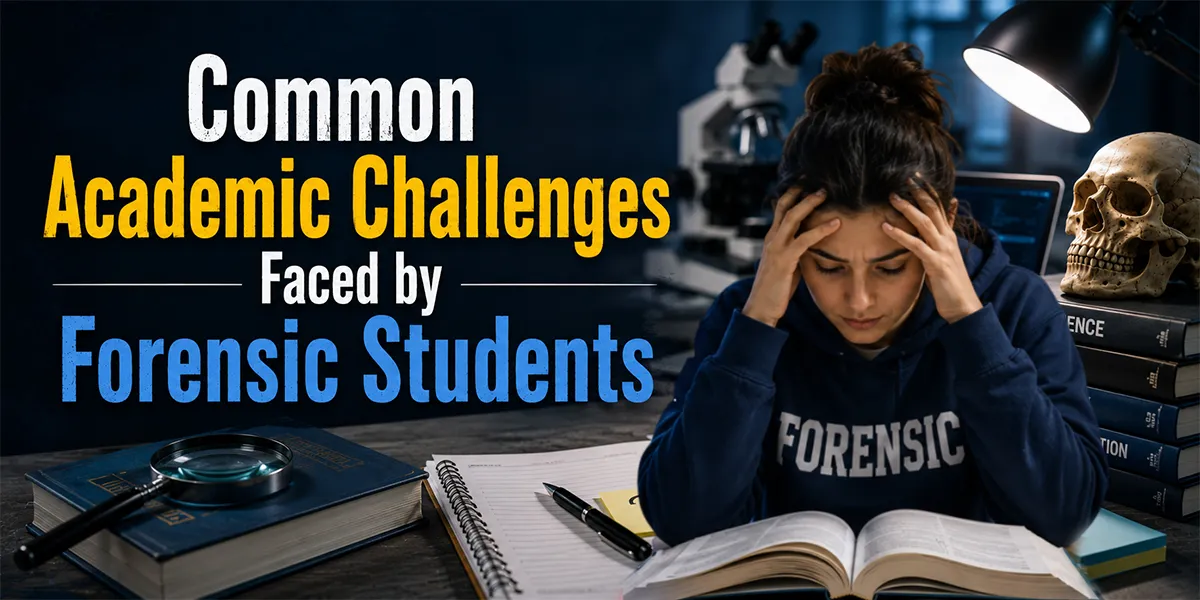
Most parents are surprised when their children say that forensic science is a hard subject. As a student, if you think the forensic course is just like any other subject, then think again. Are you aware of the fact that out of all the subjects, forensics is tough? Students in this program encounter challenges that students enrolled in a single-discipline degree do not.
The thing that makes forensics both interesting and challenging is that the course is based upon multiple subjects such as biology, chemistry, law, statistics, and laboratory technique. Based on this, the examiner is going to test the student on each module.
For example, a student who is very good with organic chemistry might find himself in difficulty when it comes to population genetics interpretation. Also, students who are doing well in DNA profiling methodology might struggle with trace-evidence statistics because they are counterintuitive.
So, what to do? Well, addressing the issue will pave the future path. That's why in this blog we will enlist major challenges faced by forensic students.
Major academic challenges faced by forensic students
1. Keeping up with curriculum
This is the major challenge faced by forensic students due to the interdisciplinary nature of the forensic science course. The framework, as such, demands that students have both knowledge and skills in the elements of biology, chemistry, law, toxicology, criminology, and psychology.
This interdisciplinary nature puts pressure on the students to balance out each subject and perform well in each aspect.
For example, a laboratory is necessary for mastering chemical analysis techniques, and critical thinking and theoretical knowledge are essential for understanding legal procedures.
Balancing or switching out between two scientific and legal concepts is very difficult and sometimes can be overwhelming, particularly for students who are stronger in one subject in comparison to another.
2. Lack of facilities and proper infrastructure
The crime rate is higher in India, but forensic laboratories are fewer. The scenario is such that in some states we have only one or two functional forensic laboratories, which are going to handle thousands of cases on a daily basis. Keeping the state aside, not every college or university has state-of-the-art laboratories on which students can learn and practice rigorously.
This situation, both at the college and national levels, results in fewer internship opportunities, restricted practical exposure, and limited access to real-world circumstances during their academic journey.
3. Lack of advancement among law enforcement agencies
Forensic science technology is evolving with each passing day, but the government and law enforcement still depend upon traditional investigating methods such as eyewitnesses, interrogations, etc. In some cases, forensic evidence is not properly collected, preserved, or used effectively.
This is due to a lack of awareness of how to deal with forensic evidence, and the best example of this is the early investigation by local law enforcement agencies in the Aarushi murder case.
Situations and circumstances like these will create dissatisfaction among both students and aspiring professionals who enter into the field where scientific expertise is not taken seriously or operated with a casual approach, since students and aspiring professionals have limited opportunities for the application of their knowledge.
4. Neglecting of emerging areas like digital forensics and cybercrime analysis
As per the Prime Minister's Digital India policy, India has witnessed a significant boost in online transactions. According to a report, India leads in real-time digital transaction payments. The UPI system of India processes approximately 49% of real-time payment transactions worldwide. And this situation brings us to the new challenges of digital theft and cybercrimes.
It is essential for a nation like India to have state-of-the-art cybersecurity and digital forensics investigative infrastructure. Unfortunately, that is not the case; the ground reality is a lot of forensic science courses still emphasize traditional disciplines such as toxicology, fingerprint analysis, and so on.
Even though a forensic science course will provide vast opportunities in the coming times due to the changing nature of crime, improper facilities, limited curriculum coverage, and a shortage of specialized instructors will leave the students in a state of uncertainty and confusion regarding their careers in the area of forensic science.
5. High-cost intensive
Modern infrastructure, facilities, tuition, and textbooks are a significant barrier for low-income students. And these financial constraints will force students to take on multiple jobs and work beyond the designated hours, which simply means overtime. Ultimately, students will not have much time to focus on studying.
Conclusion
Forensic science courses are of a multidisciplinary nature and are areas that demand a specialized study approach. If you are someone who wants to make a positive societal impact, then this could be the right choice for you.
To make a career in the field of forensic science, you need to invest in education and training, and for that, consider Lloyd Institute of Forensic Science courses:
- B.Sc. + M.Sc. Forensic Science.
- M.Sc. Forensic Science.
- Professional Diploma in Fingerprint Science.
- Professional Diploma in Document Examination.
When it comes to the best colleges for forensic science in India, the Lloyd Institute of Forensic Science will always be there due to the following:
- High-quality laboratories and infrastructure.
- Practical exposure to emerging fields of cybercrime investigation and digital forensics.
- Career placement and guidance support.
- Interdisciplinary approach.