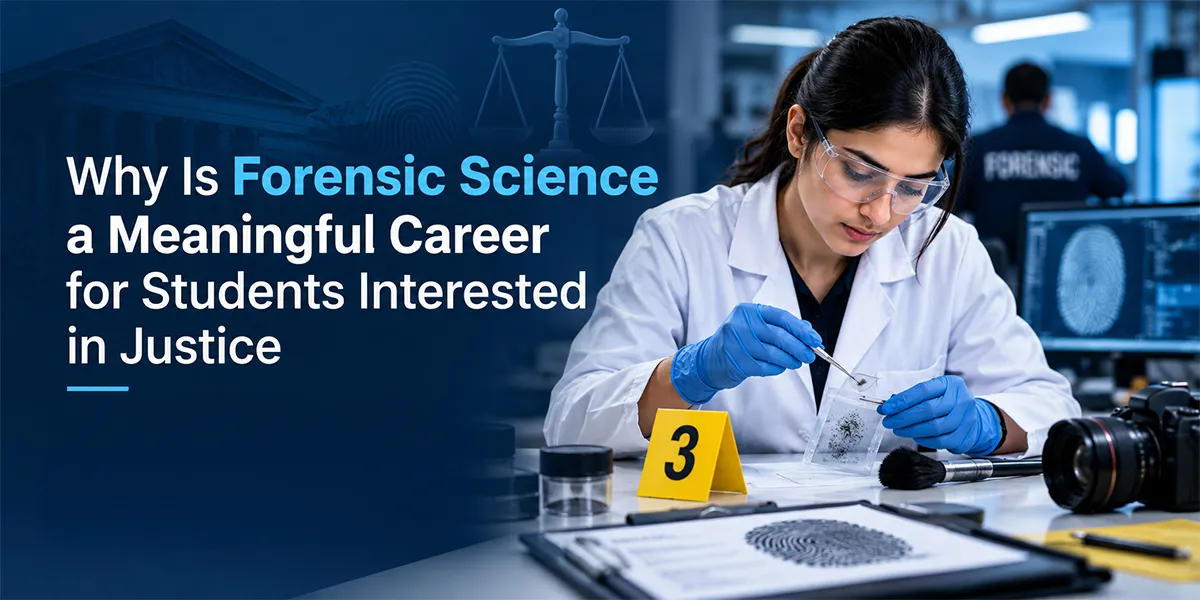
Justice depends on various factors like statements, eyewitness accounts, allegations, and so on. During criminal investigations, in many cases, it has been noticed that even minute details can help establish what actually happened, identify a suspect, or prevent an innocent person from being wrongly accused.
A DNA sample, fingerprint, or digital record retrieved from a crime scene can provide valuable information to investigators. And here the role of forensic science becomes important. For students who are interested in justice, criminal investigations, and scientific discovery, forensic science provides an opportunity to connect scientific knowledge with real-world legal challenges. Aside from being an engaging discipline, forensic science is a noble profession since it enables people to use their knowledge and skills to serve justice by investigating crimes, collecting relevant evidence, and ensuring that it is brought to light.
Important reasons why forensic science is a meaningful career for students
1. Connecting science with the pursuit of justice
The direct connection of forensic science with the justice system is one of its most interesting aspects. Forensic scientists help investigators in establishing the situation and the conditions under which a crime was committed by analyzing physical, biological, chemical, and digital evidence.
For example, with the help of DNA analysis, it can be established whether or not biological evidence belongs to a particular individual. Fingerprint examination helps in comparing impressions retrieved from a crime scene. Forensic toxicology can help in identifying substances in biological samples. Digital forensic scientists can investigate digital data, computer hardware, and computer systems to reveal data about cybercrimes or other offenses.
Scientific findings from these examinations can help investigators and agencies to analyze competing explanations of an event. Their duty is to carefully examine evidence, explain their findings precisely, and communicate scientific limitations without bias.
Students who believe that justice should be supported by facts instead of assumptions find that this combination of science and legal responsibility can make the profession highly rewarding.
2. Helping protect the innocent and identifying offenders
While a common perception of crime investigations is focused on capturing the suspect, in reality, the role of digital forensics is much broader. For instance, a thorough forensic investigation can identify errors committed by investigators, expose false claims, and reveal unreliable information.
Therefore, the role of the forensic sciences is indispensable, primarily due to their role in ensuring that investigations are accurate, thus minimizing the possibility of wrongful convictions, investigator mistakes, and unfounded allegations. However, such objectivity often requires a forensic scientist to engage in challenging endeavors, which demand high responsibility, precision, and impartiality, despite potentially contradicting the initial assumptions of the investigation.
3. Applying scientific knowledge to real-world problems
Students who don't prefer theory much but like lab experiments, scientific reasoning, and problem-solving will find the field of forensic science really fascinating. With this expertise, students can learn techniques in DNA profiling, microscopy, chromatography, chemical analysis, fingerprint examination, forensic biology, toxicology, and digital evidence.
For example, an unknown substance can be examined by a forensic chemist, whereas a forensic biologist might analyze biological material gathered during an investigation. A digital forensic analyst can, for instance, examine whether any digital data was falsified or analyze a particular computer hard drive to reveal information required to support an investigation by using an appropriate set of procedures.
Such processes require a significant amount of dedication, precision, and patience, as every piece of information must be scrutinized, evaluated, and processed.
For students who desire that their scientific education should have a practical purpose, forensic science provides a way to apply classroom knowledge to questions that matter beyond the laboratory.
Explore diverse career opportunities
Forensic science is not confined to one job role but includes several specializations; each one needs different scientific knowledge, practical skills, and educational preparation.
Some career pathways include:
- Forensic scientist
- Forensic biology or DNA analyst
- Fingerprint examiner
- Forensic toxicologist
- Digital forensic analyst
- Questioned document examiner
- Crime scene investigators
- Researcher or academic
Conclusion
Forensic science as a career is a viable option for students who are interested in justice because it places scientific reasoning at the service of truth-seeking and fair investigations. Ranging from DNA analysis and fingerprints to examining digital evidence, forensic professionals assist investigators and courts in understanding what the available evidence can establish.
Its greatest contribution lies not in producing sensational discoveries but in helping ensure that evidence is examined carefully, that conclusions are supported by the facts, and that the pursuit of justice remains grounded in scientific integrity.