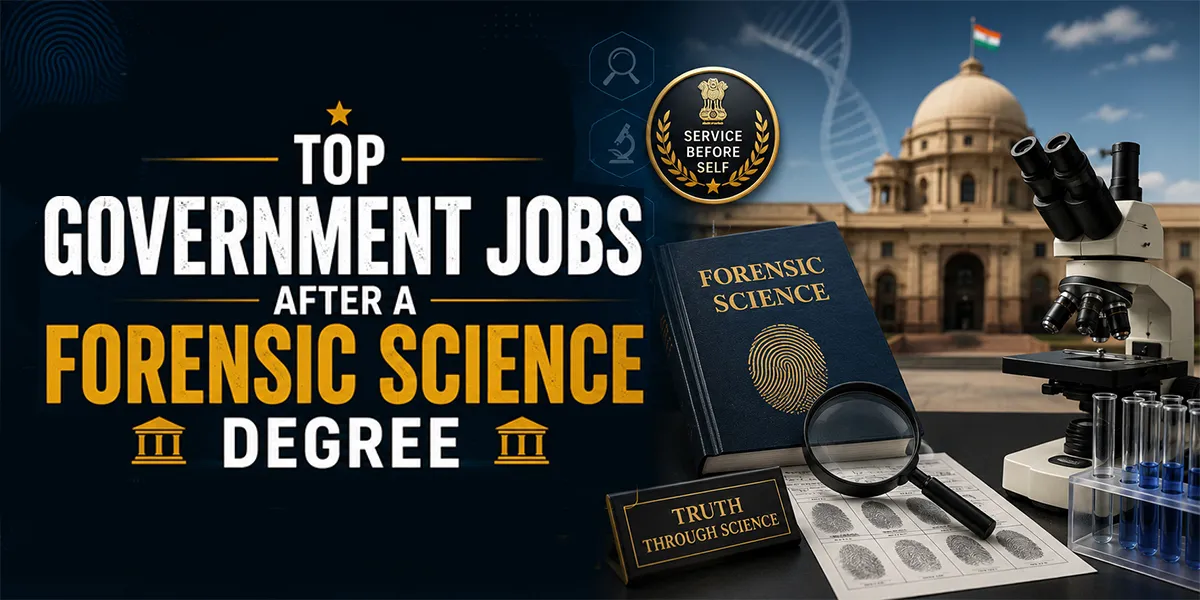
As long as humans exist on this planet, so does crime; crime always remains a part of human society, whether we like it or not. But now the criminal investigation has changed significantly; the criminal investigation process without a forensic professional cannot be imagined. It is regarded as a specialized area of science that equips professionals with scientific concepts and methods to analyze tangible evidence in criminal and judicial proceedings.
As a result, there is a wide variety of career options in forensic science. It is the sixth fastest-growing field in the world, according to a CNN Money article. There are numerous opportunities in crime investigation, judicial proceedings, and case solution when pursuing a M.Sc. in forensic science. The Bureau of Labor Statistics projects that by 2030, there will be a 16% increase in demand for forensic scientists. Top government positions following a degree in forensic science will be discussed in this article.
Widely sought government jobs after a forensic science degree
Scientific officer in forensic science laboratories (FSL)
This is one of the most sought-after government jobs to prepare for after a forensic science degree.
Job responsibilities
- Analyze physical, chemical, and biological evidence
- Scan fingerprints, DNA samples, firearms, and important documents
- Preparing forensic reports
- Appearing for expert testimony before courts
- Helping investigative agencies in solving criminal cases
Eligibility
- Having a bachelor's or master's degree in forensic science or a relevant specialization
- A lot of laboratories prefer candidates with postgraduate qualifications
- Recruitment drive takes place through either state public service commissions or direct government recruitment agencies.
Career growth
Scientific Assistant is promoted to a Scientific Officer, further promoted to Senior Scientific Officer, and then to Assistant Director.
Forensic Expert in the Central Bureau of Investigation (CBI)
The CBI needs forensic professionals for the diverse nature of investigations like corruption, financial crimes, cybercrimes, and organized crime.
Major responsibilities
- Examination of crime science
- Analysis of digital evidence
- Verification of documents
- Examination of fingerprints
- Analysis of DNA and biological evidence
Skills required
- Robust analytical skills
- Scientific report writing
- Knowledge of protocols related to evidence handling
- Knowledge of criminal procedures
A forensic professional gets exposure to high-profile investigations and advanced forensic technologies while working with CBI.
Central Forensic Science Laboratory (CFSL) scientist
The forensic scientists of CFSLs working under the Government of India have the responsibility of providing support to the national investigative agencies.
Departments include
- DNA
- Biology
- Chemistry
- Toxicology
- Ballistics
- Cyber forensics
- Questioned documents
- Fingerprints
- Physics
- Questioned documents
Responsibilities
- Examination of evidence based on scientific methods
- Laboratory research
- Technical consultations
- Appearances before courts
- Helping law enforcement agencies
Most of the times CFSs scientist work on cases of national importance.
Forensic scientists in the National Investigative Agency (NIA)
The NIA is responsible for the investigation of terrorism, organized crime syndicates, and offences affecting national security.
Forensic experts help by
- Conducting examinations of explosive residues
- Carrying out digital forensic investigations
- Analyzing mobile phones and computers
- Identification of DNA
- Reconstruction of the crime scene
The majority of professionals working for the NIA mainly deal with highly sensitive and nationally significant investigations.
Fingerprint expert
Fingerprint analysis remains one of the most reliable and trustworthy methods of scientific investigation.
Responsibilities
- Latent fingerprint collection
- Fingerprint record comparison
- Preparation of identification reports
- Helping law enforcement agencies
- Showcasing findings before court
The recruitment of fingerprint experts is done by:
- State police departments
- Fingerprint bureaus
- Forensic science laboratories
- Central investigative agencies
Candidates or graduates who are interested in pattern analysis and criminal identification find this career to be an ideal choice.
Cyber forensic expert
Due to an increase in cybercrimes every year, government agencies need to recruit trained cyber forensic professionals.
Responsibilities
- Recovery of deleted data
- Analysis of hacked systems
- Cyber fraud investigation
- Examination of digital devices
- Preserving electronic evidences
- Tracing of cybercriminal activities
Government employers include
- Cybercrime cells
- State police
- Intelligence agencies
- CBI
- CFSL
- NIA
Candidates or prospects who specialize in cyber forensics enjoy excellent career opportunities.
Forensic toxicologist
These are the professionals whose main responsibilities are drugs, alcohol, poison, or chemicals that contributed to death or crimes.
Responsibilities
- Testimony in courts
- Toxicology report preparation
- Identification of toxic substances
- Analysis of blood and urine samples
- Assist medico-legal investigations
The recruitment opportunities exist in:
- State forensic laboratories
- CFSL
- Medical colleges
- Government hospitals
DNA analyst
Criminal investigations have been transformed due to DNA analysis as it offers highly precise identification of victims and suspects.
Responsibilities
- Sample profiling
- DNA extraction
- Kinship testing
- Identification of unknown remains
- Biological evidence examination
DNA analysts work in:
- State FSLs
- Central FSLs
- Disaster victim identification teams
- Government medical institutions
Crime scene investigator (CSI)
These are the professionals whose main responsibility is to collect and preserve physical evidence before laboratory examination.
Job responsibilities
- Paying a visit to the crime scenes
- Photograph evidences
- Collecting biological samples
- Packaging exhibits properly
- Maintaining chain of custody
- Coordinating with police officers
State or government police departments increasingly recruit trained forensic graduates for CSI roles.
Forensic document examiner
When it comes to tracking forgery and fraud, document examination plays a vital role in it.
Job responsibilities
- Analysis of handwriting
- Verification of signatures
- Examination of ink and paper
- Detection of counterfeit currency
- Verification of passports
Available Recruitment opportunities
- Forensic laboratories
- Government investigation agencies
- Bank fraud investigation units
Salary Expectations
Government forensic science job salary varies depending on qualifications, department, and experience.
Approximate salary ranges include:
- Scientific Assistant: ₹35,000–₹55,000 per month
- Scientific Officer: ₹56,000–₹90,000 per month
- Senior Scientific Officer: ₹80,000–₹1,20,000+ per month
- Cyber Forensic Expert: ₹60,000–₹1,00,000 per month
- DNA Analyst: ₹50,000–₹90,000 per month
Additional benefits often include dearness allowance (DA), house rent allowance (HRA), travel allowances, medical benefits, and pension-related schemes where applicable.
Conclusion
A forensic science degree opens the door to various job opportunities in both government and private sectors. Due to high technological demand in criminal investigation, the role of forensic experts is increasing with each passing day. So, pursuing a career in forensic science programs could be the best choice you could make. And if you are looking for one of the best forensic science colleges in Delhi, then you should check out Lloyd Institute of Forensic Science, which provides both graduate, master's, and diploma programmes.