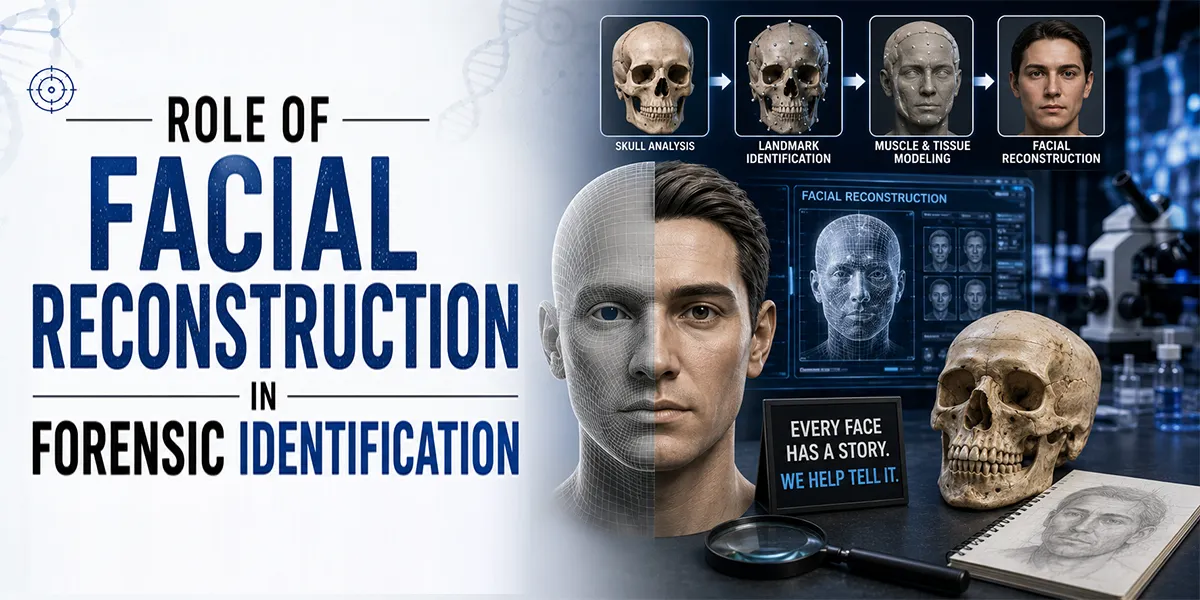
In her chapter on forensic human identification, Dr. Caroline Wilkinson provided the most clear explanation: “Facial reconstruction is a recognition tool for creating a list of names through which an individual may be identified with the aid of dental record analysis, DNA evaluation, or any other forensic technique. It is not a method of identification.”
In short, facial reconstruction is used to provide clues in unsolved or cold cases. A forensic scientist reconstructs a face from photos, which are created and provided to the appropriate law enforcement organizations for public display. The goal is for someone to identify the photograph as potentially belonging to a person they know from a close or social group. It is hoped that the individual would provide the investigating agency with important information. Following that, scientific forensic techniques such as tooth and DNA analysis might help the investigating agency carry out its investigation.
What are the different types of facial reconstruction techniques?
Due to the advancement in technology, such as medical imaging and computer technology over the years, forensic facial reconstruction has evolved significantly. Hence, these days forensic scientists deploy various techniques based on skull condition and available resources.
1. 2D (two-dimensional facial reconstruction)
This technique is one where forensic artists and forensic anthropologists work simultaneously on facial reconstruction based on the data from ante-mortem photographs and the skull that requires reconstruction. Karen Taylor first came up with this method during the 1980s in Austin, Texas. This method was utilized in the identification of the deceased from skeletal remains.
2. 3D (three-dimensional facial reconstruction)
Similar to the 2D facial reconstruction method, this one also requires the collective efforts of an artist and a forensic anthropologist. In this method, the skull is first constructed with the help of plaster or resin. The tissue depth markers are placed on particular anatomical landmarks, after which clay is added layer by layer to reconstruct facial muscles, skin, fat, and other aspects.
The best thing about this technique is that it provides a lifelike facial representation, helping investigators to appreciate facial contours from different angles. Unfortunately, working with clay is time-consuming, labor-intensive, and requires considerable artistic skills. Rebuilding parts from scratch required for any sort of modification.
3. Computer-aided three-dimensional reconstruction
With the introduction of computers, forensic science was revolutionized. For high-quality 3D reconstructions, modern software analyzes CT scans or laser-scanned skull models. Forensic scientists are able to perform facial reconstruction with accuracy and precision due to the digital addition of tissue thickness data.
Digital comparison offers various benefits in comparison to clay modelling:
- Easy modifications
- Quicker reconstruction
- Different variations
- Easily shareable among investigative agencies
- Non-destructive analysis
Due to these advantages, many forensic laboratories worldwide prefer to go with computer-assisted reconstruction.
4. Cone beam computer tomography (CBCT)
In the field of forensic science, it is one of the emerging technologies. Highly detailed 3D images can be obtained with the help of the cone beam computed tomography method. At the same time, in comparison to CT scans, the subject is exposed to significantly lower radiation. Its ability to capture precise craniofacial dimensions makes this technique stand out for assessing facial morphology and creating precise digital reconstructions. For both forensic odontology and facial reconstruction in forensic science, CBCT has become a valuable asset due to its high image resolution and affordability.
5. Laser surface scanning and Stereo photogrammetry
To record facial and skeletal structures with proper accuracy, forensic laboratories these days utilize stereo photogrammetry and laser surface scanning techniques. Without physically touching the fragile skeletal remains, these techniques can generate high-resolution three-dimensional surface models. Due to their non-invasive nature, they are a valuable asset for conducting archaeological investigations and cases involving damaged or fragile skulls.
Role of Artificial Intelligence in Facial Reconstruction
AI has revolutionized the field of forensic science. Thousands of craniofacial measurements can be analyzed with the help of machine learning, and accurate facial morphology can be predicted with increased consistency nowadays. With the help of AI-assisted software, one can estimate tissue thickness, generate realistic facial contours, improve symmetry, and one can even compare reconstructed faces against national missing person databases. In comparison to traditional construction techniques, AI also reduces reconstruction time as well.
But that doesn’t mean AI can replace forensic scientists. Human judgment remains the core irreplaceable aspect for interpreting anatomical variations, validating reconstructed images, and ensuring scientific accuracy.
Challenges and limitations of Facial Reconstruction
No matter how much technical progress has been made related to facial reconstruction or forensic science as a whole, there are still certain restrictions that are yet to be overcome.
While it is true skull can determine much of the face, but not determine everything, like:
- Wrinkles
- Bodyweight
- Hairstyle
- Facial hair
- Hair color
- Skin complexion
- Eye color
From the bone alone it’s difficult to determine features like these accurately. In fact, the nose, lips, and ears also needed a significant amount of estimation before reaching any conclusion. From the same skull, the two forensic artists can come up with slightly different but anatomically acceptable reconstructions.
Conclusion
Forensic facial reconstruction is an integral part of criminal investigation across the globe. Nowadays, due to the evolution of AI and machine learning, this process has become much smoother in comparison to manual ways of reconstruction. But ethical concerns should also be addressed to prevent misuse of this technique, especially in the Age of AI, where deep fakes or fake propaganda can be disseminated that can mislead the public; it should be avoided.
Showing reconstructed faces to the public can help identify victims, but in the case of deceased people, investigators need to ensure the dignity of their families as well.