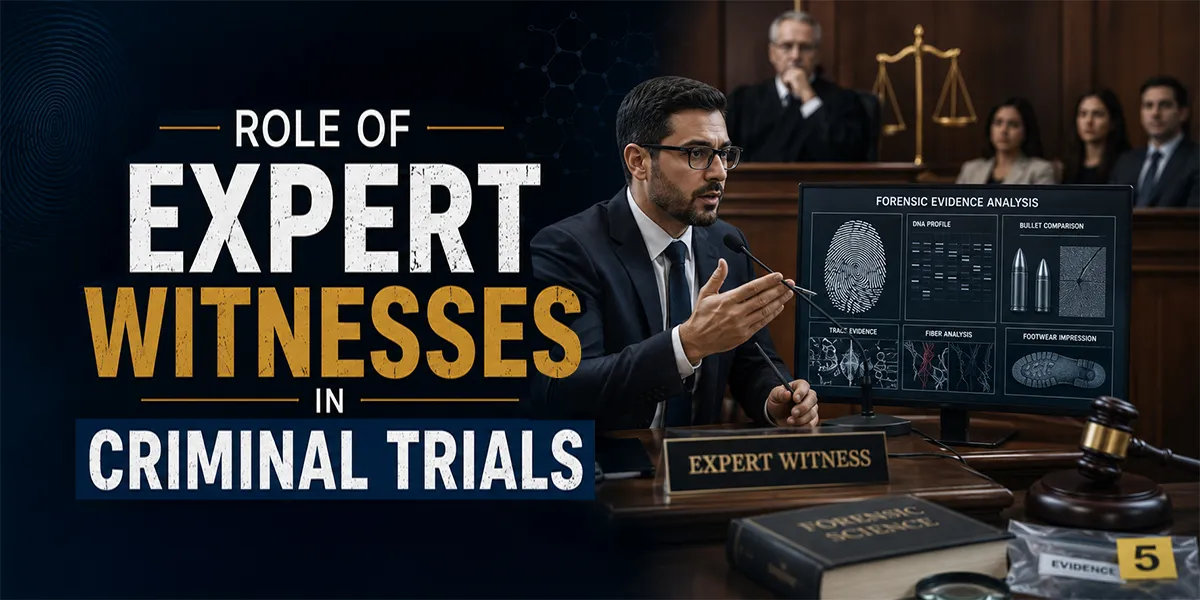
An expert witness plays a vital role in criminal trials by providing the knowledge and insights that can significantly affect the outcome of a case. In India, an expert witness is one of the most vulnerable parts of the legal process. More than the victim and the culprit, it is the witness whose life is at risk due to not having special protection laws like other nations.
What is an expert witness?
It can be defined as a professional who has specialized knowledge, skills, and experience in a particular field related to the case. Their expertise lets them offer opinions and interpretations that go beyond the common knowledge of the average person. Expert witnesses can be called upon during criminal trials for various purposes like clarifying complex issues, analyzing evidence, and providing other professional opinions that support a case.
Different types of expert witnesses in India
Due to evolution and advancement in technology, crime is becoming rapidly scientific and tech-driven; Indian courts rely upon experts from diverse disciplines to interpret evidence based on their specialized knowledge.
1. Forensic science experts
Experts examine physical evidence collected from crime scenes, comprising hair, blood, fibres, fingerprints, trace materials, weapons, and biological samples. Based on scientific techniques, experts try to establish a link between the victims, suspect, and crime scenes. Highly professional experts like these work in state or national forensic laboratories.
2. Medical experts
They are also called forensic medicine specialists; their roles are crucial role involving homicide, sexual offences, and suspicious deaths. These professionals carry out post-mortem analysis, assess injuries, calculate the time of death, and offer opinions regarding the cause and manner of death.
3. DNA experts
These experts work with biological evidence such as hair, tissue samples, blood, saliva, and semen. Scientific discoveries about these aid in the identification of criminals, their parentage, the identification of unidentified bodies, and the elimination of innocent suspects.
4. Fingerprint experts
Professional that compares latent fingerprints gathered from the crime scenes with known fingerprints of suspects. Every individual has unique fingerprints, so their analysis also offers valuable corroborative evidence.
5. Ballistic experts
Ballistic Professionals that examines firearms, bullets, cartridge cases, bullet residue, and determine whether the particular weapon used in a crime, calculate firing distance, and recreate shooting incidents.
6. Digital and cyber forensic experts
Due to an increase in electronic evidence and cybercrime, the role of digital forensic scientists has become significantly important. These experts examine smartphones, computers, CCTV footage, emails, social media records, as well as hard drives while ensuring the integrity of electronic evidence.
7. Toxicology experts
As given by the name, Toxicology experts, these professionals deal with poisonous substances, narcotics, chemicals, or alcohols in biological samples. Testimony of these experts is important in cases related to poisoning, drug offences, cases involving intoxication, and suspicious deaths.
8. Handwriting and document experts
Professionals whose job is to examine handwriting, disputed signatures, printed documents, forged certificates, counterfeit currency, and altered documents. Opinions of these experts help in cases related to fraud, forgery, and financial crimes.
9. Psychiatry and psychology experts
Psychiatrists and psychologists are kind of professionals who will determine the mental condition of an accused person, whether he/she is fit to stand trial, assess criminal responsibility, and examine the psychological condition of victims in appropriate cases.
10. Financial and Accounting experts
Professionals who deal with economic offences or financial crimes like money laundering, bank fraud, tax evasion, and corporate crimes, forensic accountants. The financial experts who analyze audit reports, financial records, and transaction trails to help investigative agencies and courts.
Conclusion
In today’s system of criminal justice, science is the defining factor that turns suspect into concrete fact. It is, however, not capable of providing all the answers; that work falls upon the expert witness. This person, combining expertise with scientific rigor, can then help courts make sense of baffling evidence, critically challenge the investigation itself, and base a sound judgment upon sound fact, their opinion guiding, not substituting, the judge.