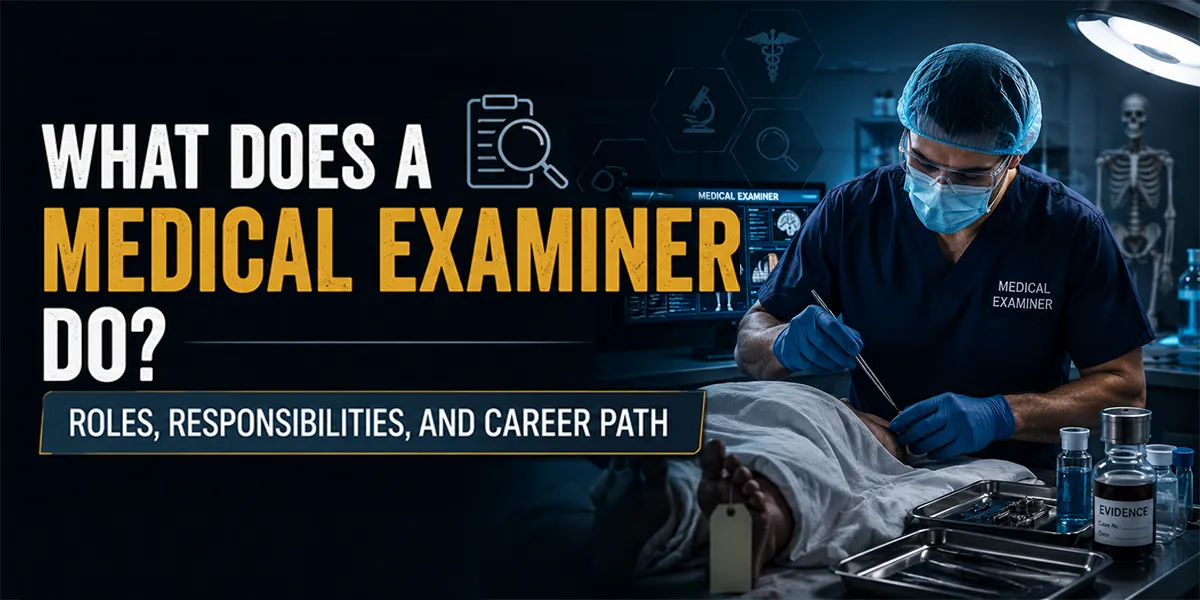
When the death is sudden, accidental, brutal, or remains mysterious and unexplained, this is the time when a physician steps in to conclude exactly what happened. Their insights and findings can resolve a financial dispute, close a criminal case, or provide relief to the grieving family by bringing closure.
Numerous aspiring forensic professionals today mistake medical examiners for coroners or crime scene investigators. However, they are unaware that the roles are not interchangeable. A licensed physician is a professional medical examiner who has undergone years of specialized medical training, not an elected official or a scene technician.
This article will guide you through what medical examiners really do, their roles and responsibilities, and their career path.
Critical responsibilities and roles of a medical examiner
The roles and responsibilities of a medical examiner can vary widely depending on the jurisdiction and the regulations governing death investigation in that area. Let's take a look at some of the important roles and responsibilities of a medical examiner:
1. Conducting autopsies
Carrying out autopsies is considered to be one of the principal duties of a medical examiner. This process involves thorough examination of the body to find out:
- Diseases
- Internal injuries
- Poisoning
- Hidden medical condition
- Signs of trauma
- Organ damage
Facts and findings that cannot be revealed by external examination alone; autopsies can reveal those as well.
2. Examining crime scene evidence
Do you know why medical examiners pay frequent visits to the crime scene, especially in homicide or mysterious death cases?
The reasons were as follows:
- Body positions
- Patterns of the blood
- Environmental conditions
- Visible injuries
- Any signs of struggle
- Possible weapons
Their observations proven beneficial for investigators during the process of reconstructing the events which leads to the cause of the death.
3. Determine cause and manner of the death
Medical examiners should try to differentiate between cause and manner of death. The cause of death refers to the scientific conclusion of how the person died; it could be from a gunshot wound, poison, or heart attack. Whereas the manner of death can be defined as the way of the individual's demise; it can be:
- Natural
- Accidental
- Suicidal
- Homicidal
- Undetermined
Legal and medical records need to know how a person might have passed away.
4. Document findings
It is still true that comprehensive medico-legal reports are included at the end of every medical report.
These reports generally comprise:
- Cause of death
- Laboratory reports or results
- Manner of death
- Supporting findings or observations
- Medical history
- Internal examination findings
- External examination findings
These documents act as an official legal document which can be reviewed during judicial proceedings.
5. Expert testimony
Medical examiners are typically called as expert witnesses in court. They could break down complex medical findings into simple language and explain them before the court. So that the court could understand:
- Cause of death
- Nature of injuries
- Timing of injuries
- Whether injuries were self-inflicted or brought on by someone else
- Medical evidence to support investigation
Expert testimony can significantly impact the result of the civil and criminal cases.
Educational qualifications and career path
The journey to become a medical examiner is really long in comparison to any other path in medicine. Here is the breakdown of the journey in simple steps:
1. Completing graduation
Without being a qualified physician, you cannot become a professional medical examiner or forensic pathologist. It implies that you must graduate from an acknowledged university or college with a medical degree. Doing so will take you around 4 years because that is how much a bachelor's program will take. Students can earn a bachelor's degree in four ways: regular, part-time, and distance modes. Students are free to pick any option as per their convenience. To get admission into forensics, the student needs to meet the basic eligibility criteria prescribed by the institute in which they want to take admission.
Eligibility required
Candidates need to pass 10th or 12th with a science background from a recognized board with 50% aggregate marks.
Bachelor's subjects
During your graduation, you will be studying various subjects such as:
- Forensic medicine
- Biology
- Chemistry
- Neuroscience
- Physiology
- Toxicology
- Infectious diseases
- Anatomy, etc.
2. Residency and practical training
To get practical or hands-on experience, you need to apply for residency programs or internships in a reputed organization where doctors learn various things:
- Carrying out autopsies
- Interpret laboratory results or findings
- Prepare medico-legal reports under expert supervision
3. Certification and licensing
Based on the nation, additional licensing or board certification in forensic pathology is still needed before an individual can practice independently as a medical examiner.
4. Get a master's degree
For better salary packages and opportunities, students can also pursue a master's degree in their respective courses. Once you finish a post-graduation course from a recognized institute, there are increased chances of you getting hired by well-known institutes across India. Students must fulfill the following requirements to be admitted to a master's program:
Eligibility criteria
- Passing the science stream in the tenth or twelfth grade with a minimum of 50% of the possible points from an accredited board.
- Also need to have passed their undergraduate program from a recognized university with at least 50% marks.
Conclusion
There is no substitute for a medical examiner in both the legal and medical fields. That's why, due to the evolution of forensic science, the demand for medical examiners is only going to rise in the coming times. But to become one, it requires dedication, advanced medical training, and commitment to lifelong learning. And if you are thinking of pursuing a course in this field, then check one of the best forensic science colleges in Delhi, Lloyd Institute of Forensic Sciences.