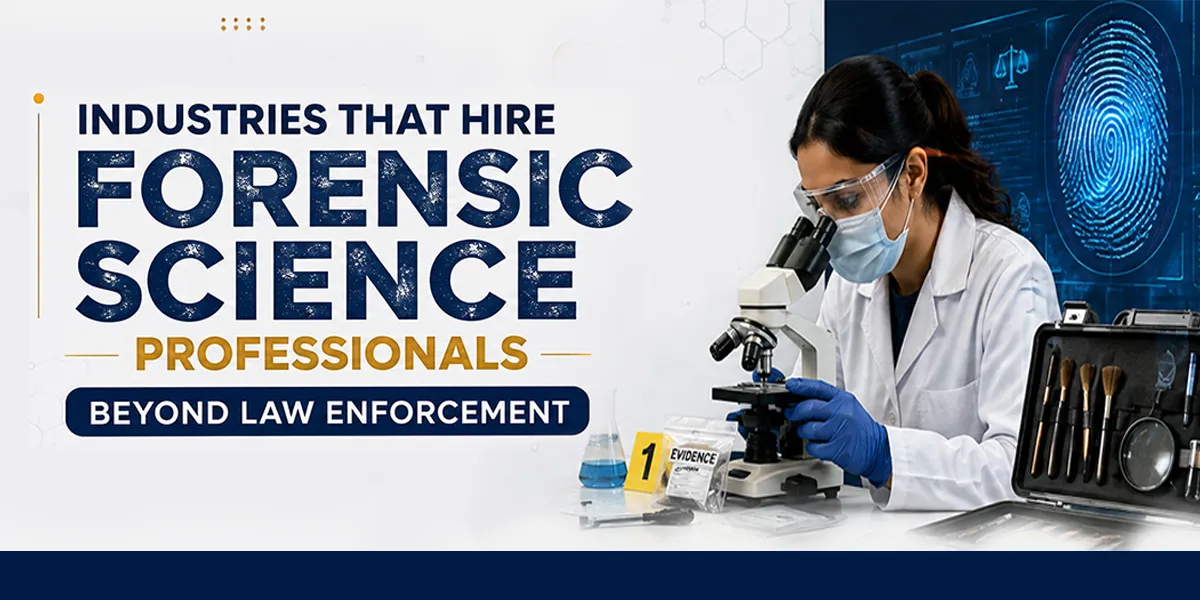
Most people commonly misunderstand forensic science as a field with career opportunities limited to police investigations and crime scenes. The fact is, it's the wider area that provides support to the judiciary with the help of evidence-based examination. Whether it is DNA analysis or digital data recovery, the main objective of forensic science is to find the answer to the question: What really happened?
Over time, technological advancements have changed the way crimes are investigated. The guesswork has been replaced by DNA analysis, legal credibility has been gained through fingerprint analysis, and cybercrimes have given rise to digital forensics. Forensic science careers now come in new roles that go far beyond traditional lab work, all because of these developments.
Hence, in this blog, we will highlight the industries that have long-term growth in the area of forensic science.
Forensic science professionals who go beyond law enforcement
While the true crime scene or law enforcement is the major area for the deployment of forensic science professionals, most of the forensic work remains hidden from public view. But there are areas of investigation where forensic science professionals can look for opportunities beyond law enforcement, such as:
1. Forensic toxicology professionals
A type of forensic toxicology professional whose main job responsibilities are the examination of blood, tissue, and other biological samples. The objective is to find out whether or not there is the presence of drugs, alcohol, or toxic substances are there. Forensic toxicologists help investigators to find out whether or not chemicals played any role in the crime, accident, or mysterious death. Careful understanding of laboratory work and an in-depth understanding of how a particular chemical reacts or responds to the human body.
2. Digital and cyber forensic experts
A rise in crimes that involve technology has made the role of digital forensic professionals really important for the examination of electronic evidence. Their main responsibility is to recover deleted and hidden data, track online activity, and carry out examinations on digital devices utilized in cybercrime and corporate investigations. They provide crucial support to legal cases where digital data becomes vital evidence.
3. Forensic psychology specialists
A category of professionals that specializes in the human aspect of crime. You might ask how? Well, it's by doing research or studying their behavioral patterns and psychological traits and assisting investigators to grasp motives, decision-making, and risk factors. For both legal proceedings and long-term investigation planning, their assessments become highly crucial. Read more about a career in forensic psychology.
4. Forensic research scientist
Research scientists are the type of forensic professionals whose major work is not known to the public, as they work behind the scenes and enhance forensic techniques. They come up with improved methods of testing, tools, and precision in forensic analysis. Across laboratories and courts, their works strength the evidence reliability.
5. Private forensic laboratory analyst
A category of forensic professionals that likes to functions with independent laboratories, insurance firms, and law firms. They specialize in evidence handling outside the jurisdiction of government settings, which reflects the rise in demand for forensic career opportunities or roles in the private sector.
Conclusion
Thanks to technological advancements, forensic science has outgrown from its conventional identity of limiting its role to law enforcement agencies and criminal investigation. Nowadays, it's more of a dynamic and interdisciplinary career that provides support to business, healthcare providers, financial institutions, tech firms, research organizations, and so on.
Due to increasing dependence of industries on scientific evidence, digital security, quality assurance, and regulatory compliance, the role of forensic professionals will continue to expand. This means the graduates will have the freedom to pursue more flexible careers, diverse specialization options, and opportunities to contribute to fixing real-world problems in both public and private sectors.
In any case, if you are seeking a career in forensic science, then studying at the best institution is essential. When it comes to that, checking out Lloyd Institute of Forensic Sciences, one of the best forensic science colleges in Delhi NCR, should be top of your checklist. It offers all three types of graduate, master's, and diploma programs.