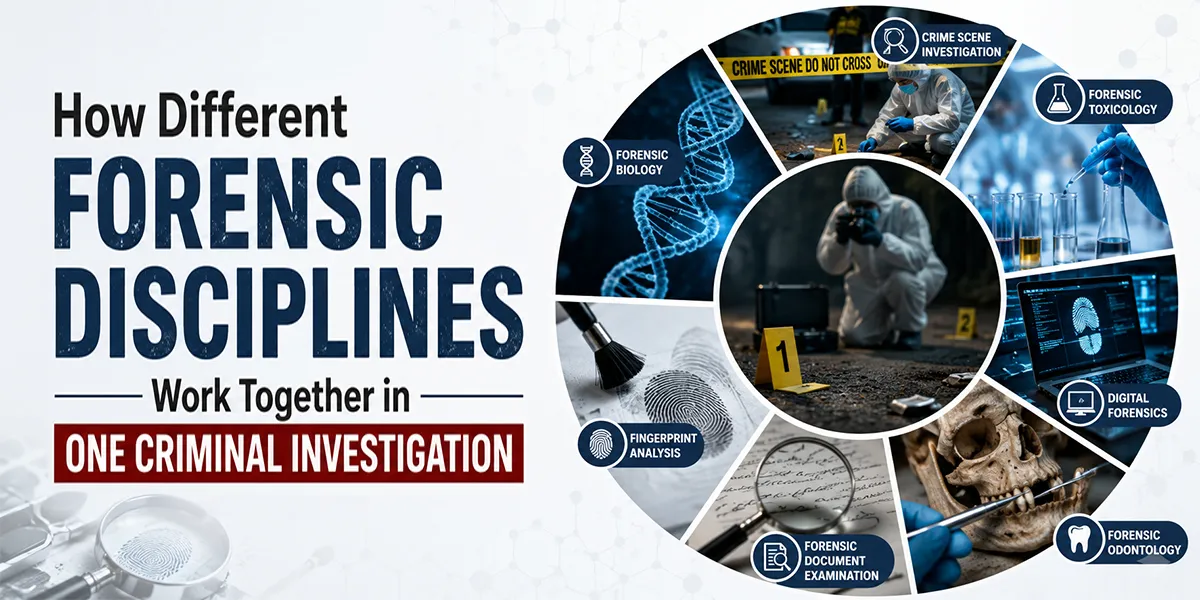
What comes to mind when seeing a crime scene? Most people imagine a criminal investigation like some forensic expert running after fingerprints or DNA and police creating a special zone for the preservation of the crime scene. Because these are the things people have generally watched in crime dramas. But the truth is, the investigation is really far more complex; there is no single forensic discipline or expert that can solve the entire case on its own.
Different crime scenes tell a different story whose pieces are scattered across fingerprints, blood stains, digital devices, bullet casings, skeletal remains, toxic substances, and countless other forms of evidence. To solve a puzzle, forensic scientists from different specializations must bring the pieces together and present a clear picture.
After that, they collaborate with law enforcement agencies so that investigators can reconstruct the sequence of events and evidence to find out what exactly happened, who was involved or the main conspirators, and can present reliable scientific evidence in court.
In simple terms, you can say that forensic science resembles a multidisciplinary orchestra where each instrument requires its specialist to perform in complete harmony. So that true justice can be achieved.
Different types of forensic disciplines
Now, let’s see different types of forensic disciplines and how they work together in harmony to solve a case:
1. DNA profiling
People don’t realize how effective DNA analysis in forensic science is for solving crimes; thanks to recent developments, even cold cases are getting solved. Are you aware of how important DNA is for solving a case? Investigators collect any biological evidence they find from the crime scene, such as:
- Sweat
- Saliva
- Hair
- Tiny bit of tissue
- Semen
- Skin cells
- Blood
Frankly speaking, forensic investigators don’t need much—only a few traces of skin cells on a doorknob—and the culprit will be behind bars.
DNA is so important for criminal investigations that even a small piece of it can help investigators in multiple ways:
- Helps in identifying the suspect
- Clearing the name of someone who was falsely accused
- Helps in identification of a culprit who cannot be identified visually
- Solves a sequence of crimes committed by the same individual
The best example is the high-profile Golden State Killer case, which remains unsolved and has gone cold for many years. But when the old DNA evidence matched with genealogy databases ultimately identified the culprit decades later. That much DNA technology has evolved.
2. Fingerprint analysis
They say old is gold, and the same could be true with fingerprint technology. This technology remains one of the most reliable techniques out there. As a matter of fact, not even twins have the same fingerprints, which is fascinating when you think about it. Collecting a fingerprint of the suspect from the crime scene and matching it with other fingerprints found at the crime scene might seem easy, but the truth is it’s not.
Process through which investigators gather fingerprints:
- Chemical developers
- Powders
- Digital scans
- Lasers
All these prints are cross-checked with national databases to look for a match.
Want to know what these fingerprints tell us?
These fingerprints help investigators in various ways:
- Who wielded the weapon or handled the objects?
- Helps in establishing the identity of unknown deceased individuals
- Helps in identifying the presence of a suspect at the crime scene
You will not believe that even a half print can sometimes prove lethal enough to solve an entire case.
3. Ballistics and firearm examination
It simply means dealing with the science of weapon crime that involves the use of weapons; for them, there are forensic scientists specialized in ballistics. Their main role is to find out tiny, unique marks a gun leaves on each bullet when it fires, almost like a fingerprint but for firearms.
The ballistic experts examine the following things:
- Entry and exit wounds
- Cartridge casings
- Gunshot residue on a suspect
- Bullet striations
And also, answer the question of how much distance there was between the shooter and victim; why does this question matter? Well, for the following reasons:
- Helping to identify the type of gun that was used
- Establishing whether or not the recovered gun was the one that was actually used
- Whether or not bullets from the different scenes matched
- Establishing the position and angle of a shooter
For solving a crime that involves the use of weapons, answers to all these sorts of questions help the investigators a lot.
4. Digital forensics
Some of the most potent clues come from the reality that we live in a tech-driven or digital world. These days, criminals leave behind just as many digital clues—in some cases, perhaps more—than physical evidence.
For the collection of digital evidence, the experts look at:
- Browsing history
- Deleted files
- GPS data
- Cloud backups
- Social media messages
- Laptops
- Phones
- Conversations via email
How does digital evidence help investigators? The digital clues help investigators in the following ways:
- Recovery of deleted messages
- Finding out someone’s location
- Discovering hidden transactions
- Narrowing down trafficking networks
- Unveiling fraud or hacking
Since in this modern digital age, the utilization of digital devices has increased, so have digital crimes, and that’s why the role of forensics in digital science becomes so crucial these days.
5. Forensic psychology
It is not necessary that every case gets solved by physical clues or evidence. Sometimes psychological clues are the ones that crack the cases. Hence, forensic psychology deals with the study of human behavior and tries to answer the “why” behind the crimes.
Ways it helps in solving cases:
- Finding out the motives
- Getting the interview of traumatized victims to obtain vital information
- With the help of predictive analysis, assessing whether someone may commit the crime again or not
- Deciding on whether someone is mentally fit for trial or not
- Profiling serial offenders
Forensic psychology deals with emotional and mental context that physical evidence cannot always provide.
6. Forensic pathology
When someone dies in suspicious circumstances, the role of forensic pathologists becomes important. Their main role is to examine the body and try to find answers hidden behind the surface.
Forensic pathologists find out these things:
- Cause of death (overdose, drowning, poison, etc.)
- Time of death
- Manner of death
- If there were signs of struggle
- Whether injuries were before or after death
Answers to these questions can change the direction of investigation fundamentally.
7. Forensic anthropology
When the body is decomposed, or it's not easy to determine it by normal means, for cases like these, the role of a forensic anthropologist becomes important. These are the professionals who analyze the skeleton and determine:
- Height
- Sex
- Age
- Origins
- Time since death
- Old injuries
Utilized in:
- War crimes
- Mass fatality events
- Old homicides
- Natural disasters
Establishing identity and bringing closure to cases that have been gone cold for a long time.
8. Forensic odontology
When the teeth tell a story, because teeth are really incredible; they can resist disaster, decomposition, and fire.
Forensic odontologists analyze:
- Tooth alignment
- Jaw structure
- Bite marks
- Dental pattern
Utilized for:
- Establishing identity of badly damaged bodies
- Connecting suspects to bite marks
- Sometimes dental records are the only way to identify victims.
- Confirmation regarding abuse cases
Some other forensic disciplines
Apart from the above-mentioned, there are some other forensic disciplines as well that work together in criminal investigation, such as:
- Toxicology
- Forensic entomology
- Trace evidence
- Handwriting and document examination
- Crime scene reconstruction
- Cybercrime and network forensics, etc.
Conclusion
Forensic science is not about a single expert solving the entire mystery just as we watch in crime dramas. It’s much more than that for a single case; forensic scientists of different specializations collaborate together and help investigators analyze the case from different angles or perspectives. Try to fit pieces of a jigsaw puzzle where every forensic discipline contributes one part of the picture.