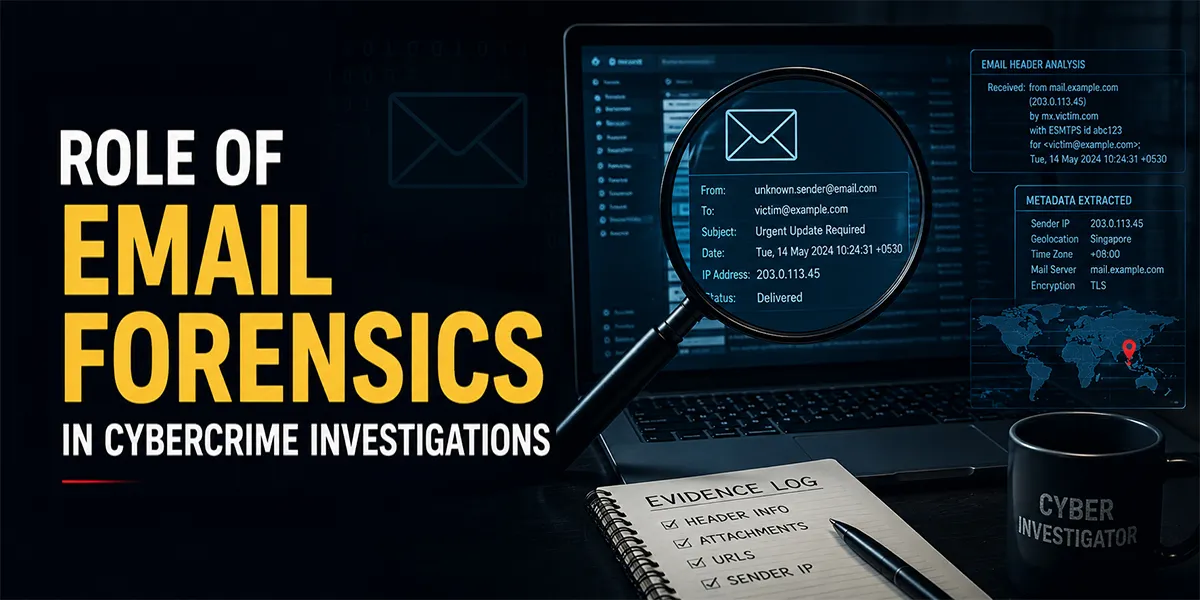
Email today is one of the primary forms of communication that civilians, corporations, and almost every sector utilize. It is the quickest and most convenient way to share information. But this common usage has also made it a prime target for cybercriminals and terrorists, and this has led to email forensics being an extended aspect of digital forensics investigations.
What is email forensics?
Unlike simply reading the content of the email, email forensics is much more than that. The email security process in which an email communication’s evidence is extracted, secured, analyzed, and archived is called an email forensic examination. A forensic scientist scrutinizes each and every technical detail related to emails, such as the email header, the date and time of the email, metadata associated with the email, the IP addresses, the email server log records, and the file attachments.
The main objectives that email forensics seeks to achieve are to address the following core questions to aid an investigation.
- Who exactly is sending the email?
- Was the email sender’s identity real or spoofed?
- Have emails been altered after sending?
- Which servers handled email transit?
- Did emails carry malware files or malicious links?
- Could the sender's location and device be determined?
Why is email forensics important?
Cybercriminals extensively use email due to its ability to reach millions of people within a few minutes. As per global cybersecurity reports, phishing continues to be one of the leading causes of cyberattacks worldwide, with millions of fraudulent emails being sent every day.
The rapid increase in the volume of online transactions in India (owing to digital banking, e-business, and e-governance) has accelerated threats of cyberattacks involving email. The attacker typically assumes the persona of a reliable institution to dupe innocent targets of confidential information – he would either pose as the owner of a well-reputed organization, the management of any given company, or of government offices, or that of a bank. Email forensic tools enable the security team to accurately distinguish legitimate emails from fraudulent emails.
How does email forensics work?
Now let’s understand the functioning of email forensics step by step:
1. Gathering and preservation
It’s the first step in securing email evidence without altering or tampering with it. The investigators obtain information through the following ways:
- User mailbox data
- Network logs
- Email client records
- Backup copies
- Mail server logs
- Original email files
It is important to maintain the integrity of the evidence because even minor alterations or errors can affect its admissibility in court.
2. Email header analysis
Many people aren’t aware that every email contains technical information called an email header. Users mainly see the sender, recipient, subject, and message body without realizing that the header contains valuable digital forensic evidence.
Investigators analyze:
- Domain information
- Date and time stamps
- Message ID
- Authentication records
- Sender IP address
- Message routing paths
- Receiving mail servers
From the analysis of the header, it can be confirmed whether the email genuinely originated from the claimed sender or it was spoofed.
3. Metadata examination
The metadata offers additional information regarding the email that includes:
- Delivery timestamps
- Email client used
- Character encoding
- Modification time
- Creation time
No matter how meticulously a cybercriminal tries to manipulate the visible content, metadata can expose the inconsistencies.
4. Attachment and malware analysis
A lot of cyberattacks are done through malicious hyperlinks or infected attachments. The forensic scientist analyzes the following:
- Zip archives
- Embedded scripts
- Hyperlinks
- Executable files
- Microsoft Office documents
- PDF files
Specialized tools help us in finding out whether an attachment contains ransomware, malware, spyware, or phishing payloads.
5. Authentic verification
The modern email system utilizes security protocols such as:
- SPF (Sender Policy Framework)
- DKIM (Domain Keys Identified Mail)
- DMARC (Domain-based Message Authentication, Reporting, and Conformance)
Investigators use these authentication methods to determine whether an email is fake or counterfeit.
Different types of tools used in email forensics
The digital forensic investigators utilize a wide range of tools for the investigation of email evidence, such as:
- Magnet AXIOM
- Autopsy
- X-Ways Forensics
- Mail Examiner
- FTK (forensic toolkit)
- Encase forensic
All of these tools help the investigators in various tasks like recovery of deleted emails, analyzing mailbox files, analyzing headers, obtaining metadata, and generating detailed forensic reports.
Legal importance of forensics in India
Electronic evidence, which also involves emails, plays an essential role in Indian judicial proceedings.
The Information Technology Act, 2000 states the legal framework for investigations regarding cyber offences, whereas Bharatiya Sakshya Adhiniyam, 2023 considers electronic records as admissible evidence, subject to compliance with the prescribed legal requirements. Proper preservation of electronic records and maintenance of the chain of custody are vital to ensuring their court reliability.
Some of the different agencies that investigate cybercrimes in India are as follows:
- State Cybercrime Police Stations
- Indian Cybercrime Coordination Centre (14C)
- Central Bureau of Investigation (CBI)
- Digital Forensic Laboratories
- CERT-In (Indian Computer Emergency Response Team)
Investigations by these agencies based on forensic examination of email communications.
Challenges in Email Forensics
Even with a lot of technological advancements these days, email forensic investigations tend to face various challenges:
1. Email spoofing
This is the method in which sender information is used by criminals as a disguise to make fraudulent emails seem as real as possible.
2. Encryption
This makes it difficult for investigators to access message content or information without authorization.
3. Cloud-based email services
Since a lot of people use cloud-based services these days, the data gets stored across multiple international servers, which creates a lot of jurisdictional challenges.
4. Deleted mails
Most often, cyber criminals erase an email post committing a crime and, in this regard, an email forensic examiner is in the process of recovering the delete mails from their designated place with high-end techniques.
5. Use of VPN and proxy servers
A VPN server offers services that mask the IP address to hide the origin of a cyber attack by the cybercriminal.
6. Always changing the methodology of attacks
The cyber criminals are very intelligent in terms of developing innovative ways of phishing emails, and that in turn asks an email forensic investigator to keep himself updated.
Email safety tips
Having been established that email forensics works well, a person also knows that an ounce of prevention is better than a pound of cure; therefore, let's follow the email security tips which will prove beneficial in order to reduce the chances of suffering through cyberattacks through email.
- Activate multi-factor authentication.
- Before responding, verify or double-check the suspicious email addresses.
- If you see any suspicious link or attachment, it's best not to open it; avoid it at any cost.
- Keep email software updated.
- Make use of spam filtering and email authentication protocols.
- Carry out cybersecurity awareness training for employees on a regular basis.
- Secure backups of important communications should be maintained properly.
All these measures will decrease the chances of email-based cyberattacks.
Conclusion
In the coming times, technology is going to evolve even more and make our already existing digital world more complex. This will automatically make the role of email forensics vital within digital forensics, which offers essential services in analyzing, recovering, and reporting email evidence for legal and investigative purposes. Also, to combat cyber threats, legal disputes, or protect sensitive information government across the globe will go on to enact cybersecurity regulations as per the requirements of their respective nation.