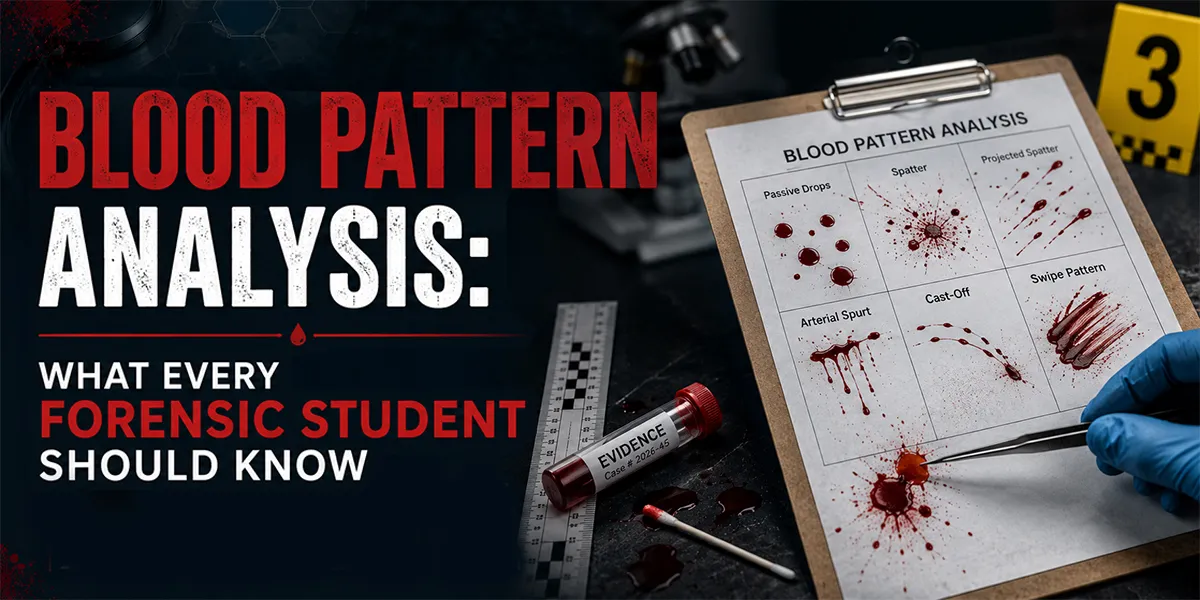
Do you know who the best friend of detectives and investigators is? It's forensic science, which helps in solving cases or crime and provides justice to the grieving families. One interesting aspect of forensic science is blood pattern analysis.
It's an interesting combination of physics, biology, and detective skills that allows us to decode how the events unfold at a crime scene. In this blog, we will explain blood pattern analysis and its importance in the real world for forensic students.
What is blood pattern analysis?
Consider it as being like a blood detective. Blood pattern analysis is a kind of scientific examination in which the shape, size, distribution, and location of blood stains are used to describe the events that caused them. The objective of BPA is not only to find out whose blood it is but also to determine facts like:
- The cause behind bloodshed
- What is the type of force behind the bloodstains
- Finding out the position of attacker and victim
- Sequence of movements that occur during or after the incident
- Was the crime scene fabricated or disturbed
For the reconstruction of the events that occurred at the crime scene, the blood pattern analysts combine the principles of biology, physics, mathematics, and criminal investigation.
Why is blood pattern analysis important?
People are not aware of the fact that blood evidence is considered one of the most reliable pieces of physical evidence. Due to the fact that it follows predictable scientific principles. Proper interpretation of bloodstains can:
- Recreate the events that might have unfolded at the crime scene
- Support or contradict statements of the witness
- Able to clearly differentiate between homicide, suicide, accident, or self-inflicted injuries
- Identifying the location where injuries occurred
- Finding out whether or not the body was moved after death
- Help courts with scientifically reliable evidence
The blood pattern analysts can further strengthen criminal investigations by combining DNA analysis, fingerprints, digital evidence, and forensic pathology.
Understanding the science behind the blood stains
Just like any other liquid, blood also follows the laws of motion, gravity, and surface tension. The appearance of a bloodstain can be affected by various factors:
- From what height the blood falls
- Direction of movement
- Velocity of impact
- Texture of the surface
- Impact angle
- Environmental conditions
- Blood volume
For example, when blood falls vertically on a smooth tile, it is most likely going to form a circular stain. And if it falls on the surface at an angle, it will most likely create an elongated stain indicating the direction of travel. Rough surfaces create irregular edges, whereas smooth surfaces create cleaner patterns.
In-depth knowledge of these scientific principles allows forensic experts to interpret blood evidence objectively instead of relying on assumptions.
Different types of blood stain patterns
Passive bloodstains
These types of stains most likely occur due to the impact of gravity without any additional force. Some of the common examples include:
- Drip stains
- Saturation stains
- Flow patterns
- Blood pools
A kind of pattern that often points out at injured person remains in a stationary position or where the accumulation of blood happens over time.
Transfer bloodstains
One will see this kind of stain when a blood-covered object comes into contact with the surface.
Some of the common examples include:
- Bloody fingerprints
- Impression of the shoes
- Handprints
- Transfer of clothing
- Impressions of weapons
With the help of transfer patterns, investigators can identify movements after the injury that can reveal objects or individuals that came into contact with the blood.
Projected blood stains
These are the types of bloodstains that occur when blood is subjected to an external force. Some of the common examples include:
- Impact spatter
- Cast-off patterns
- Expirated blood
- Arterial spurts
Most of the time, patterns like these provide the most critical information about the weapon used and the force behind the incident.
Challenges in blood pattern analysis
Even though BPA is highly scientific, its interpretation still demands rigorous training and experience.
Some of the common challenges include:
- Contamination of crime scenes
- Attempts at cleanup
- Multiple victims
- Environmental impact
- Mixed blood sources
- Human interpretation errors
- Incomplete blood patterns
A lot of modern investigators are highly dependent upon digital photography, laser scanning, and reconstruction of a crime scene in 3D that enhances accuracy and minimizes subjectivity.
Career opportunities in blood pattern analysis
- Crime scene investigation (CSI)
- Forensic science laboratories
- Police department
- Central and state forensic laboratories
- Private forensic consulting firms
- Research institutions
- Identification teams for helping disaster victims
- Academic and forensic training institutes
Forensic professionals also become specialists through advanced certifications and practical crime scene experience.
Conclusion
BPA (blood pattern analysis) is one of the most scientifically demanding areas of forensic science. A crime or case can be resolved by a single blood stain found at the crime scene. It has the potential to reveal valuable information regarding how the events at the crime scene occurred. Hence, forensic students who want to know about the behavior of blood, classification of stains, and reconstruction of a crime scene can also gain a competitive edge in both academic learning and professional practice. And in case you are thinking about pursue career in forensic science, then studying from the best institution is a must, and for that you can check out Lloyd Institute of Forensic Science, one of the best forensic science colleges in Greater Noida.