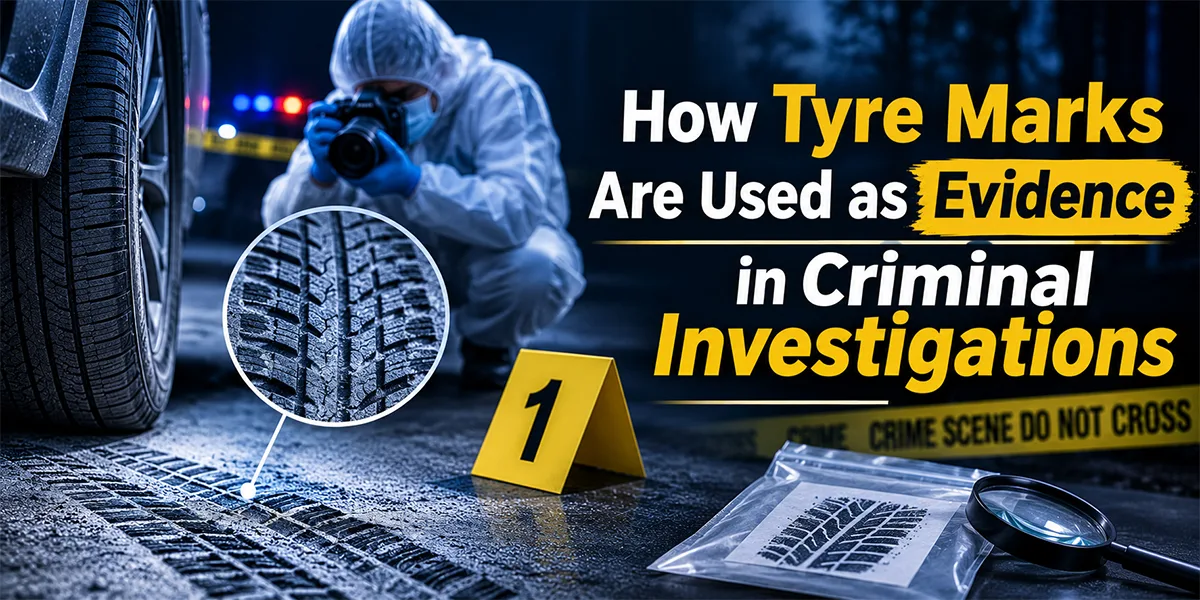
How many of you know that tyre marks are also an invaluable source of evidence in criminal investigations? If a vehicle has been involved in a crime such as a hit-and-run, robbery, kidnapping, or suspicious death, the tyre marks found on a road, muddy surface, or other terrain may help to clarify how the vehicle moved and link it to the specific incident.
Forensic scientists analyse tyre marks to identify unique patterns, learn how the vehicle moved, and match them to the tyres of a suspected vehicle. This can help investigators build up theories and test them. Tyre marks aren’t usually enough evidence on their own to identify a vehicle, but they can be useful if the quality of the marks, the matching techniques, and the other evidence are good.
What are tyre marks?
There are generally three types of tyre marks analysed in forensic science.
1. Impression marks
3D impressions left behind by the tyre pressing into a soft surface such as mud or moist soil.
2. Transfer marks
Material from the tyre is transferred onto another surface, or the tyre collects material from the ground.
3. Skid marks
Marks made by the tyre sliding or slipping across a surface, usually when braking or losing grip.
All of these can give useful information.
Different ways tyre marks can be used as evidence
1. Recording tyre marks
The first step is to find and record tyre impressions. This should be done quickly to stop them from being affected by weather, vehicles, and people. The impressions are photographed from different angles, and measurements are taken. The size, location, and environmental conditions are also recorded. Rulers can be placed next to the impressions to help measure their size.
It is very important that tyre impressions are recorded accurately, as they can easily degrade. By preserving them as they originally were, forensic experts can analyse them later and match them to other marks or tyres.
2. Analysing tyre treads
One of the main aims of analysing tyre marks is to look at the treads. Tyres have grooves, blocks, channels, and other features which create distinctive patterns.
Forensic scientists analyse these to identify whether the mark matches a certain pattern or design.
They look at:
- The pattern of the treads and the arrangement of the grooves
- The width and spacing
- The shape and size of the blocks
- Unique wear patterns
- Any cuts, cracks, or damage
All these characteristics can help narrow down the possible tyres that produced a mark. However, many tyres share similar tread designs, so a general pattern match usually cannot identify one individual tyre conclusively.
3. Identifying individual tyre characteristics
Beyond the manufacturer’s tread design, a tyre may develop individual characteristics through use. Uneven wear, small cuts, missing tread sections, and other damage can sometimes create distinctive features.
Forensic examiners may compare these characteristics with impressions recovered from a crime scene.
4. Estimating vehicle movement and direction
Tyre marks also help investigators reconstruct aspects of a vehicle’s movement before, during, or after an incident.
The direction of the tyre mark can show where the vehicle may have been travelling. The curve of the track can tell us if it was turning, and overlapping tyre marks can show the order in which vehicles travelled.
Tyre marks can also be examined in the context of a road traffic accident or suspected collision.
5. Linking a suspected vehicle to the crime scene
Tyre marks can help investigators find out whether a vehicle may have passed through the crime scene.
Take, for example, a vehicle suspected to have been used during a robbery. An investigator discovers tyre impressions near an entrance or on a dirt road leading away from the location. They document the marks and compare their characteristics with the tyres of a vehicle identified during the investigation.
If the tread design, dimensions, and distinctive features are consistent, the findings may support the possibility that the vehicle travelled through that area.
Conclusion
Tyre marks can help forensic scientists investigate hit-and-run accidents, robberies, suspicious deaths, and other crimes. The reliability of tyre mark analysis depends upon proper documentation, careful comparison, and objective interpretation.