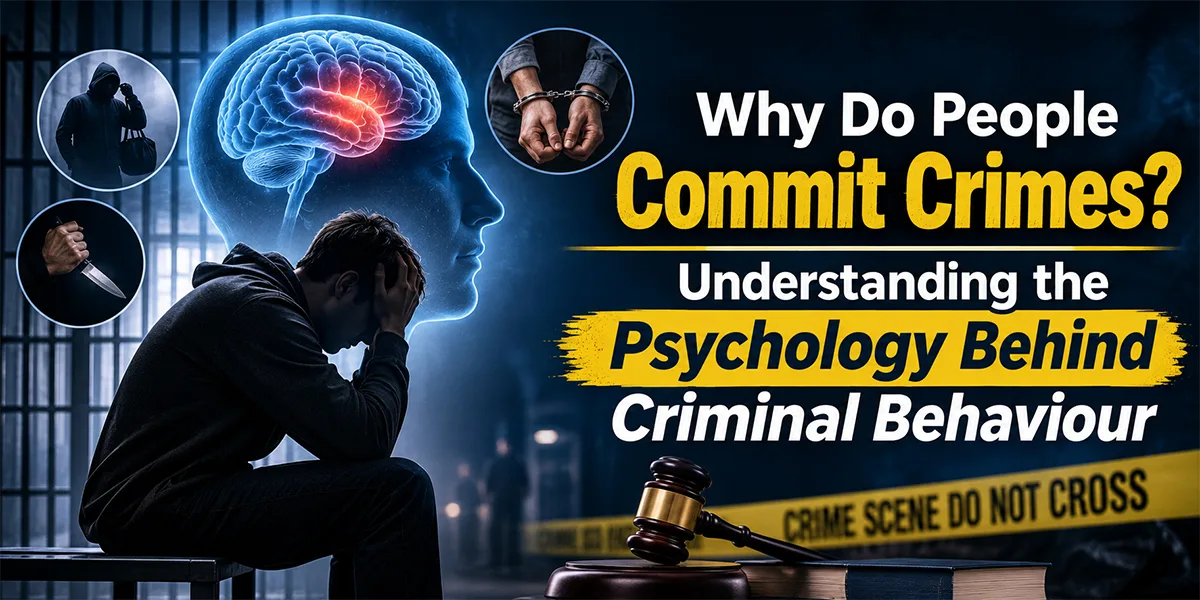
There are numerous reasons for criminal behaviour. The unlawful actions of an individual can be influenced by upbringing, emotional trauma, social environment, financial problems, personality, and opportunities.
Understanding the psychology of why people commit crimes is essential for crime prevention, rehabilitation programmes, and for criminal justice professionals to determine the circumstances of a crime. In this blog, we will look at some theories and factors that aid in understanding criminal behaviour.
Major psychological theories explaining criminal behaviour
1. Social learning theory
The psychologist associated with this theory is Albert Bandura, a proponent of social learning theory, who stated that people learn from each other by observing, imitating, and modelling behaviour. If we apply this to criminal behaviour, it can be said that criminals learn unlawful behaviour as a way to achieve rewards. The reward can be either material or social.
For example, a young person who witnesses their social circle using violence as a means to resolve conflicts may consider such conduct normal. Similarly, if a person observes their close ones profiting from fraudulent schemes without being penalised for this behaviour, they may be encouraged to engage in fraudulent activities themselves.
However, it is important to note that observation does not necessarily lead to imitation. Values, support, and social reinforcement play a role in what a person will choose to adopt from what they have learnt.
2. Strain theory
This theory originated from the work of sociologist Robert K. Merton and was later expanded upon by researchers in criminology. It examines the relationship between societal goals and the illegitimate means by which one may seek to achieve them. For example, when a person is committed to achieving financial success but does not see legitimate opportunities to do so, they may resort to crime.
A person may also turn to crime if they have a feeling of deprivation caused by, say, discrimination, the loss of a loved one, or a humiliating experience. The theory also looks at the response to strain – an individual may deal with the stressor in different ways, such as seeking help from friends or family.
It is important to note that strain theory does not suggest that poor people are more likely to be criminal, only that people may turn to crime more often if they feel there is no other way to achieve success.
3. Rational choice theory
According to this theory, a person engages in criminal activity after weighing the costs and benefits of committing the crime. Rational choice theory assumes that an offender purposely weighs the risks and rewards of illegal activity.
For example, a person considering financial fraud may be blinded by the money they expect to gain while underestimating the harsh reality of detection or punishment.
Decisions like these are influenced by perceived opportunities, the possibility of consequences, and the person’s immediate circumstances.
However, criminals’ decisions are not always carefully calculated. Some are driven by emotional distress, intoxication, or impulsivity, while misinformation and limited attention to future consequences can also affect judgement.
That’s why rational choice theory is highly beneficial for understanding certain planned offences, but it cannot fully explain every form of criminal behaviour.
How can childhood experiences influence criminal behaviour?
Childhood experiences can shape one’s emotional development, relationships, coping mechanisms, and perspectives on rules and social norms. This makes the experiences of a child a matter of concern to scientists in the fields of developmental psychology and criminology.
Specifically, certain experiences may predispose people to behavioural problems if they are exposed to them during early life and/or subjected to them repeatedly.
Such experiences include:
- Exposure to violence – Exposure to violence can desensitise people to it and lead them to perceive it as an acceptable way to resolve conflicts.
- Neglect or abuse – Adverse childhood experiences can lead to poor emotional regulation, trust issues, and difficulty forming healthy relationships.
- Inconsistent boundaries – Exposure to inconsistent boundaries during childhood can disrupt a person’s ability to regulate their own behaviour.
- Negative peer influence – Children and adolescents are often exposed to the influence of peers who encourage them to participate in anti-social activities.
- Lack of supportive relationships – The absence of reliable relationships during childhood can prevent a person from developing adaptive coping strategies.
However, it must be stressed that the fact that certain childhood experiences may predispose people to criminal behaviour does not mean that they necessarily will.
Many people who survive harsh childhood circumstances do not become criminals, thanks to the support of other family members, teachers, social workers, and the presence of a strong community.
Do socioeconomic factors affect crime?
Criminal behaviour should also be considered from the perspective of the broader social environment. Employment opportunities, education, stable housing, living conditions, and access to community resources can be important influences on individuals’ choices and opportunities.
For example, for people who experience chronic economic hardship, the stress and pressure may contribute to certain economically motivated offences.
How can forensic psychology help us understand criminal behaviour?
Forensic psychology applies psychological principles to legal and judicial matters. It can assist criminal justice practitioners in understanding the relevant aspects of an individual’s behaviour, as well as assessing specific concerns and providing an opinion on these matters.
Forensic psychologists may contribute in several ways:
- Behavioural assessment – Analysis of relevant behavioural patterns, psychological functioning, and the circumstances surrounding an offence.
- Risk assessment – Evaluating the likelihood of particular future behaviour with the help of structured methods and relevant evidence, while acknowledging uncertainty.
- Criminal profiling – In some selected investigations, behavioural analysis may help investigators generate hypotheses about an unknown offender. A profile alone is not sufficient and cannot be treated as proof of identity; its usefulness depends on the available evidence and the method used.
- Rehabilitation planning – Identification of relevant needs like substance use treatment, anger-management support, or interventions addressing harmful thinking patterns.
- Court-related assessment – Offering professional opinions on psychological questions relevant to legal proceedings, within the limits of the assessment and the expert’s role.
Don’t assume forensic psychology allows professionals to read a person’s mind or determine guilt from personality alone. Psychological assessment must be interpreted carefully alongside witness accounts, physical evidence, digital records, and other relevant information.
Conclusion
From the points above, it can be concluded that understanding the causes of criminal behaviour can help explain an offence, but explanation does not automatically excuse it. A balanced approach considers individual responsibility while examining the wider factors that may contribute to crime and the practical measures that can help prevent it.