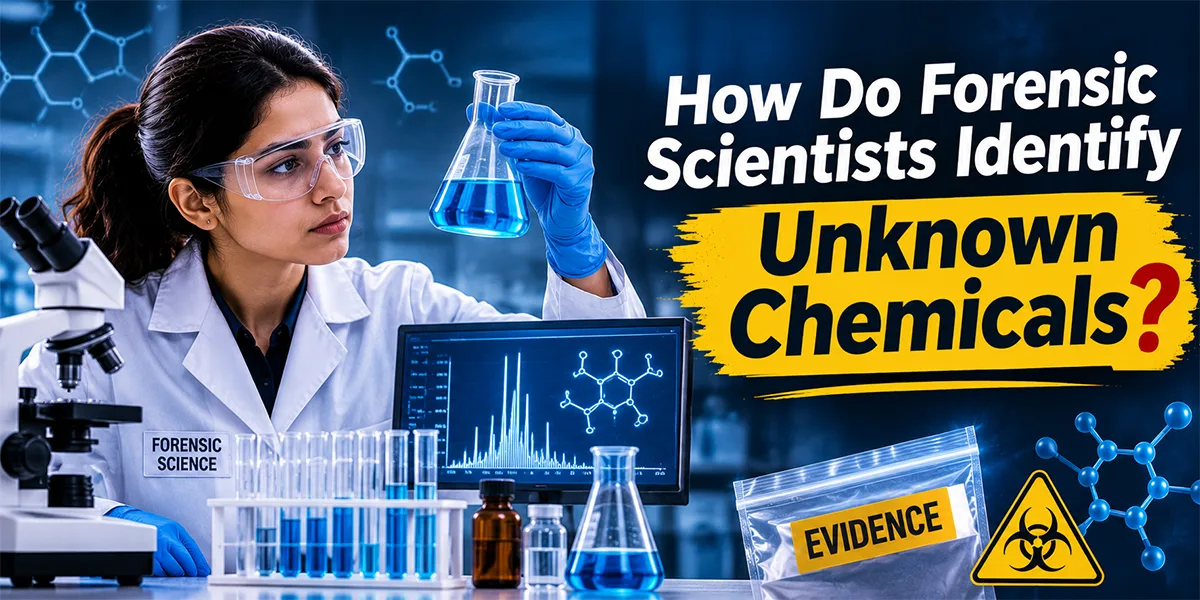
When carrying out an investigation, forensic scientists may encounter unknown powders, liquids, stains, residues, or crystalline substances. These can range from drugs, poisons, and cleaning products to explosive-related residues and other chemicals. Identifying unknown chemicals gives insight into what they are, how they were used, and whether they are relevant to the case.
However, identifying an unknown chemical is not as simple as just looking at its colour and smell. Many substances may look the same, and some chemicals can be hazardous. Therefore, the forensic scientist uses a systematic approach to identify the unknown chemical. They carry out an initial analysis, lab analysis, and instrumental analysis, and then interpret the results.
Methods used by forensic scientists to identify unknown chemicals
1. Sample collection and storage
The first stage in identifying a chemical is collecting the sample. This should be done safely. The investigator notes where the substance was found, what it looks like, and what the situation around it was.
For example, if an unknown powder was found in a vehicle, you would want to carry out a different analysis than if it was a liquid found at a suspected poisoning scene.
The forensic staff follow safety procedures and wear the correct PPE. The sample is stored in the correct container and kept under appropriate conditions.
It is important to make sure that the sample is labelled correctly and the chain of custody is recorded. This shows who collected, passed on, stored, and analysed the sample.
2. Initial analysis
Before using advanced instrumentation, the sample can be analysed for basic properties. This can help decide what analysis should be carried out.
Depending on the sample, they may note:
- What colour it is and what it looks like (powder/crystal/liquid/solid)
- What state it is in (liquid/crystal/granular)
- Solubility of the sample in chosen solvents (if it is safe and appropriate)
- Its pH in a suitable aqueous solution (acidic/neutral/alkaline)
- Any other noticeable physical properties
However, this will rarely tell you what the chemical is, as many chemicals can look the same. Therefore, initial analysis is just a screening tool.
3. Presumptive tests
Presumptive tests are used to show whether the sample could belong to a particular category of chemical. They work by reacting with the sample to produce a particular colour change.
These can be used to screen for suspected drugs or certain biological materials and chemical residues in forensic investigations.
The sample can show a colour related to a particular group of compounds. This can help determine which confirmatory tests should be carried out in the lab.
However, there are limitations to this method. The reaction can be similar for different substances, and contamination or a mixture may affect the results. Therefore, the results are treated with caution, and more targeted tests are carried out.
4. Chromatography
Chromatography is a type of analysis used to separate the components in a mixture. This can be very useful if the unknown sample contains multiple chemicals.
Because they interact differently with the stationary and mobile phases, the components behave differently, which causes them to separate.
Two important methods include:
- Gas chromatography (GC) – This is often used for volatile or suitably vaporisable compounds. It can be useful for analysing solvents, fuels, and certain drug/toxicology samples.
- High-performance liquid chromatography (HPLC) – This is suitable for analysing many compounds in a liquid-based system. It is suitable for analysing substances that aren’t suitable for gas chromatography.
This can show how many components are in the sample and help separate the substances. However, it may not always be enough to identify the compound.
5. Mass spectrometry
Mass spectrometry is one of the key techniques used in forensic chemistry. It works by measuring ions based on their mass-to-charge ratio, providing data on the molecular properties of the substance.
This can show characteristic patterns in the mass spectrum.
It is often used in conjunction with chromatography. For example, gas chromatography–mass spectrometry (GC-MS) separates the sample using gas chromatography and then analyses the separated compounds.
This is widely used in forensic labs to analyse drugs, toxicology samples, solvents, and other organic compounds.
Scientists may compare the spectra to validated libraries. This can be useful evidence; however, it needs to be considered in relation to the quality of the spectra, similarity to other compounds, and other analytical results.
6. Infrared spectroscopy to identify functional groups
Infrared (IR) spectroscopy can help scientists find out what chemical bonds and functional groups are in the sample.
When infrared light interacts with the sample, certain bonds absorb energy at characteristic frequencies. This produces a spectrum showing the bonds in the sample.
The forensic scientist may use Fourier Transform Infrared (FTIR) spectroscopy to analyse unknown powders, polymers, fibres, pharmaceuticals, and other substances.
They may see characteristic absorption in the spectrum for certain functional groups. This can be compared to reference spectra to determine whether the sample is consistent with a known compound or material.
This can be a useful technique, as the sample can often be analysed relatively quickly with little preparation. However, it can be difficult to interpret if the sample is a mixture, contains impurities, or has similar structures, so further testing may be required.
7. Other instrumentation
Some unknown samples may need other analysis methods. The choice depends on what the sample contains, what state it is in, and what properties are suspected.
Some useful techniques include:
- Raman spectroscopy – This identifies molecular vibrational properties. It can help identify certain powders, crystals, etc.
- UV-visible spectroscopy – This measures the amount of ultraviolet/visible light absorbed. It can help to analyse compounds with suitable properties.
- NMR spectroscopy – This gives detailed information about the environment of the atoms’ nuclei. It can help identify the molecular structure.
- X-ray fluorescence (XRF) – This helps identify what elements are in the sample. It is useful for certain inorganic materials, metals, and residues.
Each technique gives different information. For example, XRF can tell you what elements are in the sample; however, it generally won’t tell you the full molecular identity of an organic compound.
Choosing the correct analysis is an important part of forensic chemistry.
Conclusion
Forensic scientists use a systematic approach to identify unknown chemicals. This can include collecting and storing the sample, initial analysis, presumptive tests, chromatography, spectroscopy, and mass spectrometry. The different techniques give different information, and the best combination depends on what the sample is and what you need to know.
To identify the chemical accurately, the scientist must consider how reliable their methods are, compare their results to suitable references, consider other explanations, and communicate any limitations.
These principles can be applied by forensic chemists to turn unknown substances into scientific evidence that can help investigators.