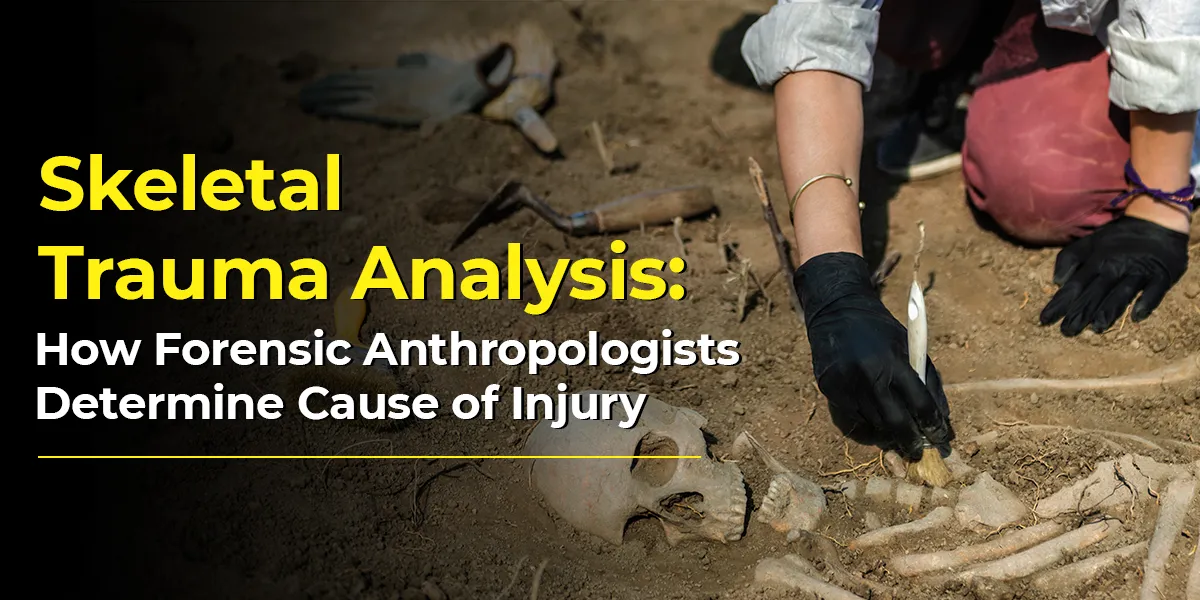
The scientific examination of bones to find evidence of injuries is known as skeletal trauma analysis, and it can be used to determine the circumstances behind a person's trauma. By examining patterns of damage, healing processes, and fracture types, this issue is essential to forensic anthropology and bioarchaeology because it helps find evidence of past events and actions. It is a crucial field in both medical and criminal investigations because experts can reconstruct historical narratives and identify causes of harm by utilizing sophisticated imaging techniques and in-depth anatomical knowledge.
Let’s Understand Skeletal Trauma
Examining bones to determine the type of damage is known as skeletal trauma analysis. In disciplines like forensic anthropology, this specialized research is frequently utilized to identify the causes of death or damage in human remains. Comprehending the impact of trauma on bones can yield vital information about historical occurrences, criminal investigations, and health issues.
What is the Importance of Skeletal Trauma Analysis?
Skeletal trauma analysis is important because it can reveal the stories that are hidden under the bones. For the following reasons, it is essential in numerous fields:
- Crime Investigations: By disclosing the reason and manner of death, trauma identification can aid in the resolution of criminal cases.
- Historical research: It sheds light on past conflicts or cultural customs that have an impact on the populace.
- Medical insights: By comprehending injury trends, safety precautions, and medical interventions can be improved.
- Archaeology: Provides insight into ancient conflicts and cultures.
Experts can add a layer for comprehending that text or artifact evidence alone might not be able to provide by analysing the patterns and types of trauma to establish if wounds were caused by violent confrontations or accidents.
What are the Techniques Used in Skeletal Trauma Analysis?
Techniques for analysing skeletal damage have greatly improved, utilizing new tools and approaches to look at bone injuries. These methods aid in the proper identification of trauma traits, which results in more thorough and exact interpretations of historical events or forensic data.
Innovative Techniques in Skeletal Trauma Analysis
The way scientists interpret bone injuries has been completely transformed by recent advances in skeletal trauma analysis. The following innovative methods are causing a stir in the industry:
- 3D Imaging and Reconstruction: Skeletal injuries can be seen in great detail thanks to advanced imaging technologies like MRI and 3D CT scans. Despite physically changing the material, they enable researchers to produce computer reconstructions that provide an in-depth study.
- Finite Element Analysis (FEA): This computational method simulates the possible responses of bones under different forces. It makes it possible to estimate patterns of stress and strain, which sheds light on the mechanics of bone failure.
- Stable Isotope Analysis: By analysing isotopic signals in bone collagen, researchers can deduce the person's previous dietary habits and potential environmental exposures, providing further context for skeletal trauma.
These methods aid forensic anthropologists in distinguishing between different kinds of trauma and comprehending the underlying causes.
Certain Notable Cases in Skeletal Trauma Analysis
Prominent skeletal trauma analysis cases demonstrate excellent uses of this field, offering practical settings and conclusions:
- The Tutankhamun Case: Complex fractures were found when the Pharaoh's mummy was examined. Initially thought to be an assassination, further investigation revealed a car accident similar to chariot crashes.
- Jamestown Skeletons: Early American immigrants' bones revealed brutal injuries and hunger, illuminating early colonial struggles and clashes with native communities.
- Ötzi the Iceman: This well-preserved corpse was discovered with defensive wounds and a pointed tip in his shoulder, indicating violent conflicts. Reconstructing the circumstances of his death was made possible by a thorough examination of his skeleton.
Each instance offers significant insights into human behavior, historical settings, cultures, and individual lives.
Conclusion
Skeletal trauma analysis, which allows specialists to decipher the silent testimony stored in human bones, is a potent convergence of science, history, and justice. Forensic anthropologists are able to precisely reconstruct patterns of injury by fusing traditional anatomical knowledge with cutting-edge technologies like imaging and computational modeling. This offers crucial insights about the circumstances surrounding a person's life and death, in addition to aiding in the identification of the source and moment of trauma. Skeletal trauma analysis continues to expand our knowledge of human experiences throughout history, whether it is used in criminal investigations, archeological research, or medical studies. In the end, it turns bones into powerful stories of truth and proof.