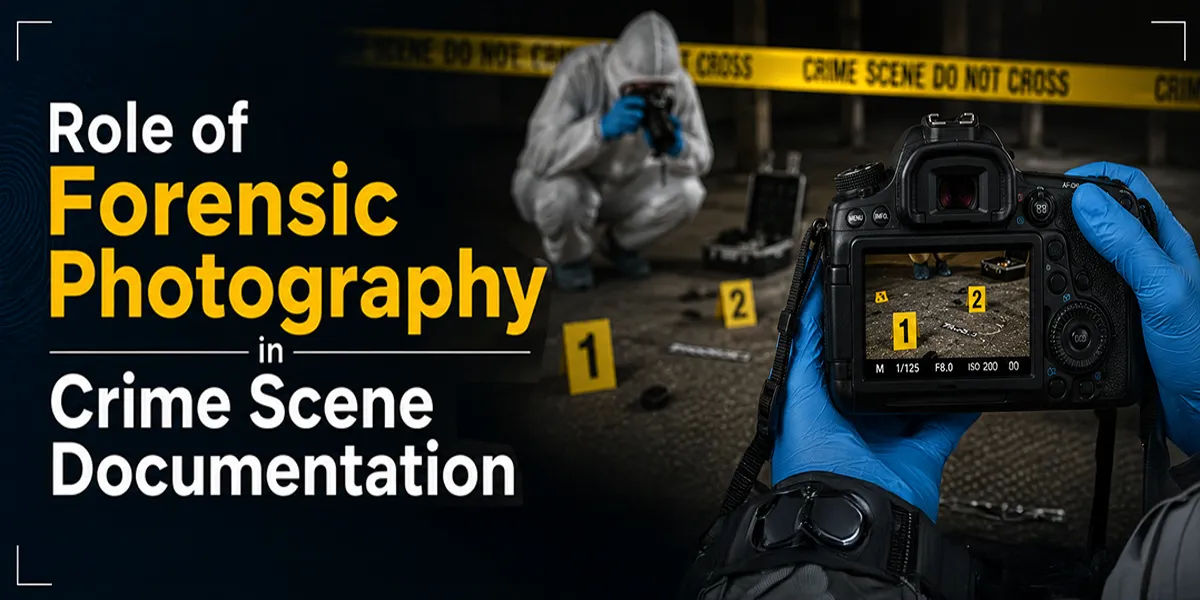
The primary objective of forensic photography is to accurately and in detail document and preserve the crime scene. This will assist investigators, forensic professionals, legal professionals, and the courts in reconstructing or understanding what occurred during a crime. In modern criminal courts, forensic photography has become an important tool in preserving evidence so that investigations can be conducted fairly.
What is Forensic Photography?
Forensic photography is an effective and reliable method of documenting a crime scene. It provides an accurate representation of all physical evidence associated with the crime scene, including the condition of the crime scene and how it was altered or disturbed after the crime occurred. There is a difference between a typical photograph and a forensic photograph; while a typical photo is created for creative purposes, the purpose of forensic photographs is to document the initial state of the crime scene in a manner that will be admissible in court. Therefore, the average person does not consider how to take a typical photograph, but the forensic photographer must think about how they will create the photographs and what they will do with the photographs after they are taken, or how their photographs may be used in criminal investigations, during laboratory examinations, and potentially in the legal process.
Importance of Forensic Photography in Crime Scene Documentation
Crime scenes somewhere are temporary in nature. Once the evidence is collected, it is difficult to recreate it in the same way as it was. Forensic photography helps to preserve the originality of the scene permanently.
1- Preserving Evidence
The role of forensic photography is to preserve evidence in a visual format. Physical evidence can deteriorate with time or can be lost/destroyed in the evidence collection process, such as blood stains, fingerprints, shoe prints, weapons, broken items, and injuries. By taking photographs, investigators can create a visual report of the physical evidence that can be used as a reference in the future.
For example, a photograph of a blood stain pattern will help an expert analyze how a crime was committed (e.g., the direction and the type of weapon used) long after the scene has been cleaned.
2- Documentation of crime scenes
Forensic photography provides accurate documentation of a crime scene. Investigators will photograph the same area from different angles and distances to create a complete picture of the scene's configuration and the exact location of evidence.
This type of photographic evidence allows investigators to reconstruct how the crime occurred and provides clarification about the following:
- Location of the evidence
- Location of the victim
- Entrance and exit locations
- Evidence of physical struggle
- Environmental conditions
Without proper photographic evidence, investigators may not be able to collect the important information.
3- Provides support to investigators and forensic experts
Photography allows forensic experts to evaluate evidence in detail without actually being present at the scene.
Crime scene investigators, experts, ballistic specialists, fingerprint experts, and medical examiners rely on crime scene photography for review/analysis.
Fingerprint specialists use close-up images of fingerprints to provide comparison evidence. Ballistic experts look at the images of the crime scene to determine the trajectory of the bullets
Medical examiners review autopsy photography of injuries. Therefore, forensic photography enhances the coordination of different forensic divisions in their respective tasks.
4- Assist with crime scene reconstruction
The process of reconstruction of a crime scene will help law enforcement determine how the crime occurred. Forensic detectives can utilize forensic images to assist them in this process so that they may recreate the events in sequence.
For instance, the investigators will use forensic photography of the scene to answer critical questions about the incident:
- Where did the crime happen?
- What method did the assailant use to gain entry to the location?
- Where did the perpetrator move to and from?
- What weapon was used in the incident?
The forensic investigator can identify patterns not readily observed during the initial examination of a crime scene by carefully reviewing the forensic photographs.
Evidence can also be used in a variety of ways in support of other witness statements, which help the prosecution prove their case, clarify complex evidentiary findings related to forensic science, and establish timelines.
Inappropriate use by others can lead to unreliable evidence being presented in court; however, proper authentication of forensic photographs can provide strong visual evidence and will be considered highly persuasive evidence.
Different Types of Emergency Pictures
Photographers will usually take three main types of emergency images
- Overall:
These images show the whole area. They give you an idea of how the evidence correlates to the feature(s) that are or were displayed at the scene.
For example:
- The view of the exterior section of a structure
- Complete view of a room
- The view of the roadway or distance to an open area from the physical environment of where the object is located
- Midrange:
These images will focus on the specific evidence and show a reference to the location of evidence as it pertains to the environment. The mid-range images will assist in locating the exact location of the item of evidence relative to the environment.
Examples of this type of photograph:
- The knife is lying next to the victim.
- Bloodstain on the side of the piece of furniture or residence where the deceased lies.
- Close-up:
The close-up images will provide the finest detail regarding the evidence. The close-up images will contain a measurement scale; a photograph will be taken both with and without scales for proof of measurements.
Examples of this type of photograph:
- Fingerprint
- The marks left on a person or object
- Tool Marks made on a subject's body
- Bullets holes
- Blood stain patterns
- Forensic Photography Techniques
To maintain the integrity and the reliability of photographs, a photographer must use proper techniques.
What are the Techniques used in Forensic Photography?
The nine principles of forensic photography are as follows.
Proper Lighting:
Using proper lighting when obtaining photographic evidence is extremely important when trying to obtain clear photographic evidence of a scene. Proper use of flashlights, ultraviolet light, infrared photography, and other alternate light sources can all help reveal hidden evidence (for example, fingerprint evidence, biological stains).
Measurement Scales:
Photographic evidence is also typically taken next to measurement scales in order to ascertain the size and dimension of the evidence.
Multiple Angles:
Taking photographs of the evidence from multiple angles creates a more complete representation of the event and will help investigators locate any significant detail they may have missed.
Sequential Photography:
All images of the same scene should be taken in a sequential fashion (starting from the overall view of the scene to a close-up view of the scene) in order to document the evidence in an organized manner.
High-Resolution Digital Cameras:
Forensic photography today uses high-resolution digital cameras to capture fine details with high clarity. Advances in imaging technologies can also help create more visible photographic evidence.
Forensic Photography Challenges
Forensic photography is often viewed as minimal in significance, yet it has many challenges:
- Low levels of light exist at many crime scenes, particularly when investigating a crime after dark. Photographers should carefully tune their equipment to compensate for the distortion caused by a lack of light at night.
- Weather conditions such as rain, fog, heat, and wind create additional problems for photographic quality and can alter the condition of evidence.
- Photographers taking pictures must take precautions to avoid disturbing any evidence during the course of photographic documentation.
- Photographs taken in forensic photography must retain original accuracy; any alteration or editing of photographs can adversely affect their integrity as evidence in a court proceeding.
Technological Advancements in Forensic Photography
1- Digital Camera System
Digital cameras allow investigators to view images right away and take more photos in very short order.
2- 3-D Crime Scene Imaging Method
Many modern forensic teams use 3-D scanners and specialized software to create very realistic images of crime scenes (digital models) that allow investigators to analyze crime scenes better.
3- The Use of Drones for Aerial Photography
Drones have also become more popular for taking images of large crime scenes, such as accident scenes, wooded areas, or disaster areas, from an aerial view.
4- Image Enhancement Software
Various software programs help improve the clarity of images that have been taken under less than ideal lighting (such as blurry photos or images taken under low light) while still maintaining the original evidence.
Ethical and Legal Issues Related to Professional Conduct
As a forensic photographer, you are responsible for following ethical and legal guidelines when photographing crime scenes.
- All photographs taken should be an accurate representation of the scene.
- The victims' privacy and dignity should always be respected.
- Evidence handling procedures must be closely followed.
- A chain of custody must be maintained for each digital image taken.
- Failure to meet the above ethical and legal standards could result in the exclusion of evidence from the court.
Conclusion
A crucial aspect of crime scene investigation and documentation, forensic photography serves many purposes, preserving vital evidence, assisting forensic analysis, helping investigators in their work, and presenting reliable pictorial evidence for use in a court of law. Proper and systematic documentation using forensic photography plays an important role in increasing the likelihood that justice will be served in a timely and fair manner.
The advancement of digital technologies is continuing to expand and improve upon the accuracy of forensic photography and how it contributes to the accuracy of criminal investigations. New forensic technologies such as 3-D imaging, drone photography, etc., will enable forensic investigators to document crime scenes more effectively and with greater precision than ever before.
In some cases, a particular photograph can be the only piece of evidence that ultimately resolves a case; this illustrates how powerful forensic photography is in the documentation of crime scenes and as a tool in the criminal justice system across the globe.