
Forensic report preparation is a crucial part of investigations and requires meticulous attention to detail. Documenting the results of an inquiry conducted for legal purposes is part of this process.
Following forensic report writing best practices is necessary since the quality of the report can have a significant impact on legal outcomes. The word "forensic" describes procedures intended for use in a court of law. Therefore, in order to ensure that information is transmitted accurately, forensic reports must be created with careful attention to detail and clarity.
The requirements for creating forensic reports will be discussed in this article, with a focus on the key elements that result in a coherent document.
Basic Definitions
Forensic
Any process or action meant to be presented in a court of law is referred to as forensic. Handwriting analysis, tool mark analysis, document authentication, forensic accounting, DNA testing, forensic psychology, and forensic engineering are just a few of the many fields that fall under this umbrella. Each of these disciplines deals with gathering evidence and presenting it in a way that satisfies legal examination requirements.
Report
A report in forensic investigations describes the actions conducted by investigators, the techniques used, the tests carried out, the outcomes attained, and the expert assessments offered. The investigation and its findings are officially documented in this paper.
Standards
In forensic report writing, standards are the requirements, guidelines, and customs that determine a report's quality. Following these guidelines increases the report's legitimacy in a legal context by ensuring that it is accurate, dependable, and error-free.
Key Standards of Forensic Report Writing
It is crucial to adhere to the specified guidelines to produce an impeccable forensic report. The following is a list of twelve essential guidelines that need to be followed:
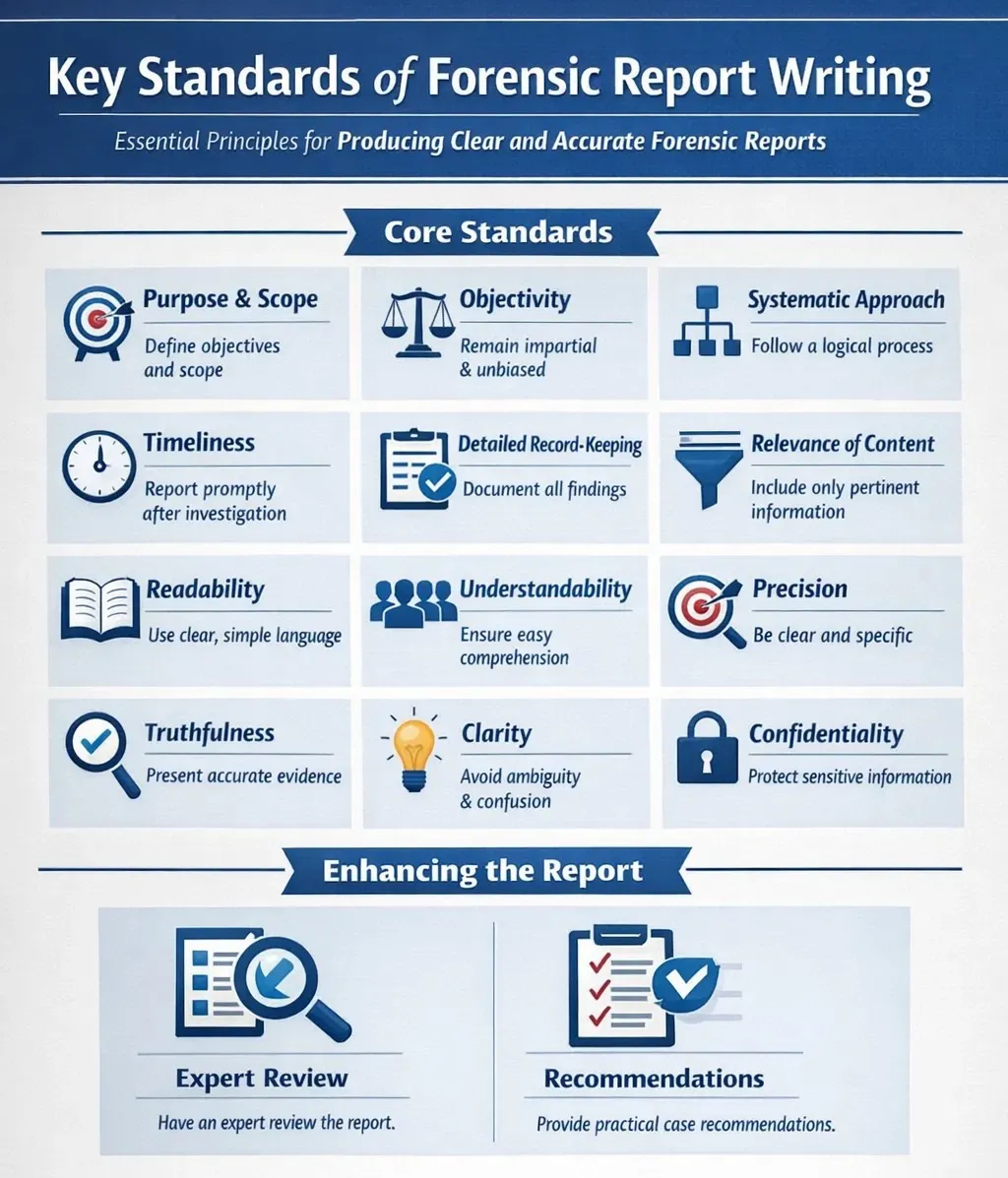
Purpose and Scope: The report should address the scope and constraints of the analysis, provide investigation questions, and explicitly state the purpose for which it was prepared. The content must be succinct, pertinent, and include a synopsis of the methods used.
Objectivity: The report must be created without any emotional impact, preserve objectivity, and accurately explain information. Maintaining neutrality is crucial to building the findings' credibility and making sure they can withstand critical scrutiny.
Systematic Approach: The final report must adhere to the underlying systematic nature of a forensic investigation. The results should be presented in a logical order, detailing the steps performed during the investigation from start to finish.
Timeliness: After the investigation is over, reports must be produced right away. Any delay could lead to memory loss, which could compromise the veracity of the report.
Thorough Record-Keeping: Good forensic reports need to include every aspect of the investigation, including methods, findings, and conclusions. This degree of specificity makes the record transparent to anyone looking at the report.
Content Relevance: Only information pertinent to the case should be included. Unrelated details could make the report less clear and cause the reader to become confused.
Readability: The report's language must be simple and devoid of superfluous jargon so that those without specialized training can successfully understand its content. It is recommended to steer clear of superfluous language and offer concise descriptions of conclusions and suggestions.
Understandability: Reports should be written so that those without specialist knowledge, such as jurors and courtroom staff who might not be familiar with forensic investigations, can understand them.
Precision: Every assertion in the report needs to be precise and succinct. To preserve the report's integrity, any uncertainty must be removed.
Honesty: Every piece of evidence must be accurate and supported by reliable sources. Every assertion made in the report needs to be backed up by relevant data. This could include expert analysis, actual proof, or witness testimony, all of which should be properly cited to increase the report's credibility.
Clarity: To avoid any potential for different interpretations and to avoid misconceptions that could jeopardize the report's integrity, information must be communicated clearly. To help the reader navigate the text logically, it should have headings and subheadings.
Confidentiality: Until they are required for legal procedures, forensic reports are often kept private. However, their contents may be made public after they are subpoenaed, underscoring the need for accuracy from the start.
In addition to the standards listed above, a few actions can be taken to improve the report's usefulness, such as:
- Expert Review: Hiring a professional reviewer to evaluate the report can ensure that all necessary requirements are met. A reviewer can eliminate unnecessary words, fix errors, and enhance the report's overall clarity.
- Suggestions: A successful forensic report usually concludes with recommendations based on the findings. These recommendations should be useful and pertinent to the particular case under consideration.
Conclusion
In Indian court cases, forensic report writing serves as a vital link between scientific inquiry and judicial decision-making, going beyond simple recording. A well-written forensic report guarantees that intricate technical discoveries are converted into understandable, trustworthy, and legally admissible proof. The report's credibility is increased, and it can withstand intense judicial scrutiny by following recognized standards such as objectivity, clarity, precision, and methodical presentation.
Additionally, preserving truth, secrecy, and relevance throughout the report protects the investigation's integrity and promotes just trial outcomes. The report's usefulness is further enhanced by the inclusion of expert assessment and useful recommendations, which turn it into a guide for legal authorities as well as a record of results.
In the end, a forensic report's efficacy depends on its capacity to convey the truth in an organized, objective, and understandable way, guaranteeing that justice is backed by reliable scientific data.