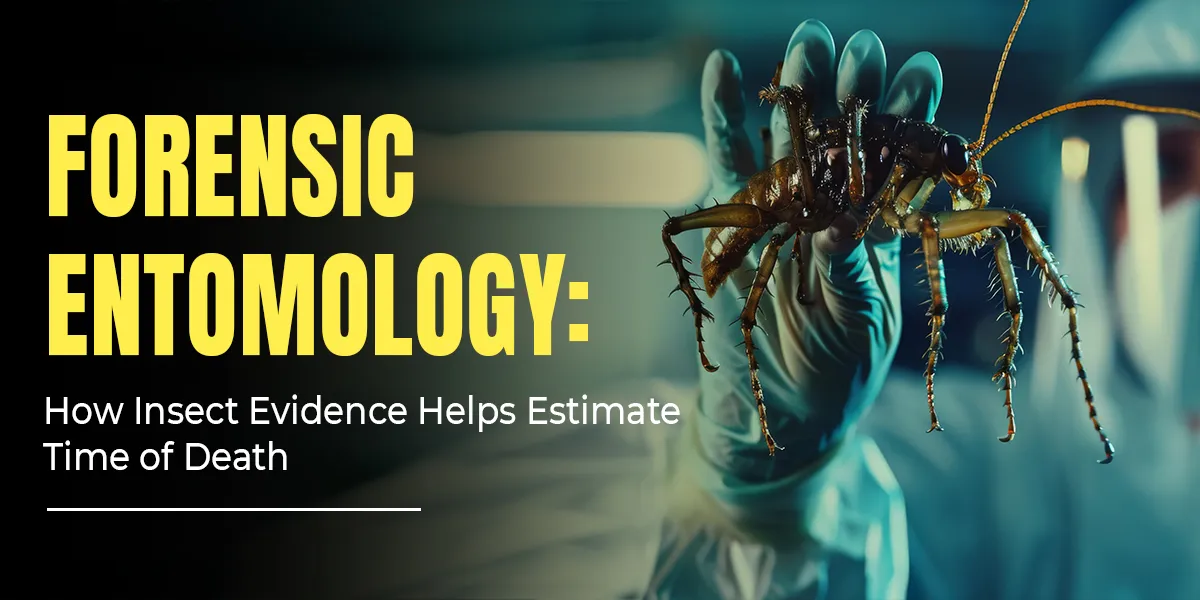
Do you know blow flies can predict the time of death? Fascinating right!! Forensic Entomology simply put is a sub-discipline of forensic science that uses anthropoids to Predict Postmortem Interval (PMI). Maggots and their developmental stages have been assisting investigators since hundreds of years.
There are various insects which exhibit necrophilic behaviour. They feed on the dead bodies. Now the question is how are they able to detect dead bodies?
The answer is- after death the body starts to decompose on its own. A process namely autolysis takes place and the soft tissues begin to break which releases liquids and gases. Hence, this smell attracts these necrophilic insects which use dead body as a base to reproduce.
The smells emitted at the various stages of decay attract different species of necrophagous insects, which arrive at the body to feed on it or to lay their eggs. The first to appear are usually flies.
The first incident in which Forensic Entomology was used occurred in China in the year 1235.
Definition and Scope of Forensic Entomology
The study of insects and other anthropoids in criminal investigations is known as forensic entomology. It is a technique for forecasting the post-mortem interval (PMI) for people who have passed away or gone missing.
The reproduction stage of insects found on the scene is used in forensic entomology to determine PMI. Insects used in criminal investigations are primarily beetles, flies, or moths; this may also include various scavenging insects and hitchhiking mites. These organisms assist in the colonization of decomposed tissue, supplying crime scene investigators with living samples that are gathered and analyzed for biological evidence. You will be surprised to know that the flies can smell the dead bodies from as far as 16kms.
Since forensic entomology requires skilled entomologists frequently and training is required for proper analysis of collected evidence, it is currently a niche application in most investigations. However, as insect populations increase with global temperatures, this forensic sub discipline may become more significant over time in solving complex criminal cases especially where the body is badly decomposed.
Even while forensic entomology is a specialized field with a relatively small number of countries using it, it has a wide scope. Insects offer important information about how quickly a body decomposes and can be used to determine the last known location of a victim. They can also be apprehended and tested either on-site or off-site to more easily and legally frisk for a victim's DNA than a human offender. Additionally, insects don't need specific instruction, thus they may accurately decide the post-mortem interval.
Role of Forensic Entomology in modern Forensic Science
The role of forensic entomology in modern forensic science is crucial as it may help when other evidences do not work. Insect evidence can be used to support or challenge human testimonies, reconstruct crime scenes and provide valuable scientific evidence in court.
In a recent case in Nevada an accused was acquitted after 16 years in prison by using forensic entomology.
Insect's crucial role in determining time of death
After the death the first ones to arrive are insects especially flies which can arrive within minutes. Because insects arrive and grow in a predictable pattern, they become extremely useful for estimating how long a person has been dead. Insect activity can still provide valuable timelines when it becomes difficult for the doctors to use traditional medical methods.
The PMI is the estimated time that has elapsed since a person has died. Determining PMI is crucial in criminal investigations especially in murder cases to determine suspects, establish alibi and understand the sequence of events.
There are two main ways in which insects are helpful in determining PMI:-
- Age of the insect- The growth stage of larvae is studied by experts to determine for how long the person has been dead because insects start laying their eggs as soon as a person dies.
- Arrival patterns of the insects- Different insects arrive at different stages of decomposition, so the types of insects present can give clues about how much time has passed.
Insects are very reliable because of their predictable pattern of growth which can be scientifically studied and established. For example- blowflies follow a definite stage of eggs, larvae, pulpa and adult stages. Since the growth of insects largely depends on temperature they can be studied by experts to predict PMI in surprisingly accurate manner.
The use of insects to determine PMI, go beyond the cases of homicide. Insects have been used to confirm whether a body was moved after death uncover drug or poison traces in tissues and demonstrate cases of neglect in children and the elderly.
In simple terms, insects function as a biological clock. By meticulously examining them, forensic specialists can reconstruct timelines and assist investigators in uncovering the truth.
Challenges of using Forensic Entomology
Although Forensic Entomology is a crucial tool in the determination of PMI it also faces severe drawbacks. The drawbacks include:
- There are several cases in which no insects have been found on the deceased's body;
- If the insects are not handled properly it can lead to destruction of whole evidence;
- Insects require specific temperature and humidity ranges for optimal breeding, and if these ranges are unmet, the body may exhibit little to no maggot or live insect specimens to use;
- Forensic Entomology is a subdiscipline of forensic science and requires a whole certification to pursue and hence remains unpopular amongst students.
Real world cases
The first documented case of using Forensic Entomology as evidence is the Ruxton case of 1935 which happened in UK. In this case a physician murdered his wife and her maid. He brutally destroyed the body, cut it into parts and disbursed it to prevent identification. The time frame of the maggots found on the body parts matched with the disappearance of women and hence helped in corroboration of evidence in the Court.
In India the Court have time and again relied on forensic entomology to pass judgements. In Kuttikunkan vs State of Kerala 2008 the defence relied on the lifecycle of maggots to prove reasonable doubt and the Court could not sustain murder charges on the accused.
Conclusion
Forensic Entomology is a novel tool which can be used to solve complex criminal cases. It should be taught as a separate discipline to remove its impediments and awareness around this should be spread.