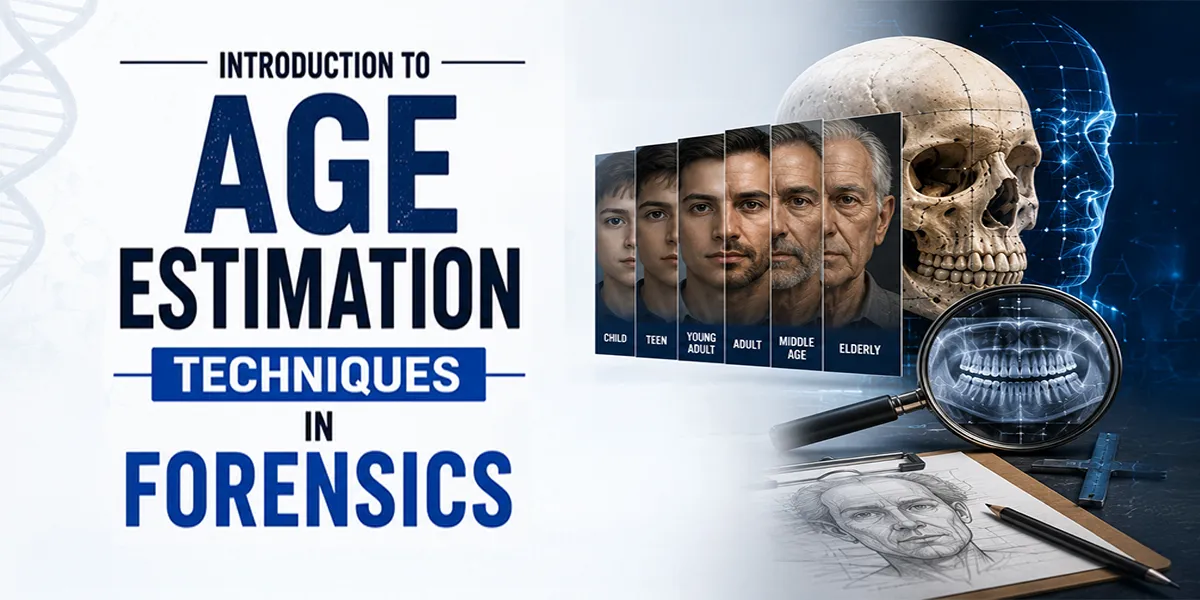
Age is one of the most common questions investigators try to answer whenever they find an unidentified body or deal with a case where the identity of a living person is not conclusive. Whether it's an immigration dispute, a case involving a missing person, or a major calamity such as an earthquake or a flood, in forensic science, age estimation can provide significant leads to the investigators, and they can narrow down their search for identification.
In crime dramas, you have seen that forensic scientists immediately reveal the person's exact age; in the real world, identifying the real-life age of a person is not that easy. It's a complex process influenced by nutrition, genetics, health conditions, lifestyle, and environmental factors. Hence, forensic scientists always provide an estimated age range instead of a specific number.
This blog will guide you through the science behind forensic age estimation, commonly used techniques, and why it's important for modern investigations.
What are the factors that affect age estimation?
No single method exists that can determine age with clarity throughout life. Different tissues grow and age at different rates, which is why forensic scientists pick out methods based on a person's estimated age group.
Different factors influence biological ageing, such as:
- Hormonal imbalance
- Lifestyle habits
- Environmental factors
- Physical activity
- Nutritional status
- Genetic inheritance
Due to the involvement of these variables, forensic reports describe an estimated age range instead of an exact number. But the estimated range in the report will be backed by scientific evidence.
What are the different types of age estimation techniques?
There are different types of age estimation techniques in forensic science, such as:
1. Dental Age Estimation
In this technique, teeth are considered the most reliable biological factor, particularly in the case of children. Because they resist decomposition, burning, and environmental damage. Instead of describing every method, we divided in two major categories:
1. Developmental Techniques (Children and Adolescents)
The experts conducted their study based on:
- Tooth formation
- Crown formation
- Root development
- Mineralization stages
Keep in mind that these stages often follow a predictable sequence and are often assessed with the help of dental X-rays.
Some of the other methods are:
- Demerijian method (evaluates the stages of tooth mineralization)
- Cameriere method (analyzes open root apices)
2. Degenerative Techniques in Adults
After the development of the tooth, forensic scientists carry out their study based on age-related changes such as:
- Root transparency
- Cementum annulation
- Tooth wear (Attrition)
- Secondary dentine deposition
The Gustafson method combines several of these dental changes to estimate adult age. Always remember the fact that lifestyle, diet, and oral health can affect these changes, so results are usually given as an age range.
2. Skeletal Age Estimation
It explains the changes that bone undergoes throughout life, making it another important source of age estimation. This can be further divided into two parts:
1. Growing Skeleton
It talks about:
- Long bone development
- Hand and wrist examination
- Clavicle maturation
- Epiphyseal fusion (growth plate)
For a forensic odontologist and forensic anthropologist, these techniques are highly beneficial until the early twenties.
2. Adult Skeleton
Once growth stops, forensic experts carry out their study based on age-related degeneration instead of growth.
a. Pubic Symphysis
Describe the surface changes from ridged to smoother and finally more porous with age based on the Suchey-Brooks method.
b. Auricular Surface
Explain the changes that happen in the pelvic auricular surface, which is another indicator of adult age as per the Lovejoy Method.
c. Fourth Rib End
Describe how the texture and shape of rib ends gradually change. This study is based on the İşcan Method.
d. Cranial Sutures
States that skull sutures gradually fuse with age but vary greatly among individuals; they are not taken as the primary method, only used as supplementary evidence.
3. Radiological Techniques
With the help of radiology, forensic scientists can make age estimations without causing any damage to the body. The techniques they utilize are:
- MRI
- CT scanning
- Cone Beam CT
- Digital X-Rays
Radiological imaging has proven to be a highly valuable asset for living individuals involving legal age disputes. Since it involves no invasive procedures, it allows evaluation of skeletal maturity. An interesting thing is that radiology often combines with dental or skeletal analysis instead of being used alone.
4. Histological Techniques
Describes how histology studies tissue under a microscope. Some of the histological techniques were as follows:
- Microscopic dental changes
- Bone remodeling
- Osteon counting
While these methods can be highly accurate, they still require laboratory processing and are generally reserved for difficult forensic cases.
5. Molecular and Biochemical techniques
With the help of these techniques, forensic scientists carry out age estimation by studying molecular changes taking place inside the cells. They do this through three major approaches:
1. DNA Methylation
"In simple terms, as human's age, certain chemical markers known as methyl groups are added to DNA in predictable patterns."
Many might not be aware of the fact that DNA methylation is one of the most forensic techniques considered by experts because it can do age estimation based on blood, Saliva, and other biological samples.
2. Aspartic Acid Racemization
It describes how the proteins found in teeth change chemically during the course of a person's life. These alterations aid forensic anthropologists and forensic odontologists in estimating an adult's age because they occur at a somewhat constant pace.
3. Telomere length
Explain the process of how telomeres shorten due to cell divisions over time, although their rate of shortening varies considerably, which makes them less reliable when used alone. Keep in mind that molecular methods are still developing and currently complement existing forensic techniques instead of replacing them.
Conclusion
On a concluding note, we can say that there is no single technique that is universally accurate. That's why forensic scientists across the globe combine dental, skeletal, radiological, histological, and molecular evidence to come up with the most reliable age estimation. In the coming days, genetics, artificial intelligence, and imaging technology are going to evolve continuously, which will eventually make age estimation more accurate while still acknowledging the natural variation in human ageing.