REGISTER NOW!




Admissions for the following programs for the Academic Year 2026-27 will be conducted through CUET (Common University Entrance Test) as per the guidelines of participating universities:
The CUET is a national-level, computer-based entrance examination conducted for admission to undergraduate and postgraduate programs across central and participating universities in India. It ensures a standardized, transparent selection process by assessing candidates on their subject knowledge, aptitude, and analytical skills relevant to their chosen field.
Choose Campus Preference (if applicable)
If your selected programme is offered across multiple campuses, choose your preferred study center,
arrange other campuses in order, and mark “Not interested” where applicable.
| Events | Dates |
| Application start Date | May |
| Application End Date | Mid July |
| Classes Commencement | August |
Different courses offered by Lloyd Institute of Forensic Science
Duration
Eligibility criteria
B.Sc + M.Sc. in Forensic Science
Passed or appeared in 10+2 (or its equivalent) in Science, Physics/Chemistry/Biology/Mathematics with at least 60% for General/OBC/EWS category candidates and 55% or equivalent for SC/ST and PwD category candidates.
M.Sc. Forensic Science
Bachelor’s degree in science / Forensic Science/ Medicine / Engineering / Pharmacy with at least 55% for General/OBC (NCL)/EWS category candidates, and 50% or equivalent for SC/ST and PwD category candidates.
PG Diploma in Fingerprint Science
Graduate degree from any discipline with minimum 50% for General/OBC(NCL)/EWS category candidates, and 45% for SC/ST/PwD candidate
PG Diploma in Forensic Document Examination
Graduate degree from any discipline with minimum 50% for General/OBC(NCL)/EWS category candidates, and 45% for SC/ST/PwD candidate
M.Sc Multimedia Forensic
Bachelor’s Degree in Forensic Science, Physics, Mathematics, Computer Science, IT, Electronics with minimum 55% aggregate or Btech / BE in Computer Science, IT, Electronics & Communication with minimum 55% aggregate for General / OBC (NCL)/ EWS category candidates and 50% or equivalent for SC/ST and PwD category candidates.
Note :- Kindly read the complete admission policy before filling the application form Read More
The B.Sc + M.Sc. (Integrated Course) in Forensic Science is a comprehensive program designed to provide students with in-depth knowledge and practical experience in the field of forensic science. The program aims to nurture and develop the next generation of forensic scientists who will play a pivotal role in strengthening the justice system. It equips students with the essential skills and expertise required for the collection, analysis, and interpretation of forensic evidence to aid in criminal investigations and legal proceedings.
The curriculum combines theoretical knowledge with hands-on practical training, covering diverse areas of forensic science such as forensic biology, toxicology, ballistics, forensic chemistry, DNA analysis, fingerprint analysis, and digital forensics. The program also includes specialized subjects that focus on advanced investigative techniques and the integration of cutting-edge technologies, ensuring that graduates are well-prepared for the challenges of modern forensic science.
The B.Sc + M.Sc (Integrated Course) not only focuses on forensic science but also emphasizes the ethical and legal dimensions of forensic work, ensuring that students understand the critical role they play in justice administration. By the end of the program, students will have developed advanced problem-solving skills, scientific inquiry, and the ability to conduct independent research, making them valuable assets to law enforcement agencies, legal firms, and forensic laboratories.
One of the vital strength of the School of Forensic Science is M.Sc. Forensic Science Programme. The Programme aims to train and transform the potential scientists to create a strong legal system for tomorrow. The programme ensures skilled scientific investigators by way of skill based training in collection, handling and analysis of evidences for the purpose of justice.
Moving away from the traditionally conceived expertise of M.Sc. Forensic Sciences such as Fingerprints, Questioned Documents , Ballistics, Speaker Recognition, Video Authentication , Analytical Chemistry, Toxicology , Explosives Serology and DNA Analysis, Forensic Science has evolved into a new arena. By that, there is a scope of extending the expertise for the various complex issues relating to any of the commonly encountered in the society to its realization. In every specialty of Forensic Sciences, there has been synergetic inclusion of the novel techniques for the easier, smoother, full proof methods of investigation for more prudent results without any flaws or the reliable ones.
In every means, the composite technology and expertise is made available to the prospective investigative experts through this specialized academic programme by means of routine practical, simulations analysis and other methods. This leads to the scope of technology dependence/reliance and authentication with the necessity for the proof and also as a hallmark.
Fingerprint Evidence has been one of the most illustrious and Gold evidence in Forensic Crime Scene Investigations. Fingerprints finds its impressions since ages in Indian scriptures Samudra Shastra, compiled by a sage named Sudra Rishi in 3102 BC , which describes the significance of fingerprints as evidence. Fingerprints are also being used as biometrics and has been able to solve civil and criminal related cases to a length since ages. It has significant advantage over many evidences as even the identical twins could be identified by fingerprints.
The Professional Diploma in Fingerprint Science is being offered at National Forensic Sciences University which strengthens academically and practically the students from multiple backgrounds for work in the field of Forensic investigations , development of fingerprints at crime scene and at laboratory, identification and individualization through fingerprints with the support of conventional and modern methods of investigative tools and automated techniques.
The teaching pedagogy involves the amalgamation of latest teaching methodology using, multimedia, case studies, simulation and investigation of cases and moot court presentations. For practical training students are also attached to reputed NABL Accredited Forensic Science laboratories to have hands on training on Automated Fingerprint Identification System (AFIS).
Fingerprints Science is one of the skill developing course which can creates forensic entrepreneurs making them self reliant and capable of investigating the case. Fingerprints knowledge is extremely useful as they have applications in teaching , research and consultancy in various cases involving immigration, disaster victim identification, child swapping cases and many more.
Documents often hold critical evidence in both criminal and civil cases. A disputed signature—was it forged? An altered document—can the original content be recovered? A threatening note—can the writer be identified?
The field of questioned document examination focuses on the scientific analysis of documents to determine authenticity, detect alterations, and identify authorship. While commonly associated with fraud and forgery cases, it also plays a crucial role in legal disputes, financial crimes, and even serious offenses.
Through the application of scientific techniques, experts examine handwriting, signatures, inks, papers, and indented or obliterated writings. Advanced instrumentation allows forensic examiners to uncover hidden details that may validate or challenge the authenticity of a document.
a) PG Diploma in Fingerprint Science
b) PG Diploma in Forensic Document Examination?
No

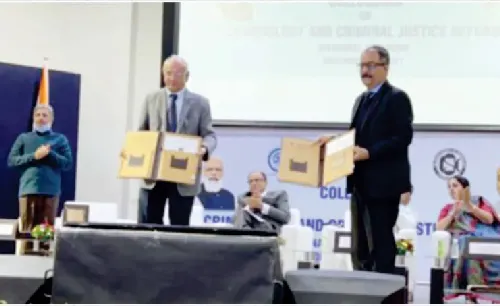
MoU signed between
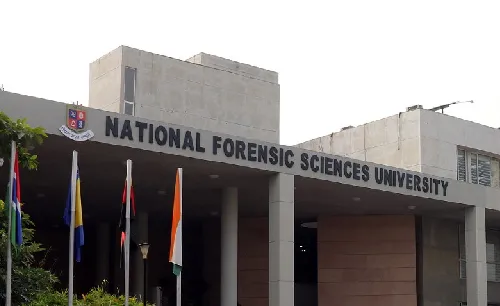
National Forensic Sciences University
and
Lloyd Group of Institutions

National Forensic Sciences University
Knowledge | Wisdom | Fulfilment
An Institution of National
Importance
(Ministry of Home Affairs, Government of India)